Category Archives: food safety training

Singapore – Manna Pot Catering Pte Ltd fined $8,000 for multiple food safety lapses

SFA

Manna Pot Catering Pte Ltd was fined $8,000 by the Court today for
multiple food safety lapses committed under the Sale of Food (Non-Retail Food
Business) Regulations.
2 In May 2022, the Ministry of Health (MOH) and Singapore Food Agency
(SFA) received reports of gastroenteritis involving 21 persons after consuming food
prepared by the food establishment located at 1550 Bedok North Avenue 4 #04-16,
Bedok Food City, Singapore 489950. None of them were hospitalised

Germany – Brick, snack loaf, ore chunks, FichtelBERG cheese – STEC E.coli

LMW

Alert type:

Groceries

Date of first publication:

September 26, 2023

Product name:

Brick, snack loaf, ore chunks, FichtelBERG cheese

Manufacturer (distributor):

Achim Uhl Mobile cheese dairy Hartensteiner Straße 105 OT Oberdorf 09366 Stollberg DE SN 10682 EG

Reason for warning:

The above-mentioned products are classified as harmful to health due to the detection of verotoxin-producing Escherichia coli in the brine and lubricating water used for production.

Packaging Unit:

1kg/piece, 1.5-1.8kg/piece

Durability:

Brick: 10/01/2023/ 05/06/07/08/10/2023/ 12/13/14/10/2023/ 19/10/2023; Vesper loaf: October 1st, 2023/ October 5th, 2023/ October 7th, 2023/ October 12th, 2023; Ore chunks: 10/01/2023/ 05/06/07/08/10/2023/ 12/13/14/10/2023; FichtelBERGkäse: 09/30/2023/ 10/01/2023/ 10/13/2023; FichtelBERG cheese (small): October 1st, 2023.

Additional Information:

An illness with verotoxin-producing Escherichia coli usually manifests itself within a week of infection with diarrhea and abdominal cramps. In particular, infants, small children, seniors and people with weakened immune systems can develop more severe illnesses with bloody diarrhea. Rarely, especially in small children, acute kidney failure can occur in a second attack a few days after the onset of diarrhea. People who have eaten this food and develop severe or persistent symptoms should seek medical attention and report a possible EHEC infection.

The above-mentioned cheeses may also have been sold differently from the manufacturer by other distributors (possibly partly direct marketers) and possibly also with different cheese names, so that identification should be carried out in particular using the identification mark (DE SN 10682 EG), or this can be done by the be asked from sellers.

Customers should definitely pay attention to the recall and not consume the affected products.

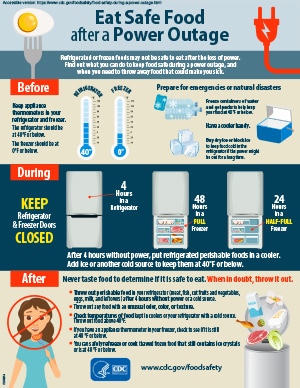
USA – Free Posters – Food Safety for Power Outages – Various Languages

Other Languages

CDC

Eat safe food after a power outage PDF thumbnail

FDA continues work on a plan to reduce infant illnesses from Cronobacter in formulas

Food Safety News

The Food and Drug Administration has released an update on its work to develop a strategy to help prevent Cronobacter sakazakii illnesses related to powdered infant formula.

The agency is working on the strategy as part of its response to an outbreak of illnesses and the subsequent temporary closure of the Abbott Nutrition production plant in Sturgis, MI. The closure led to a nationwide shortage of infant formula that lasted for months.

In response to the situation, the FDA initiated the development of a prevention strategy, with the draft released in November 2022.

“At the time, the FDA committed to using the strategy to guide its work to enhance the safety of powdered infants, including through engagements with the infant formula industry and other stakeholders,” according to an FDA statement. “These engagements further supported the strategy laid out, and at this time, the strategy will continue forward without further actions being added. As more information becomes available, the FDA may add additional actions over time.”

Infant formula firms are now required to develop, maintain, and implement, as appropriate, risk management plans to identify and evaluate risks to the supply of critical food, such as infant formula, and ways to mitigate such risks. This is a new requirement mandated by Congress in the Food and Drug Omnibus Reform Act of 2022.

Hong Kong – Mooncakes and Food Safety

CFS

In the recent years, consumers have higher expectations: good taste, appetizing appearance and high nutrition value. Apart from the traditional mooncakes, there are snowy mooncakes and ice-cream mooncakes that have won the hearts of many young people and children. The ingredients also come with a large variety from the lotus seed paste, egg yolk, bean paste, to chocolate, coffee or even bird nest flavours.

Due to the absence of a high-temperature treatment during the manufacturing process, snowy and ice-cream mooncakes tend to pose a higher microbiological risk than traditional mooncakes. Hence, strict hygiene and stringent temperature control are necessary during processing, transportation and storage to prevent contamination and growth of bacteria.

Following are some safety tips for consumers who purchase and consume snowy or ice-cream mooncakes:

  • Beware of the storage temperature at the place of purchase. Snowy mooncakes should be kept in a chiller at 4℃ or below while ice-cream mooncakes should be kept in a freezer at -18℃ or below
  • When purchasing mooncakes, check if they are properly packaged and watch out for any unusual appearance
  • Check the expiry dates and consume them before the expiry dates
  • Take snowy or ice-cream mooncakes home immediately after purchase, keep them in a suitable temperature compartment of a refrigerator, and make sure that they are wrapped properly to avoid cross contamination
  • Do not leave snowy or ice-cream mooncakes under room temperature as bacteria can multiply rapidly in the temperature danger zone of 4℃ to 60℃
  • Discard snowy and ice-cream mooncakes that have been kept at room temperature for more than two hours
  • Do not consume the mooncake if it looks or tastes abnormal
  • Use an icebox to keep snowy or ice-cream mooncakes at appropriate temperature when carrying them outdoors. Take the mooncakes out of the icebox only upon eating
  • Cleanse the hands before consuming the mooncakes

Moreover, consumers are advised to eat mooncakes in moderation as most of these cakes are rich in sugar and fat. Patients with chronic illnesses should consult dieticians before eating mooncakes.

Hong Kong – Poon Choi and Food Safety

CFS

“Poon Choi”, which comprises a great variety of food, involves a number of processing steps, which demands meticulous attention during preparation.

People should order their “Poon Choi” from reputable and licensed food suppliers. If they want to make their own, they should maintain good personal and food hygiene to prevent cross contamination.

To enjoy a delicious and healthy meal, people should pay particular attention to food safety.

Here are some safety tips for enjoying “Poon Choi”:

When purchasing “Poon Choi”:

  • Order from reputable licensed suppliers
  • Hot “Poon Choi” should be kept at 60℃ or above and chilled “Poon Choi” should be kept at 4℃ or below to prevent growth of bacteria
  • Ask for the reheating instruction for the “Poon Choi”. For example, does the “Poon Choi” have to be reheated before consumption and if so, how and for how long? And is it possible to reheat it in its original container?
  • Notify the supplier of the time you collect the “Poon Choi”. It is best to collect it half an hour to one hour before consumption
  • Return home immediately after collecting the “Poon Choi”. Avoid keeping it for a prolonged period of time at room temperature
  • Keep chilled “Poon Choi” at 4℃ or below to minimise its exposure to the temperature danger zone of 4 to 60℃

When preparing “Poon Choi” at home:

  • Buy ingredients from reputable retailers
  • Plan the work schedule ahead of time, with consideration to ingredients involved. Don’t start cooking too early
  • Defrost frozen food inside the chilled compartment of a refrigerator or under cool running water
  • Cook high risk food such as poached chicken and seafood like fresh oysters thoroughly
  • Raw and cooked food should be covered and stored separately to prevent cross contamination
  • If the ingredients need to be stored after cooking, they should either be kept chilled at 4℃ or below, or kept warm at 60℃ or over
  • Cover food properly to prevent cross contamination
  • Since lots of ingredients and cooking utensils are involved in the course of preparing “Poon Choi”, a well-organised work schedule can help prevent cross contamination
  • Before preparing “Poon Choi”, thoroughly clean and sterilize cutting boards, knives, containers and other cooking utensils
  • Maintain good personal hygiene. Wash hands with liquid soap before handling food and after using the toilet

When consuming “Poon Choi”:

  • Consume the “Poon Choi” as soon as possible after it is collected or cooked. Don’t keep it under room temperature for more than two hours
  • As “Poon Choi” is generally served in a large pot, a longer period of time is required to reheat it thoroughly
  • When eating “Poon Choi” in a restaurant, pay attention to its serving temperature. When in doubt, stop eating and inform the caterer in charge
  • Use communal chopsticks and spoons when consuming “Poon Choi”
  • Consume “Poon Choi” in one go

Hong Kong – Microbiological Quality of Non-hot Served Dishes with Chicken Meat

CFS

France – OLD-FASHIONED AC HAM COOKED IN A TOWEL – Listeria monocytogenes

Gov france

  • Product category Food
  • Product subcategory Meats
  • Product brand name TALLEC
  • Model names or references OLD-FASHIONED AC HAM COOKED IN A TOWEL
  • Product identification
    GTIN Batch Date
    3268680020474 02324109 Use-by date 01/10/2023
  • Start/end date of marketing From 08/29/2023 to 08/30/2023
  • Storage temperature Product to keep in the refrigerator
  • Health mark FR 29 004 023
  • Geographical sales area Whole France
  • Distributors Monoprix

Information – Safer Food Choices for Pregnant People

CDC

If you are pregnant, you are more likely than other people to get sick from certain germs.

To prevent food poisoning, some foods are safer choices than others. That’s because some foods—such as undercooked meat and eggs, unwashed fruits and vegetables, and unpasteurized milk — are more often associated with foodborne illnesses. Use the table at the link above as a guide to safer food choices.

Information – Safer Food Choices for People With Weakened Immune Systems

CDC

People with weakened immune systems have a higher risk of food poisoning. That’s because a weakened immune system may make it more difficult for your body to fight germs and sickness effectively. Weakened immune systems may be due to diabetes, liver disease, kidney disease, alcoholism, HIV, autoimmune disorders (such as lupus), or receiving chemotherapy or radiation therapy.

To prevent food poisoning, some foods are safer choices than others. That’s because some foods—such as undercooked meat and eggs, unwashed fruits and vegetables, and unpasteurized milk — are more often associated with foodborne illnesses. Use the table at the link above as a guide to safer food choices.