Category Archives: Uncategorized

India – 170 orphanage school students hospitalised with suspected food poisoning

My Pune Pulse

Around 170 students at an orphanage school in Sangli, Maharashtra, were hospitalised on Monday following a suspected case of food poisoning.

They were admitted to the hospital, and their conditions are stable, an official said.

According to the information received, the affected children were students at Samata Ashram School in Umdi.

In Sangli, students in the age group of 5 to 15 complained of nausea, vomiting, and diarrhoea shortly after consuming dinner served by the school staff.

USA – Food Safety – Hurricane Season: Be Prepared

FDA

Here are some food-related tips to remember:

  • Do not eat any food that is not in a waterproof container if there is any chance it came in contact with flood water.
  • Inspect canned foods and discard any food in damaged cans. Damaged cans may have swelling, leakage, punctures, holes, or rusting.
  • Do not eat food packed in plastic, paper, cardboard, cloth and similar containers that have been water-damaged.
  • Discard food and beverage containers with screw-caps, snap lids, crimped caps (soda bottles), twist caps, flip tops and home canned foods, if they have come in contact with flood water. These containers cannot be disinfected.
  • Follow tips on how to keep food safe at proper temperatures.
  • Discard any perishable food (such as meat, poultry, fish, milk, eggs or leftovers) that has been held at room temperature for 2 hours or more (or 1 hour if outdoor temperatures are above 90º F).

Food safety doesn’t stop with inspecting the packaging. It also involves what comes in contact with the food after you open it:

  • Thoroughly wash pots, pans, ceramic dishes, and utensils (including can openers) with soap and water, using hot water if available. Rinse and then sanitize them by boiling in clean water or immersing them for 15 minutes in a solution of 1 tablespoon of unscented household (5.25% concentration) liquid bleach per gallon of water.
  • Thoroughly wash countertops with soap and water, using hot water if available. Rinse and then sanitize by applying a solution of 1 tablespoon of unscented household (5.25% concentration) liquid bleach per gallon of water. Allow to air dry.

Power loss is common in severe storms, but there are ways to increase the time the food in your fridge will remain safe to eat. It’s important to keep the refrigerator and freezer doors closed. Food in an unopened refrigerator and freezer is safe to consume if the power outage lasts less than 4 hours. The foods in the freezer are typically safe for 48 hours if it is full or 24 hours if the freezer is half full.

For refrigerated items, after the 4-hour power outage, it is best to pack them into a cooler surrounded by ice or frozen gel packs for storage. Check the food temperature of these items before cooking or eating them and toss them out if the item has been above 40 degrees Fahrenheit for two hours or more.

For infants, ready-to-feed formula should be used. However, if only concentrated or powdered formula is available, prepare the formula with bottled water or water that has been sterilized. Your doctor or public health authorities can advise if water needs to be boiled before use. You should ensure that the bottles and nipples used are also sanitized.

Research – Foodborne Botulism, Canada, 2006–2021

CDC

Abstract

During 2006–2021, Canada had 55 laboratory-confirmed outbreaks of foodborne botulism, involving 67 cases. The mean annual incidence was 0.01 case/100,000 population. Foodborne botulism in Indigenous communities accounted for 46% of all cases, which is down from 85% of all cases during 1990–2005. Among all cases, 52% were caused by botulinum neurotoxin type E, but types A (24%), B (16%), F (3%), and AB (1%) also occurred; 3% were caused by undetermined serotypes. Four outbreaks resulted from commercial products, including a 2006 international outbreak caused by carrot juice. Hospital data indicated that 78% of patients were transferred to special care units and 70% required mechanical ventilation; 7 deaths were reported. Botulinum neurotoxin type A was associated with much longer hospital stays and more time spent in special care than types B or E. Foodborne botulism often is misdiagnosed. Increased clinician awareness can improve diagnosis, which can aid epidemiologic investigations and patient treatment.

Poland reveals foodborne infection data for 2022

Food Safety News

According to recently released data, Salmonella remained the top cause of food poisoning in Poland in 2022 despite the number of infections declining.

Findings come from a report on inspection work in 2022, including controls over the safety of food, published by the Chief Sanitary Inspectorate (GIS).

In 2022, 6,221 Salmonella infections related to food were confirmed. This is down from the previous year when 8,014 cases were recorded.

As part of the multi-country monophasic Salmonella Typhimurium outbreak linked to Ferrero chocolate, intensified supervision was carried out from April to December 2022. A total of 87 suspected cases were reported, and of these, 38 were sequenced, but none belonged to the outbreak.

Poland’s battle to control Salmonella is well-documented. Data from the Rapid Alert System for Food and Feed Network (RASFF) for 2022 shows 190 Salmonella reports concerned poultry meat products from the country, although this is down from 2020 and 2021, and most reports were made by Poland.

The number of establishments operating in the food sector under the supervision of authorities exceeded 560,000, an increase of more than 17,000 compared to 2021.

Research – Dynamics of biofilm formation by Listeria monocytogenes on stainless steel under mono-species and mixed-culture simulated fish processing conditions and chemical disinfection challenges

Academia Edu

The progressive ability of a six-strains L. monocytogenes cocktail to form biofilm on stainless steel (SS), under fish-processing simulated conditions, was investigated, together with the biocide tolerance of the developed sessile communities. To do this, the pathogenic bacteria were left to form biofilms on SS coupons incubated at 15 °C, for up to 240 h, in periodically renewable model fish juice substrate, prepared by aquatic extraction of sea bream flesh, under both mono-species and mixed-culture conditions. In the latter case, L. monocytogenes cells were left to produce biofilms together with either a five-strains cocktail of four Pseudomonas species (fragi, savastanoi, putida and fluorescens), or whole fish indigenous microflora. The biofilm populations of L. monocytogenes, Pseudomonas spp., Enterobacteriaceae, H 2 S producing and aerobic plate count (APC) bacteria, both before and after disinfection, were enumerated by selective agar plating, following their removal from surfaces through bead vortexing. Scanning electron microscopy was also applied to monitor biofilm formation dynamics and anti-biofilm biocidal actions. Results revealed the clear dominance of Pseudomonas spp. bacteria in all the mixed-culture sessile communities throughout the whole incubation period, with the in parallel sole presence of L. monocytogenes cells to further increase (ca. 10-fold) their sessile growth. With respect to L. monocytogenes and under mono-species conditions, its maximum biofilm population (ca. 6 log CFU/cm 2) was reached at 192 h of incubation, whereas when solely Pseudomonas spp. cells were also present, its biofilm formation was either slightly hindered or favored, depending on the incubation day. However, when all the fish indigenous microflora was present, biofilm formation by the pathogen was greatly hampered and never exceeded 3 log CFU/cm 2 , while under the same conditions, APC biofilm counts had already surpassed 7 log CFU/cm 2 by the end of the first 96 h of incubation. All here tested disinfection treatments, composed of two common food industry biocides gradually applied for 15 to 30 min, were insufficient against L. monocytogenes mono-species biofilm communities, with the resistance of the latter to significantly increase from the 3rd to 7th day of incubation.

However, all these treatments resulted in no detectable L. monocytogenes cells upon their application against the mixed-culture sessile communities also containing the fish indigenous microflora, something probably associated with the low attached population level of these pathogenic cells before disinfection (< 102 CFU/cm2) under such mixed-culture conditions. Taken together, all these results expand our knowledge on both the population dynamics and resistance of L. monocytogenes biofilm cells under conditions resembling those encountered within the seafood industry and should be considered upon designing and applying effective anti-biofilm strategies.

USA – Gummies recalled due to Salmonella

Food Poison Journal

An Arizona marijuana establishment is voluntarily recalling a specific product due to possible contamination of Salmonella, a bacterium that, in the event of infection, can cause diarrhea, fever, and stomach cramps.

The product being voluntarily recalled is Grape Cloud 9 Gummies 100mg batch number C9G04102023.

The Arizona Department of Health Services (ADHS) is advising purchasers to dispose of the products described in the table below, which were found in laboratory tests to be positive for Salmonella.

To date, no illnesses have been reported.

Denmark – Listeria monocytogenes in meal salads

Foedevarestyrelsen

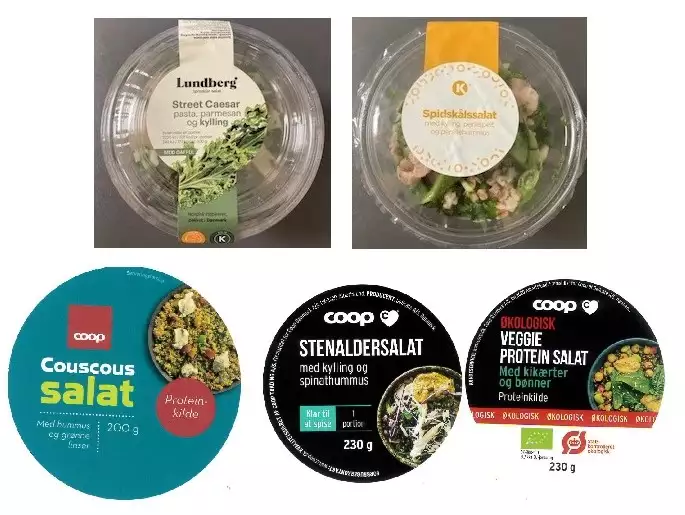
Delicate A/S is recalling coop Couscous salad, coop Stone Age salad, coop Organic Veggie Protein salad, Lundberg Street Cæsar Salad and Cicle K Spinach salad with chicken, pearl spelled and parsley hummus, as Listeria has been found in the products. The products should be returned to the store where they were purchased or discarded.

Updated on 08-08-2023 with the addition of more products and images.

See picture of the products here

Which foods are recalled

coop Couscous salad with hummus and green lentils
Net content: 200g
Best before: 29.07.2023
EAN code: 5704177011931

coop STENALDER SALAD with chicken and spinach hummus
Net content: 230g
Best before: 29.07.2023
EAN code: 5704177009167

coop ORGANIC VEGGIE PROTEIN SALAD with chickpeas and beans
Net content: 230g
Best before date: 29.07.2023
EAN code: 5700382854554

Sold in: Coop stores.

Lundberg Street Cæsar Salad
Net content: 300g
Last use-by date: 07.08.2023
EAN code: 5713300031166

Sold in: Netto and Føtex stores all over the country.

Cicle K Spinach salad with chicken, pearl barley and parsley hummus
Net content: 275g
Best-by date: 07.08.2023
EAN code: 5713300020399

Sold in: Circle K stores nationwide.

Why are the products being recalled?

The bacterium Listeria monocytogenes has been found in the products. You can therefore become infected with Listeria bacteria if you eat the products. The symptoms can include flu-like symptoms, fever and headache and, in rare cases, gastrointestinal problems. 

What should you do as a consumer?

The Danish Veterinary and Food Administration advises consumers to return the products to the store where they were purchased, or to discard them.

Who recalls the product

Delicate A/S, Greve Main 12, 2670 Greve

Research – Exploring Long-Read Metagenomics for Full Characterization of Shiga Toxin-Producing Escherichia coli in Presence of Commensal E. coli

MDPI

Abstract

The characterization of Shiga toxin-producing Escherichia coli (STEC) is necessary to assess their pathogenic potential, but isolation of the strain from complex matrices such as milk remains challenging. In previous work, we have shown the potential of long-read metagenomics to characterize eae-positive STEC from artificially contaminated raw milk without isolating the strain. The presence of multiple E. coli strains in the sample was shown to potentially hinder the correct characterization of the STEC strain. Here, we aimed at determining the STEC:commensal ratio that would prevent the characterization of the STEC. We artificially contaminated pasteurized milk with different ratios of an eae-positive STEC and a commensal E. coli and applied the method previously developed. Results showed that the STEC strain growth was better than the commensal E. coli after enrichment in acriflavine-supplemented BPW. The STEC was successfully characterized in all samples with at least 10 times more STEC post-enrichment compared to the commensal E. coli. However, the presence of equivalent proportions of STEC and commensal E. coli prevented the full characterization of the STEC strain. This study confirms the potential of long-read metagenomics for STEC characterization in an isolation-free manner while refining its limit regarding the presence of background E. coli strains.

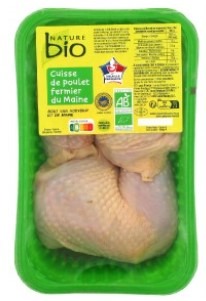
France – 2 plain organic chicken thighs – Listeria monocytogenes

Gov france

Identification information of the recalled product

  • Product category Feed
  • Product subcategory Meats
  • Product brand name Nature Organic
  • Model names or references 2 organic chicken thighs
  • Identification of products
    GTIN Batch Date
    3266980100339 2023086098 Use-by date 07/16/2023
    3266980100339 2023086098 Use-by date 07/17/2023
    3266980100339 2023086098 Use-by date 07/18/2023
  • Packaging plastic tray
  • Marketing start/end date From 07/07/2023 to 18/07/2023
  • Storage temperature Product to be stored in the refrigerator
  • Health mark EN 72.168.001 EC
  • Further information tray of 2 chicken thighs
  • Geographic area of ​​sale Whole France
  • Distributors cora, Match supermarkets, Migros

The Peruvian Army reports alleged food poisoning of 100 soldiers

Breaking Latest News

LIMA (AP) — The Peruvian Army reported Friday that 100 soldiers were taken to a Lima hospital after suffering severe stomach pains due to suspected food poisoning.

In an official statement, the Army said that the alleged mass poisoning occurred the day before in the 503 battalion that works in a barracks in the Peruvian capital. 23 soldiers were still hospitalized on Friday night in the military hospital due to dehydration.