Category Archives: Pathogen

US Raw Milk – Campylobacter

Campylobacter Blog 

Your Family Cow Campylobacter Outbreak the number ill in the campylobacter outbreak has now reportedly risen to 77.

Food Poisoning Bulletin

The state of California is investigating Claravale Farm for the possibility that its raw milk was contaminated with Campylobacter. Last week, the dairy stopped distributing its products to the stores that sell it. Raw milk and raw milk products are legally available in California

More E. coli Research

Food Safety News

In the wake of the devastating European E. coli outbreak linked to sprouts that killed at least 50 people and sickened more than 4,000, experts from the European Union and the United States are calling for new research on how to combat toxic strains of E. coli.
 
In November of 2011, 4 months after the outbreak ended, an international group of public health officials, medical professionals, epidemiologists, microbiologists and environmental scientists met to determine what lessons can be drawn from this epidemic. The results of this summit were released Thursday in Eurosurveillance. 
 
The group determined that more needs to be learned about shiga toxin-producing E. colis (STECs) such as E. coli O104:H4, the strain responsible for the European outbreak.

New 3M™Molecular Platform for the Detection of Salmonella and E. coli O157

Available worldwide, the 3M Molecular Detection System is based on an innovative combination of unique technologies involving isothermal DNA amplification and bioluminescence detection. The system was designed with 3M’s customer testing needs in mind, which translates into a compact, simple, robust system that offers easy implementation and low maintenance without compromising accuracy and reliability.

3M Link 

Video Link

Autoclaves for Catagory 3 Laboratories

Rapidmicrobiology

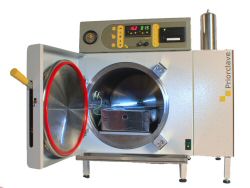
The Compact C40 vacuum autoclave is the first priorclave to become available with stand-off legs, providing easy access beneath the steam steriliser for cleaning and disinfection of laboratory work surfaces to prevent spread of virus and eliminate potential cross contamination.

This option plus the benefit of Biocote® antimicrobial surface protection makes the autoclave ideal for the demanding requirements of CAT3 laboratories.

US – Norovirus Outbreak – 85 Cases

The Washington Post

George Washington University officials alerted the campus Wednesday that about 85 students were infected by norovirus this week.

After testing by the university’s Student Health Service and D.C. Department of Health, officials confirmed that norovirus was the cause of dozens of cases of gastrointestinal illness since Monday, university officials said in a prepared release. They said they could find no common link for the infections, as students were affected who live at the Foggy Bottom campus, the Mount Vernon campus and off campus.

US – Raw Milk Debate – Campylobacter

Food Safety News

An additional five confirmed infections have brought the total number of Campylobacter illnesses to 76 in an outbreak linked to raw milk from Your Family Cow dairy in Chambersburg, Pennsylvania, the Pennsylvania Department of Health said Wednesday. At least 9 people have been hospitalized.

Food Safety News

The order of a federal judge has finally shut down Rainbow Acres Farm, the raw milk dairy located near Washington D.C. in Pennsylvania’s Amish County.

It ends a nasty confrontation between Dan and Rachel Allgyer, Amish dairy farmers with operations based in Pennsylvania where commercial sales of raw milk are legal, and the U.S. Food and Drug Administration (FDA), which caught Rainbow making deliveries inside Maryland and the District of Columbia.
 
The heartland states of Iowa and Indiana are entertaining changes to their raw milk laws, but with far differing approaches.
 
In Iowa, which is bordered by Minnesota, Illinois, Missouri, Nebraska and South Dakota, lawmakers are considering allowing on-farm sales to make the state’s approach more consistent with its neighbors.

US – Sprouting Seeds Again – E.coli O26

Food Poisoning Bulletin

The Center for Disease Control (CDC) has reported a multi-state outbreak of shiga-toxin producing E. coli 026 (STEC) infections linked to raw clover sprouts at Jimmy John’s restaurants.

So far, 12 people have been infected with the outbreak strain of STEC 026. The case distribution is:

  • Iowa (5)
  • Missouri (3)Kansas (2)
  • Arkansas (1)
  • Wisconsin (1)

Two people have been hospitalized, but no deaths have occurred as of February 15, 2012.

FDA-Regulated Food Recalls Surged in Last Quarter 2011

Food Safety News

Foods regulated by the U.S. Food and Drug Administration (FDA) were recalled 50 percent more in the fourth quarter last year and affected over 80 percent more units when compared with the previous period, according to the ExpertRECALL ™ Index.
 

Listeria – UV and Hydrogen Peroxide

Food Production Daily

UV and hydrogen peroxide combo most effective listeria reducing treatment, claims study. A combination of ultraviolet-light (UV) and hydrogen peroxide (HP) is the best treatment to reduce listeria during brining, according to a study.

Study Link

Postprocessing contamination of the products in a processing plant has been identified as one of the major reasons for food contamination with Listeria; brining is one such postprocessing area. Our previous study has shown that the combinations of UV and antimicrobials reduces the number of this organism significantly in fresh brine, but brine is usually recycled from days to weeks depending on its use. Therefore, this study is focused on the reduction of L. monocytogenes in recycled chill brine (obtained from a frankfurter processor) using the combinations of UV and antimicrobial agents, such as citric acid (CA), hydrogen peroxide (HP) and dimethyl dicarbonate (DMDC). Results show that the combinations of UV and 2000 ppm and 4000 ppm HP were the most effective treatments in reducing the Listeria population with the total processing time of 120 min. Both of these treatments were found to be more effective than UV or HP alone. Additionally, all other treatments, such as the combinations of UV and CA (0.2 and 0.5%) and UV and DMDC (250 and 500 ppm) were comparatively less effective. This may be due to the presence of organic matter in spent brine, which may have reduced the penetration of UV and availability of antimicrobials for microbial interaction.

Bacillus Spore Germination

Physorg.com

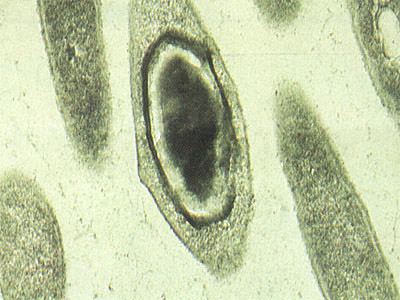
Some bacteria can form spores (survival capsules) that are particularly resistant to heat. Since sporogenous bacteria can also cause food poisoning and a reduction in food quality, they constitute a significant threat to the food industry.

If spores are to pose a risk, they have to “wake up” from a state of hibernation and return to their normal growth cycle through a process called germination.

Refrigerated foods with a shelf-life of several weeks are often heat-processed at temperatures between 65 – 95 C. This kills the majority of bacteria, but Bacillus spores can survive, germinate and develop into growing bacteria. Thermal treatment of this kind will in fact improve the growth potential of sporogenous bacteria because the heat kills competing bacteria flora and stimulates the surviving spores so that germination can commence more rapidly. The thermal treatment can increase the risk of spore germination in food and result in subsequent bacterial growth and a risk of quality deterioration and food poisoning.

Løvdal has investigated how the germination characteristics of the spores of four different Bacillus species are affected by heat treatment. She has used knowledge about the spores’ response to temperature to experiment with a method which can reduce the spore level without increasing the overall thermal treatment of the food product.