Category Archives: Microbiological Risk Assessment

UK – Morrisons Tackling Campylobacter

Morrisons

Since 2013 we have been working hard to reduce Campylobacter levels in fresh chicken. We have introduced a Campylobacter reduction plan which has shown significant improvements year on year.

Our results for the 2nd Quarter of 2021 (April to June) are as follows:

  • 0.8% of our chickens have the higher levels of contamination compared to the FSA retail target of 7% from a sample of 120 chickens tested.

Our results now for the last 26 consecutive quarters have been below the 7% FSA retail target.

The facts:

• Campylobacter is a common bacteria which causes food poisoning which can be found on fresh chicken.
• Campylobacter is destroyed if chicken is cooked thoroughly.
• As a bacteria, campylobacter can be transferred on to any surface that raw chicken contacts.
• Food Standards Agency (FSA) advice is Do Not Wash raw chicken.

Click here for a quick guide from the FSA about Campylobacter

How you can prevent it:

We understand that campylobacter can be a concern when it comes to handling fresh chicken.

However there are 4 simple steps you can take at home to minimise the risk of food poisoning:

  • Step 1 – Cover and chill raw poultry at the bottom of the fridge
  • Step 2 – Do not wash poultry
  • Step 3 – Wash hands and utensils after handling raw poultry
  • Step 4 – Ensure poultry is thoroughly cooked

What Morrisons have achieved:

  • A long term reduction of campylobacter levels from 2014 to 2021.
  • We have worked with our suppliers and implemented a Campylobacter Action Plan, which has successfully reduced campylobacter levels on fresh chicken.
  • We have established our own monitoring program; our test results show levels of campylobacter are now consistnently below the FSA 7% target (for the last 26 quarters).

image4mr2e.png

What’s next?

While the results of our reduction programme are extremely encouraging, we are not complacent and we will continue to work closely with all areas of the industry to continually find areas to improve.
UK – Co-op Tackling Campylobacter

COOP

Food safety is an absolute priority for Co-op and we are determined to tackle Campylobacter. How will we do this? By working together with our farmers and suppliers to reduce the incidence of Campylobacter. We have been keen supporters of the initiatives the FSA (Food Standards Agency) have driven to combat Campylobacter.

Industry Campaign

Co-op were one of the first retailers to sign up to be part of the Foods Standards Agency’s ‘Acting on Campylobacter Together’ (ACT) campaign. The joint aim was to rapidly introduce and share the best workable and available technologies and techniques in food production and across the supply chain.

The FSA started the Campylobacter retail survey in 2014 sampling from nine retailers and publishing results showing % of chickens with incidence of Campylobacter at highest contamination levels (>1000cfu/g) . By the beginning of 2017 the overall results were showing a significant reduction in the percentage of chickens with high levels of Campylobacter from 20.3% (July 2014 – February 2015) to 7% with highest contamination levels (August – December 2016).

Heather Hancock, Chairman of the Food Standards Agency, said:

“The challenge we set of reducing the number of people who get ill from campylobacter has been achieved. In the absence of any other clear indicators, we can reasonably say that the work that we and the food industry have done from farm to fork has given us this really positive result for public health.

“This has been achieved by working with the industry to tackle this difficult problem and raising consumer awareness. We commend the efforts of the larger retailers and the major processing plants who supply them, all of which have shown significant improvement and many have achieved the target we set to reduce the highest levels of campylobacter. They have invested a lot of effort and money into interventions to tackle the problem.

Extract taken from the Campylobacter News Story 13.03.17

Our Results

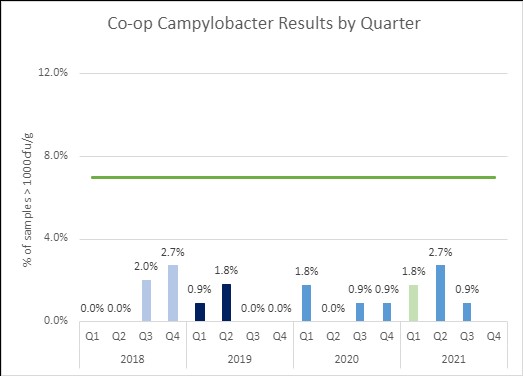
From January 2017, food retailers have published our own Campylobacter test results for fresh chicken, in collaboration with the open data scheme on Campylobacter with the Food Standards Agency.

Campylobacter results Q3 2021

UK – J Sainsbury Tackling Campylobacter

Sainsburys

12 January 2021

Our customers’ health and safety is of paramount importance to us. Working closely with our suppliers and farmers, we are committed to ensuring that levels of Campylobacter on our fresh chicken are kept as low as possible

Campylobacter is commonly found on chicken and can cause food poisoning if chicken isn’t prepared and cooked properly. It’s not yet possible to eliminate it from raw chicken, but we have been working hard to reduce levels.

From farm to fork

Smiley face

With our suppliers, we’ve been busy finding ways to tackle Campylobacter at every step of the food chain. This starts on the farm by trying to stop Campylobacter from colonising flocks, introducing novel thermal treatments in the factory as well as new convenient roast in the bag packaging.

Like other raw meats, chicken still needs to be handled with care, but lower levels of Campylobacter means improved safety for our customers when they are preparing chicken at home. We were the first retailer to include food safety advice on our products.

How are we doing?

We test nearly a thousand chickens a year to check on how we are doing, and we continue to make progress. We’ve achieved a target that was set by the UK Food Standards Agency (FSA), but are committed to continue making further improvements wherever we can. To do this, we need to find new solutions through further research and trials, working closely with our suppliers.

UK – M&S Campylobacter Results Q2 – 2021

Click to access campylobacter-q2-2021.pdf

Research – Reduction of Escherichia coli O157:H7, Listeria monocytogenes, and Salmonella on Whole Yellow Onions (Allium cepa) Exposed to Hot Water

Journal of Food Protection

In-home or food service antimicrobial treatment options for fresh produce are limited. Hot water treatments for whole (unpeeled) produce have been proposed, but data to support this practice for onions are not available. Separate cocktails of rifampin-resistant Escherichia coli O157:H7, Listeria monocytogenes, and Salmonella were cultured on agar and suspended in sterile water. The outer papery skin at the equator or root or stem ends of the whole yellow onions was spot inoculated at 6 log CFU per onion. After drying for 30 min and, in some cases, storage at 4°C for 6 days, onions were immersed in water at ca. 100°C for 5 s or 85°C for 10 to 180 s. No significant difference (P > 0.05) in the mean decline of Salmonella was found on onions that were exposed to hot water after drying the inoculum for 30 min or after storage at 4°C for 6 days. Exposure of whole onions at 100°C for 5 s reduced E. coli O157:H7 and L. monocytogenes populations by >5 log CFU per onion at all inoculum sites and Salmonella populations by >5 log CFU per onion at the stem end and equator but not consistently at the root end. Mean root-end reductions of ≥5 log CFU per onion of E. coli O157:H7, L. monocytogenes, and Salmonella were achieved consistently when the root end was fully immersed in 85°C hot water for 45 or 60 s except in a small number of cases (4 of 57; 7%) when the root end was oriented upward and above the water line during treatment. When onions were held at 85°C for 180 s with the root end above the water line in an uncovered water bath, no significant declines in Salmonella populations were observed; significant mean declines in Salmonella were achieved (mean, 5 log CFU per onion; range, 3.49 to 6.25 log CFU per onion) when the water bath was covered. Short exposure to hot water can significantly reduce pathogens on the surface of whole onions. Reductions are more consistent when the root end is submerged and when the water bath is covered.

HIGHLIGHTS
  • Short hot-water exposure significantly reduces pathogen populations on whole onions.
  • Salmonella reductions were greater at the stem and equator than at the root end.
  • Pathogen reduction was greater for fully submerged root ends in covered water baths.

UK – Aldi Tackling Campylobacter

Aldi

Facing up to the challenge

We understand that we have a role to play to reduce the level of Campylobacter in the supply chain and to help raise awareness with our customers as to how they can handle fresh poultry in a safe manner.

The Food Standards Agency (FSA) has identified Campylobacter as a key priority and is working with those directly in the industry to tackle it. Aldi is dedicated to supporting the FSA in this goal, which is why we are a signatory of the Acting on Campylobacter Together (ACT) campaign.

As well as working with the FSA (and other industry bodies), we understand that we need to take a lead with our suppliers to deliver against the FSA target.

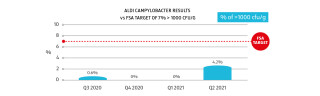
Aldi monitors the levels of Campylobacter carefully by compiling regular sets of independently verified data which is shared with the FSA via the BRC for the purposes of industry reporting. The results for Q2 2021 (April to June) show that 4.2% of birds were in the >1,000 cfu/g category. Our results are below the FSA target of less than 7% of birds in the >1,000 cfu/g category.

UK – Tesco Plan to Tackle Campylobacter

Lasted updated: August 2021

Campylobacter is a naturally occurring bacterium found in raw poultry that has the ability to cause food poisoning if the product is not cooked or handled correctly. Customers can keep safe by following the handling and cooking instructions provided on all Tesco raw poultry.

Providing high quality, safe food is always our absolute priority. It has long been our commitment to reduce levels of Campylobacter in our poultry and we are now seeing real progress at all stages of the supply chain, in tackling the issue through the work we have done with our suppliers.

Our Plan

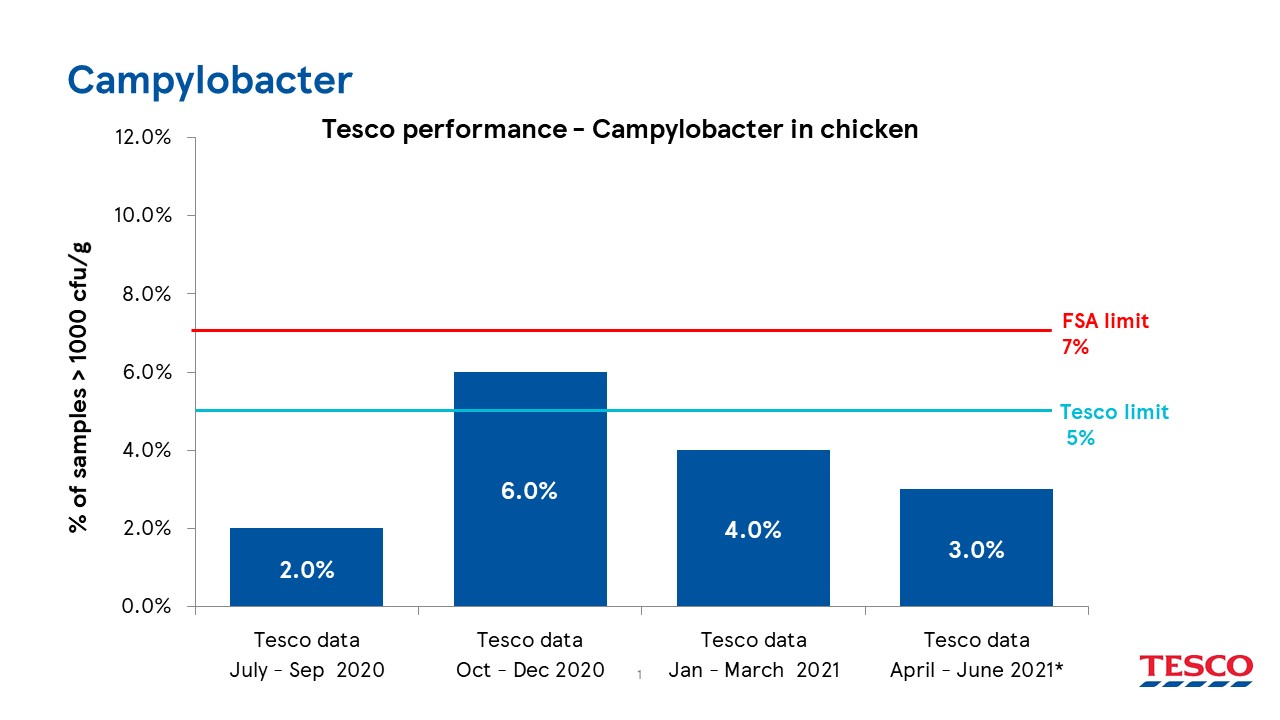
We aim to remain at the forefront of progress on Campylobacter reduction and to ensure we deliver this we have introduced our own industry leading target- that at least 95% of chickens supplied to Tesco will have minimal levels of Campylobacter (less than 1000 cfu/g). This will enable us to help our customers be a safe as possible, whilst handling and cooking poultry.

  • All of our raw poultry contains safe handling information on packaging and cooking instructions are checked to ensure thorough cooking. For further information please visit our Real Food website: Food Safety in the Home

Our Performance

UK – Lidl Tackling Campylobacter

Lidl

Safety and satisfaction are close to our hearts, which is why our quality assurance team accepts nothing short of perfection. Food safety is at the heart of what we do and underpins our purchasing policy across food and non-food items.

We work hard to ensure our suppliers meet national, European and Global safety standards and implement a strict internal Quality Management System comprising of rigorous product testing and supplier auditing.

Campylobacter

Food safety is the highest priority at Lidl UK, and together with our suppliers and the Food Standards Agency (FSA) we are committed to tackling Campylobacter in chicken. This is being achieved through several initiatives throughout the process, from the farm and processing stages to supply chain and in-store, too. These initiatives are demonstrated in our plan below.

What is Campylobacter?

Campylobacter is the most common cause of food poisoning in humans. Campylobacter is naturally occurring in the environment and lives inside many animals including chickens.

The most common ways Campylobacter is spread is through cross-contamination and undercooked chicken.

Customer advice

Lidl strongly advises all our customers to follow the FSA’s advice when handling and cooking raw chicken:

  • Cover and chill raw chicken, store it at the bottom of the fridge so juices cannot drip on to other foods.
  • Don’t wash raw chicken.
  • Thoroughly wash and clean all utensils, chopping boards and surfaces used to prepare raw chicken. Wash hands thoroughly with soap and warm water after handling raw chicken.
  • Cook chicken thoroughly, making sure it is steaming hot throughout, with no pink meat and all the juices running clear.

Lidl UK’s actions on Campylobacter

  • Lidl joined the new Acting on Campylobacter Together (ACT) board in 2015 as a joint way of tackling Campylobacter between retailers, processors and the FSA.
  • Our poultry suppliers are working hard on increased bio-security on-farm to reduce Campylobacter in poultry flocks.
  • Our poultry suppliers have implemented innovative factory interventions to reduce Campylobacter through the process of slaughtering and production.
  • All of our flavoured birds are sold as roast-in-bag, reducing the need for customers to touch raw chicken.
  • All of our raw poultry contains hygiene information on the packaging advising customers of good practice.

Lidl Campylobacter Results > 1000 cfu/g

Lidl Campylobacter Results

UK – Campylobacter chicken levels still high at small UK retailers

Food Safety News

The percentage of chicken sold at smaller retailers that is contaminated with high levels of Campylobacter remains above a Food Standards Agency target.

A UK-wide survey sampled 1,008 chickens from August 2019 to October 2020. It looked at levels of Campylobacter on whole fresh retail chickens from independent shops, butchers and smaller chains such as Iceland, McColl’s, Budgens, Nisa, Costcutter and One Stop.

Campylobacter was detected in 59.6 percent of the chicken skin samples from non-major retailers, and 12.8 percent of them were above 1,000 colony forming units per gram (CFU/g) of chicken skin. This continues to be higher than levels found in samples from the nine major retailers.

The highest single count was 89,000 CFU of Campylobacter per gram of skin. The proportion of highly contaminated chickens was the most for butchers compared to the stores that are part of smaller retail chains.

Rise from last survey
The Food Standards Agency (FSA) has a maximum acceptable level of no more than 7 percent of birds with more than 1,000 CFU/g of Campylobacter. In 2019, the UK reported 58,718 cases of campylobacteriosis with raw chicken meat identified as a key vehicle of infection.

Research – Prevalence of Listeria Species and Listeria monocytogenes on Raw Produce Arriving at Frozen Food Manufacturing Facilities

Journal of Food Protection

The ubiquity of Listeria monocytogenes in the environment affects the food industry and presents concerns for frozen food facilities. This study determined the prevalence and numbers of Listeria species and L. monocytogenes on raw produce arriving at frozen food facilities. Raw produce was collected using multilevel blinding protocols to ensure anonymity of participants and avoid traceback. Five raw vegetables were selected: corn, carrots, green beans, peas, and spinach. Raw products were collected after arrival at the facilities but before cleaning or other preprocessing steps that are typically performed inside the facility. The U.S. Food and Drug Administration’s Bacteriological Analytical Manual method for detection of Listeria spp. and L. monocytogenes was followed, with PCR screening followed by selective plating methods. Listeria numbers were estimated from positive samples using the most-probable-number (MPN) methodology. A total of 290 samples were collected, with 96 and 17 samples positive for Listeria spp. (33.1%) and L. monocytogenes (5.9%), respectively. Enumeration data for the 96 Listeria spp. samples indicated 82 samples had greater than 100 MPN of Listeria spp. per g and 14 samples had less than 100 MPN Listeria spp. per g. The prevalence of Listeria spp. varied by commodity: spinach (66.7%), peas (50%), corn (32.2%), green beans (22.2%), and carrots (13%). L. monocytogenes prevalence was determined in corn (13.6%), peas (6.3%), and green beans (4.2%) arriving at processing facilities. Such data were previously unavailable to frozen vegetable processors and are valuable in implementing process control standards. The prevalence and pathogen concentration data from raw commodities found in this study can provide the industry with information to conduct more accurate quantitative risk assessments and a baseline to model and target appropriate pathogen reduction steps during processing.

HIGHLIGHTS
  • Prevalence of Listeria spp. and L. monocytogenes in raw produce was determined.
  • 96 Listeria spp. and 17 L. monocytogenes samples were found from 290 produce samples.
  • 82 produce samples had >100 MPN/g and 14 samples had <100 MPN/g for Listeria spp.