Category Archives: foodbourne outbreak

USA – 129 passengers, 25 crew struck by Norovirus outbreak in US

Cruise Passenger

Australian cruisers have escaped the current norovirus outbreak currently affecting passengers in the US. While there have been a reported 13 norovirus outbreaks on cruise ships in US ports since the start of the year. So far the southern hemisphere has escaped unscathed.

The most recent norovirus outbreak in the US was on Queen Victoria. She was on her way to Honolulu from San Francisco on a 107-night world cruise when more than 150 people on board reported symptoms.

US Centers for Disease Control and Prevention officials said of the 1824 passengers onboard, 129 (7.07%) reported being ill during the voyage. Of the 967 crew 25 (2.59%) also reported being unwell.

Norovirus is mainly spread directly from person to person or by touching contaminated surfaces.
Research – Multistate nontyphoidal Salmonella and Shiga toxin-producing Escherichia coli outbreaks linked to international travel—United States, 2017–2020

Cambridge.org

Abstract

Enteric bacterial infections are common among people who travel internationally. During 2017–2020, the Centers for Disease Control and Prevention investigated 41 multistate outbreaks of nontyphoidal Salmonella and Shiga toxin-producing Escherichia coli linked to international travel. Resistance to one or more antimicrobial agents was detected in at least 10% of isolates in 16 of 30 (53%) nontyphoidal Salmonella outbreaks and 8 of 11 (73%) Shiga toxin-producing E. coli outbreaks evaluated by the National Antimicrobial Resistance Monitoring System. At least 10% of the isolates in 14 nontyphoidal Salmonella outbreaks conferred resistance to one or more of the clinically significant antimicrobials used in human medicine. This report describes the epidemiology and antimicrobial resistance patterns of these travel-associated multistate outbreaks. Investigating illnesses among returned travellers and collaboration with international partners could result in the implementation of public health interventions to improve hygiene practices and food safety standards and to prevent illness and spread of multidrug-resistant organisms domestically and internationally.

USA -Listeria Outbreak Linked to Queso Fresco and Cotija Cheese

CDC

What You Should Do
  • Do not eat any recalled cheeses or dairy products.
    • Throw them away or return them to where you bought them.
  • Clean the refrigerator, containers, and surfaces that may have touched the recalled products.
    • Listeria can survive in the refrigerator and can easily spread to other foods and surfaces.
  • Call a healthcare provider right away if you have these symptoms after eating recalled products:
    • Pregnant people usually have fever, muscle aches, and tiredness.
    • People who are not pregnant usually have fever, muscle aches, and tiredness. They may also get a headache, stiff neck, confusion, loss of balance, or seizures.
What Businesses Should Do
Fast Facts
  • Illnesses: 26
  • Hospitalizations: 23
  • Deaths: 2
  • States: 11
  • Recall: Yes
  • Investigation status: Active
Round block of cheese on a wooden cutting board

Queso fresco

Recalled Food

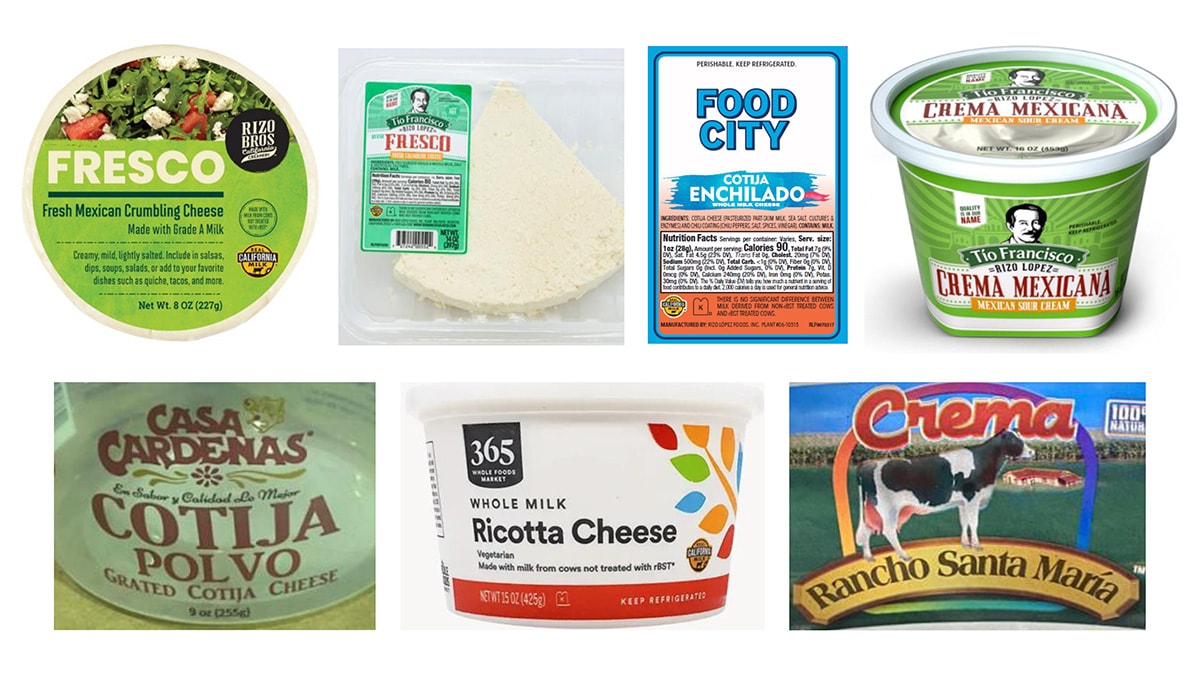
Cheeses, crema, and yogurt made by Rizo-López Foods

  • On February 6, 2024, Rizo-López Foods recalled all cheeses and other dairy products made in their facility.
  • Products were sold nationwide under these brands and at deli counters:
    • Campesino
    • Casa Cardenas
    • Don Francisco
    • Dos Ranchitos
    • El Huache
    • Food City
    • La Ordena
    • Rio Grande
    • Rizo Bros
    • San Carlos
    • Santa Maria
    • Tio Francisco
    • 365 Whole Foods Market

USA – FDA – Investigations of Foodborne Illness Outbreaks

FDA

What’s New

  • An outbreak advisory was issued for the outbreak of Listeria monocytogenes (ref #1214) linked to Queso Fresco and Cotija Cheese manufactured by Rizo Lopez Foods, Inc. On 2/5/2024, Rizo Lopez Foods, Inc. expanded their voluntary recall for Cotija Mexican Grating cheese to cover all dairy products manufactured in their Modesto, California, facility.
  • For the investigation of elevated lead levels in Cinnamon Applesauce Pouches (ref # 1198) the advisory was updated to include investigation updates.

Research – Power Law for Estimating Under-detection of Foodborne Disease Outbreaks, United States

CDC

Abstract

We fit a power law distribution to US foodborne disease outbreaks to assess under-detection and underreporting. We predicted that 788 fewer than expected small outbreaks were identified annually during 1998–2017 and 365 fewer during 2018–2019, after whole-genome sequencing was implemented. Power law can help assess effectiveness of public health interventions.

Each year in the United States, >800 foodborne outbreaks are reported, causing >14,000 illnesses and >800 hospitalizations (13). Foodborne outbreaks range from small, localized outbreaks, such as those associated with a locally contaminated meal shared by family or friends, to large, multistate outbreaks associated with a contaminated food that is widely distributed. Selection and information biases, pathogen testing methods, and outbreak size can affect detection, investigation, and reporting (4). However, few methods are available to estimate the extent of outbreak under detection and underreporting.

Outbreaks can be considered natural occurrences with a mathematical relationship between frequency and size. Several studies have used a power law distribution, where one variable is proportional to the power of another, to help describe disease outbreaks or transmission (59). We examined the mathematical relationship between foodborne outbreak frequency and size to estimate the number of expected outbreaks of different sizes, comparing power law, log-normal, and exponential distributions by using censored and complete data to clarify under detection and underreporting.

Research – The financial impact of foodborne illness outbreaks at restaurants: Chipotle Mexican Grill

Wiley Online

As demand for food away from home increases, outbreaks at restaurants become an important source of food-related illness. In the United States, over 60% of foodborne illness outbreaks occur at restaurants and 97% of outbreaks are limited to a single state. Despite this, we currently know little about restaurant outbreaks and in particular, single-state outbreaks are not well understood. We use Chipotle Mexican Grill’s eight outbreaks (2015–2018) to evaluate the media and stock market responses to both single and multistate outbreaks. Using news and stock market data, we provide evidence that multistate outbreaks brought swift stock price declines and single-state outbreaks’ impact depended on their timing, rather than their severity. Before Chipotle’s more well-known, multistate outbreaks, the firm’s single-state outbreaks brought little reporting and no financial losses, whereas after the multistate food safety events, single-state events resulted in national media coverage and large financial impacts. Our findings are consistent with the literature on food scares that can result in chronic low-level anxiety, which can bring about a large resurgence of concern for smaller outbreaks. The lessons learned from Chipotle’s case underscore the importance of investment in outbreak prevention. [G14 (Information and Market Efficiency, Event Studies, Insider Trading)].

Research – USA – Study: Multistate foodborne illness outbreaks change public perception of restaurants

The Packer

Multistate foodborne illness outbreaks bring swift financial losses to restaurants, increased media attention and an environment that makes subsequent smaller outbreaks more financially damaging, a new study says.

The research, from University of Illinois Urbana-Champaign’s consumer economics professor Maria Kalaitzandonakes, said that more than 60% of foodborne illness outbreaks in the U.S. occur at restaurants, according to a news release.

Most of those outbreaks are confined to a single state, however, when restaurants experience multistate outbreaks — as did the fast-casual chain Chipotle Mexican Grill in 2015 — that can lead to a stock market penalty, substantial negative news media coverage and a discernible change for the worse in how investors and the public view the company’s smaller outbreaks, according to Kalaitzandonakes.

USA – Outbreak Investigation of Listeria monocytogenes: Queso Fresco and Cotija Cheese (February 2024)

FDA

Image 2 – Labeling, Rizo Bros Cojita, front of label

Products:

Recalled products include all “Sell By” dates of cheese, yogurt, and sour cream (crema) sold under the brand names:

  • Tio Francisco
  • Don Francisco
  • Rizo Bros
  • Rio Grande
  • Food City
  • El Huache
  • La Ordena
  • San Carlos
  • Campesino
  • Santa Maria
  • Dos Ranchitos
  • Casa Cardenas
  • 365 Whole Foods Market

Product description, size, and UPCs are listed below. Additional information is also available in the firm’s recall notice.

Symptoms of Listeriosis (Listeria Infection)

Symptoms usually start within two weeks after eating food contaminated with Listeria but may start as early as the same day or as late as 10 weeks after. Mild symptoms may include a fever, muscle aches, nausea, tiredness, vomiting, and diarrhea. If the more severe form of listeriosis develops, symptoms may include headache, stiff neck, confusion, loss of balance, and convulsions.

Stores Affected

  • Sold Nationwide

Status

Ongoing; updates will be provided as they become available.

Recommendations:

  • Do not eat, sell, or serve recalled brands of cheeses, sour creams (cremas), or yogurts manufactured by Rizo Lopez Foods, Inc.
  • Check your refrigerators and freezers for any recalled products and throw them away. If you froze a product without the original packaging and can’t tell if it is part of the recall, throw it away.
  • Consumers, restaurants, and retailers who purchased or received recalled products, including wholesale products, should carefully clean and sanitize any surfaces or containers that it touched. Follow FDA’s safe handling and cleaning advice to reduce the risk of cross-contamination. Listeria can survive in refrigerated temperatures and can easily spread to other foods and surfaces.
  • If you have symptoms of listeriosis you should contact your health care provider to report your symptoms and receive care.

Recommendations for At-Risk Groups

  • Listeria is most likely to sicken pregnant people and newborns, adults aged 65 or older, and people with weakened immune systems. Other people can be infected with Listeria, but they rarely become seriously ill.
  • Pregnant people typically experience only fever, fatigue, and muscle aches. However, Listeria infection during pregnancy can lead to miscarriage, stillbirth, premature delivery, or life-threatening infection of the newborn.
  • Call your healthcare provider right away if you have symptoms of a Listeria infection.

Research – CEO of seafood firm stresses Listeria control measures

Food Safety News

The chief executive officer of a Norwegian company linked to a Listeria outbreak has insisted it takes comprehensive action to tackle the pathogen.

Comments from Henning Beltestad, CEO of Lerøy Seafood Group, come after scrutiny of the Lerøy Midt slaughterhouse and the Norwegian Food Safety Authority’s (Mattilsynet) follow-up on Listeria control.

Citing a notification to the company from the Norwegian Food Safety Authority, Norwegian broadcaster NRK said Listeria had been detected 700 times in the production environment at the salmon slaughterhouse from August 2022 to November 2023.

“In our operations, we have always focused on minimizing the occurrence of Listeria and providing accurate and comprehensive information to our customers and public authorities. We have an integrated value chain for salmon production, which gives us the best conditions to ensure safe and healthy products for consumers,” said Beltestad.

USA – Bellevue Ihop linked to Salmonella Outbreak

Food Poison Journal

Seattle & King County Public Health announced that three individuals fell ill due to a Salmonella outbreak linked to the IHOP restaurant located at 14747 NE 20th St, Bellevue, WA. The illnesses occurred between October 23 and December 23, 2023, and two people required hospitalization. No deaths were reported. This investigation is now completed.

Laboratory testing confirmed all three cases as Salmonella infections. Further testing revealed that all three cases were infected with the same strain of Salmonella, as determined by genetic fingerprinting (whole genome sequencing or WGS) at the Washington State Public Health Laboratory.