Category Archives: Food Illness

India – 40 girls from the BC Ladies Hostel in Suryapet in Telangana were hospitalised after presenting with symptoms of food poisoning.

The News Minute

The girls had all eaten dal and rice for dinner at their hostel mess and within hours, all of them developed severe stomach pain and vomiting, and had to be taken to the Suryapet Government Hospital.Doctors at the hospital immediately began treatment for food poisoning, after which all 40 of them recovered and were discharged, according to officials from the Suryapet District Medical and Health Officer (DMHO) Dr Niranjan’s office.

“The girls were admitted on Sunday immediately after they began presenting with vomiting and stomach pain. They were all treated and discharged,” said an official from the DMHO’s office. “We have arranged for a team of health experts to follow up on the issue with the hostel and are taking efforts to ensure that something like this doesn’t happen again,” the official added.

Poland – Epidemiological update: Salmonella in eggs from Poland

ECDC

Since the joint ECDC-EFSA rapid outbreak assessment ’Multi-country outbreak of Salmonella Enteritidis infections linked to Polish eggs’ published on 12 December 2017, 15 EU/EEA countries (Belgium, Czech Republic, Denmark, France, Hungary, Iceland, Ireland, Italy, Luxembourg, Netherlands, Norway, Poland, Slovenia, Sweden and United Kingdom) have reported 336 confirmed, 94 probable and 3 new historical-confirmed cases associated with this ongoing multi-country outbreak of Salmonella Enteritidis in the EU/EEA. In the same period, seven historical probable cases were reclassified as excluded.

Overall, 1 412 cases have been found associated with this outbreak: 532 confirmed and 166 probable cases since 1 February 2017 and 343 historical-confirmed and 367 historical-probable cases between 2012 and 31 January 2017. In addition, no dates have been reported for four outbreak-confirmed cases, so they are unclassifiable as current or historical cases (Table 1).

Table 1. Distribution of cases by case classification and country, EU/EEA, February 2012 to November 2018 (n=1 420; 4 cases missing date of onset or sampling or receipt at reference laboratory), as of 12 November 2018

Reporting country Confirmed cases Probable cases Historical-confirmed cases Probable-confirmed cases Total number of cases
Belgium 0 46 14 127 187
Croatia 0 0 4 0 4
Czech Republic 0 6 0 3 9
Denmark 16 0 6 2 24
Finland 0 0 0 1 1
France 21 0 8 0 29
Greece 0 0 0 2 2
Hungary 0 29 0 5 34
Ireland 12 0 4 4 20
Ireland 1 0 0 0 1
Italy 0 12 1 19 32
Luxembourg 4 0 5 0 9
Netherlands 8 25 90 164 287
Norway 22 18 11 32 83
Poland 25 0 0 0 25
Slovenia 0 7 3 0 10
Sweden 11 20 12 2 45
United Kingdom 412 3 185 6 606
Total 532 166 343 367 1408
              698                 710


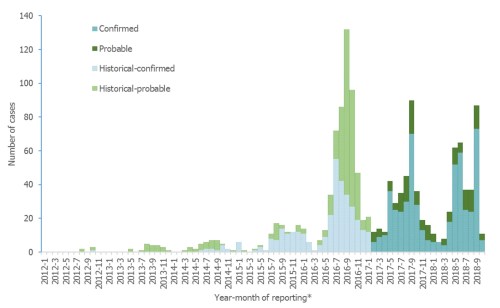
Most outbreak cases were reported during the summer months (Figure 1). Due to reporting delays, additional cases are expected to be reported with onset in recent months.

A total of 112 confirmed or historical-confirmed cases were reported with travel history in an EU country during the incubation period and therefore were likely infected there. Countries where infections likely took place were Poland (25 cases identified from 2016 to 2018), Bulgaria (22 cases from 2015 to 2018), Cyprus (14 cases in 2016 and 2018), Portugal (11 cases from 2015 to 2017) and Hungary (10 cases from 2016 to 2018). Additional travel-associated cases were also reported (<10 cases per country) with travel history to Austria, Belgium, Greece, Italy, the Netherlands, Romania, Slovenia and Spain.

Figure 1. Distribution of cases by month of onset* and case classification (n=1 412; 4 cases missing any date of report), EU/EEA, January 2012 to October 2018, as of 12 November 2018

aaaaa

The 2016 and 2017 European outbreak investigations identified eggs originating from Poland as the vehicle of infection in this outbreak (ECDC/EFSA rapid outbreak assessments published in March and December 2017). Outbreak-confirmed cases belong to four different WGS clusters.

Assessment

As reported in the previous ECDC/EFSA rapid outbreak assessment, in 2016 and 2017, evidence from epidemiological, microbiological, environmental and tracing investigations identified eggs originating from Poland as the vehicle of infections in this multi-strain outbreak. Control measures were implemented following these investigations. However, new outbreak cases were notified in 2017 and in 2018 with similar magnitude and temporal patterns. Based on the analysis of the travel-associated cases, it is likely that more countries where molecular typing is not performed routinely for human S. Enteritidis isolates are affected by the outbreak, including Bulgaria, Cyprus and Portugal.

Actions

ECDC monitors the occurrence of human cases associated with this threat and offers sequencing services for countries reporting probable cases of human S. Enteritidis isolates with MLVA profile 2-9-7-3-2 or 2-9-6-3-2 or
2-9-10-3-2 or 2-10-6-3-2 or 2-10-8-3-2 or 2-11-8-3-2. EU/EEA countries should consider interviewing new outbreak-confirmed cases.

Pakistan – Karachi food poisoning: Sindh government takes charge after deceased’s family complains of inaction

Samaa TV

Sindh government swung into action after the parents of children who died after alleged food poisoning in Karachi complained that the government has done nothing for them.

On November 11, four-year-old Ahmad and one-and-an-half-year-old Muhammad died after eating ‘unhygienic food’ at Arizona grill – a restaurant in Karachi’s DHA.

UK – Nailsea pub slapped with zero rating after 60 people got food poisoning turned around to get five stars

Bristol Post

A pub where dozens of diners suffered food poisoning after eating there on Mothering Sunday has been issued with a five star food hygiene rating.

More than 60 people fell ill, suffering from sickness and diarrhoea in March this year after eating at the Old Farmhouse in Nailsea.

The kitchens at the pub, off Trendlewood Way, were temporarily closed while officials from Public Health England and North Somerset Council launched an investigation into the cause. It was given a zero food hygiene rating after an inspection.

The source of the food poisoning was traced to an organism called Clostridium perfringens.

USA – Clostridium perfringens in Brunswick Stew cause of Poplar Tent Presbyterian Church BBQ Outbreak

Food Poison Journal

South Africa – Durban eatery confirms Salmonella poisoned its patrons

Times Live

Old Town Italy confirms salmonella poisoning of more than 20 patrons two weeks ago .

A Durban eatery has confirmed that certain food samples submitted for laboratory testing have emerged positive for traces of salmonella.

Two weeks ago at least 20 people were hospitalised with suspected salmonella poisoning after eating at the popular Old Town Italy restaurant in Umhlanga.

Salmonella is most often contracted by eating raw or undercooked meat, poultry and eggs and causes diarrhoea, fever, chills and abdominal pain.

The restaurant has since completely removed hollandaise sauce – a mixture of egg yolk,melted butter and lemon juice – from its breakfast menu. In a statement posted on its Facebook page on Friday the restaurant said test results from two independent laboratories had been submitted to them.

“We can confirm the samples taken from our restaurant for the period 03 November 2018 to 09 November 2018 have tested positive for salmonella.

“However, it is important to highlight that the positive salmonella test results were limited to the hollandaise sauce, rocket and egg mix only.”

USA – Infant botulism cases prompt alert about honey pacifiers – Clostridium botulinum

DSHS Texas 

CDC Clost Spore

Children under 12 months old should not consume honey

The Texas Department of State Health Services is warning parents and other adults not to give babies pacifiers containing honey after four babies were treated for botulism in Texas. Each infant had been given a honey-containing pacifier purchased in Mexico.

The four illnesses occurred from mid-August to the end of October and caused all four babies to be hospitalized for life-saving treatment. The unrelated infants are residents of West Texas, North Texas and South Texas.

Botulism is a serious illness caused by a toxin that attacks the body’s nerves and can cause difficulty breathing, paralysis and even death. Honey may contain bacteria that produce the toxin in the intestine of babies that eat it. By the time children get to be 12 months old, they’ve developed enough other types of bacteria in their digestive tract to prevent the botulism bacteria from growing and producing toxin.

DSHS today also issued a health alert asking health care providers to look out for cases of infant botulism and to remind parents not to let babies eat honey. The Centers for Disease Control and Prevention and the American Academy of Pediatrics have long advised that children under 12 months old should not consume honey.

Honey-filled pacifiers are not common in the United States but may be available in some specialty stores and through online retailers. Most aren’t designed for the honey to be consumed, but some have a small hole so a child could eat the honey, or the pacifier could accidentally rupture or leak. Parents should also avoid pacifiers containing any other food substance, because they could also pose a risk of botulism.

Texas has had seven to eight cases of infant botulism per year in recent years. Ten confirmed or suspected cases have been reported in 2018. Additional information on botulism is available on the DSHS website.

USA – Consumer Reports Calls on USDA to Protect Consumers, Identify Turkey Brands Linked to Deadly, Antibiotic-Resistant Salmonella Outbreak

Food Poison Journal

Consumer Reports urged the U.S. Department of Agriculture today to identify the brands of turkey that have been linked to a drug-resistant strain of Salmonella in turkey that has sickened consumers across the nation. The outbreak in raw turkey products has been going on for a year, but neither the turkey industry nor the USDA has released any information about which brands are making people sick.

“The USDA should immediately make public which turkey producers, suppliers, and brands are involved in this outbreak — especially with Thanksgiving right around the corner,” said Jean Halloran, Director of Food Policy Initiatives for Consumer Reports. “This information could save lives and help ensure consumers take the precautions needed to prevent anyone in their home from getting sick.”

USA – Jennie-O Turkey is Link in Salmonella Reading 164 Person Outbreak

Food Poison Journal

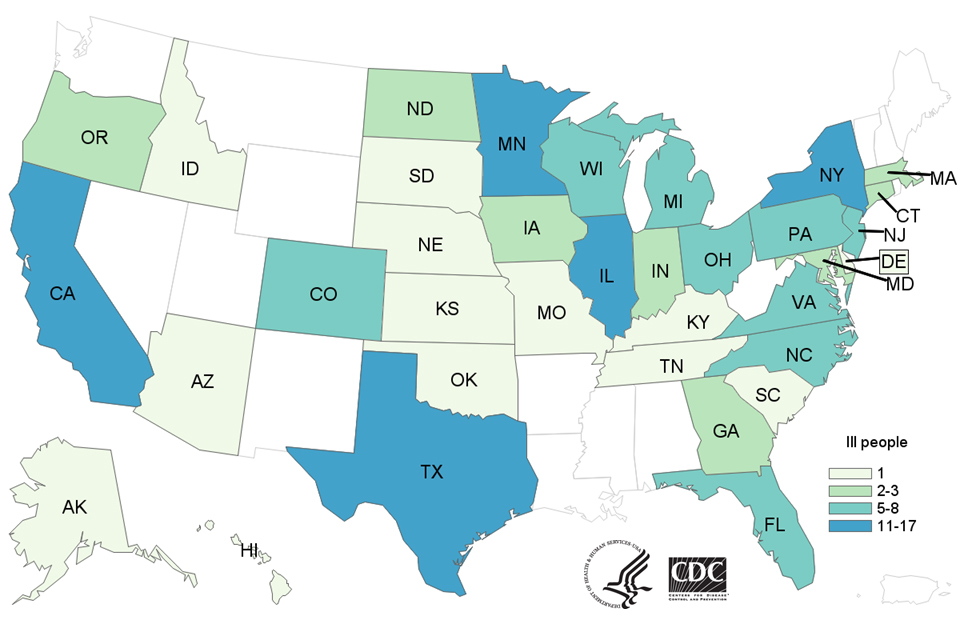
As of November 5, 2018, 164 people infected with the outbreak strain of Salmonella Reading have been reported from 35 states.

Tonight Jennie-O Turkey Store Sales, LLC, a Barron, Wis. establishment, is recalling approximately 91,388 pounds of raw ground turkey products that may be associated with an illness outbreak of Salmonella Reading, the U.S. Department of Agriculture’s Food Safety and Inspection Service (FSIS) announced.

Singapore – 1 dead, 72 sick from Spize restaurant – Salmonella

Barfblog

The Sats officer who fell sick after consuming food from popular restaurant Spize has died on Wednesday (Nov 14).

Mr Fadli Salleh, who was married with two young children, had been in critical condition in the intensive care unit (ICU) of Sengkang General Hospital (SKH) after he was one of 72 people who suffered gastroenteritis, allegedly after eating bento boxes prepared by Spize’s River Valley outlet for an event last Tuesday. (the raw egg looks like a Salmonella factory).

The party was for a Deepavali celebration organised by security company Brink’s Singapore and held on its premises at Kaki Bukit.

Mr Fadli attended the gathering as he was deployed to Brink’s Singapore, though the event itself did not involve Sats.

A Sats spokesman said: “We are providing support to the family during this sad and difficult time. Please approach Brinks if you have further questions.”