Category Archives: Cronobacter sakazakii

Ireland – Recall of Nutramigen LGG Stage 1 & 2 Hypoallergenic Formula due to the possible presence of Cronobacter sakazakii

FSAI

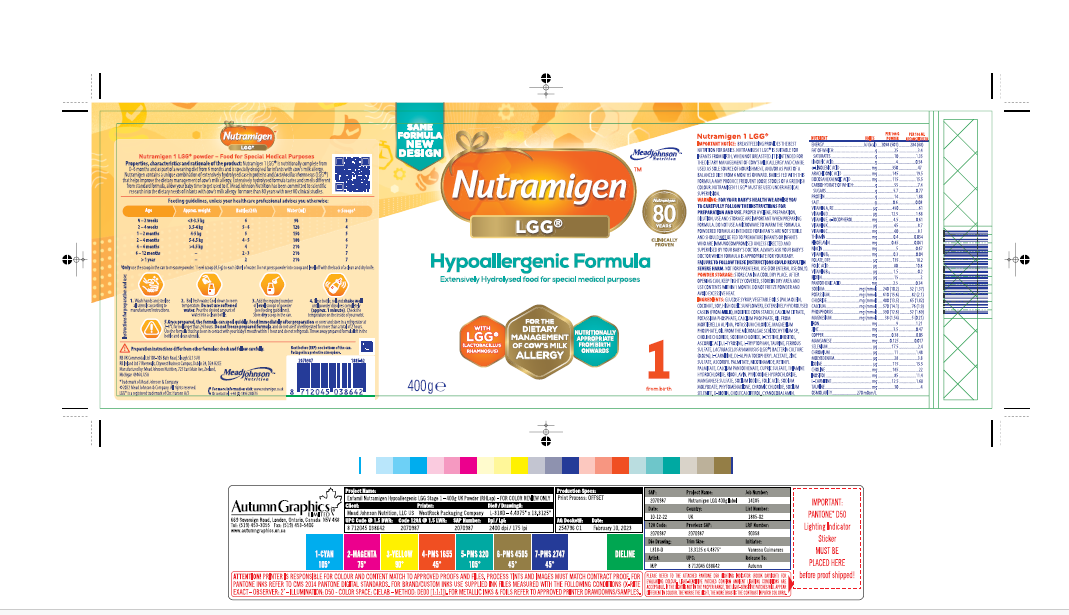
Nutramigen LGG Stage 1

Alert Summary
Category 1: For Action
Alert Notification: 2024.01
Product Identification: Please see table below.
Batch Code Please see table below.
Country Of Origin: USA

Message:

Reckitt/Mead Johnson Nutrition are recalling the above batches of Nutramigen LGG Stage 1 & 2 as a precaution due to the possible presence of Cronobacter sakazakii. Recall notices will be displayed at point-of-sale.

Product name Pack size Batch code
Nutramigen LGG Stage 1 400g ZL3F7D
Nutramigen LGG Stage 2 400g ZL3FAA and ZL3FDM

Nature Of Danger:

Cronobacter sakazakii infections are rare but they can be serious for babies younger than 2 months or babies born prematurely or immunocompromised.  Illness usually starts with a fever and poor feeding, excessive crying, or very low energy. In severe cases, it may lead to sepsis or meningitis.

Action Required:

Manufacturers, wholesalers, distributors, caterers & retailers:

Retailers are requested to remove the implicated batches from sale and display recall notices at point-of-sale.

Consumers:

Consumers are advised not to consume the implicated batch.

Canada – Enfamil brand Nutramigen A+ LGG Hypoallergenic (infant formula) recalled due to possible presence of Cronobacter sakazakii

CFIA

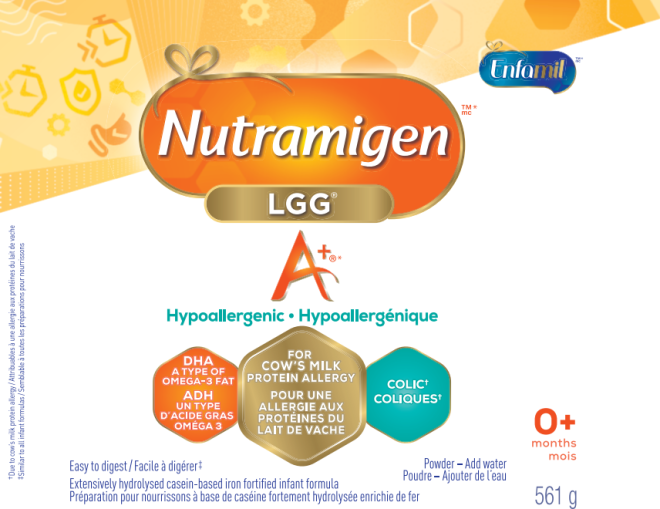
Enfamil - Nutramigen A+ LGG - 561g - Label

Summary

Product
Nutramigen A+ LGG Hypoallergenic (Infant Formula)
Issue
Food – Microbial Contamination – Other
What to do

Do not consume, use, sell, serve or distribute recalled products.

Distribution
National

Enfamil

Nutramigen A+ LGG Hypoallergenic (infant formula)

561 g

0 56796 00498 2

Item# 3230626
Expiry 01-JA-2025
Batch # 0704376 (ZL3FVY)

Enfamil

Nutramigen A+ LGG Hypoallergenic (infant formula)

4 x 561 g

0 56796 90498 5

Item# 3230626
Expiry 01-JA-2025
Batch # 0704376 (ZL3FVY)

The affected products are being recalled from the marketplace due to possible Cronobacter sakazakii contamination.

What you should do

  • If you think you became sick from consuming a recalled product, contact your healthcare provider
  • Check to see if you have recalled products
  • Do not consume, serve, use, sell, or distribute recalled products
  • Recalled products should be thrown out or returned to the location where they were purchased

Food contaminated with Cronobacter sakazakii may not look or smell spoiled but can still make you sick. Although Cronobacter sakazakii is not commonly linked to human illness, in rare cases it can cause serious or fatal infections. Cronobacter sakazakii can cause rare bloodstream and central nervous system infections and has been associated with severe intestinal infection (necrotizing enterocolitis) and blood poisoning (sepsis), especially in newborns.

USA -Reckitt/Mead Johnson Nutrition Voluntarily Recalls Select Batches of Nutramigen Hypoallergenic Infant Formula Powder Because of Possible Health Risk – Possible Cronobacter

FDA

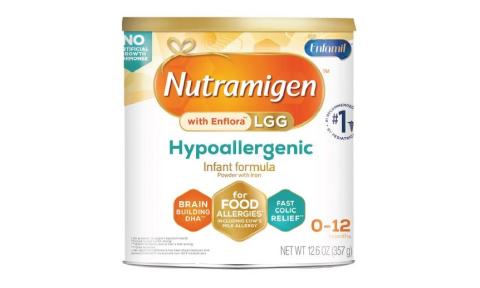
Image 1 - Nutramigen infant formula in 19.8oz can

Company Announcement

  • All product tested by MJN was confirmed negative for contaminants.
  • No illnesses or adverse consumer reactions have been reported to date.
  • No Nutramigen liquid formulas or any other Reckitt nutrition products are impacted.

Recalled product batches are ZL3FRW, ZL3FPE, ZL3FXJ, ZL3FQD, ZL3FMH, ZL3FHG with a UPC code of 300871239418 or 300871239456 and “Use By Date” of “1 Jan 2025” (Photo: Business Wire).

PARSIPPANY, N.J.–(BUSINESS WIRE)–Reckitt/Mead Johnson Nutrition (MJN), a producer of nutrition products, announced today that it has voluntarily chosen to recall from the U.S. market select batches of Nutramigen Powder, a specialty infant formula for the dietary management of Cows Milk Allergy (CMA) in 12.6 and 19.8 oz cans, due to a possibility of contamination with Cronobacter sakazakii in product sampled outside the U.S. All product in question went through extensive testing by MJN and tested negative for the bacteria.

Cronobacter bacteria can cause severe, life-threatening infections (sepsis) or meningitis (an inflammation of the membranes that protect the brain and spine). Symptoms of sepsis and meningitis may include poor feeding, irritability, temperature changes, jaundice (yellow skin and whites of the eyes), grunting breaths and abnormal movements. Cronobacter infection may also cause bowel damage and may spread through the blood to other parts of the body.

Nutramigen in 12.6 and 19.8 oz containers was manufactured in June 2023 and distributed primarily in June, July, and August 2023. Based on the limited availability of the remaining stock of this special infant formula, it is believed that much, if not all, of the products recalled in the United States have been consumed. There are no reports of illnesses or adverse events to date. The products were distributed through retail stores nationwide. The batches in question can be identified by the batch code on the bottom of the can.

The following recalled product batch codes and can size associated with each batch were distributed in the U.S.:

  • ZL3FHG (12.6 oz cans);
  • ZL3FMH (12.6 oz cans);
  • ZL3FPE (12.6 oz cans);
  • ZL3FQD (12.6 oz cans);
  • ZL3FRW (19.8 oz cans); and
  • ZL3FXJ (12.6 oz cans).

The products have a UPC Code of 300871239418 or 300871239456 and “Use By Date” of “1 Jan 2025”.

No other U.S. distributed Nutramigen batches or other Reckitt products are impacted.

Reckitt/Mead Johnson Nutrition manufactured additional products during this finished product campaign and distributed them outside of the U.S. Reckitt/Mead Johnson Nutrition will be contacting the regulatory authorities in each of those countries to determine the proper disposition of those products.

If parents have any questions, they should consult with their pediatrician or contact us at 866-534-9986 24/7 or by email at consumer.relations@rb.com.

We are committed to the highest level of quality and safety and it is for this reason that we have taken this measure. Other testing of the batches in question tested negative for Cronobacter and other bacteria.

The health and safety of infants is our highest priority. All of our products undergo rigorous and industry-leading quality tests and checks to ensure that they meet or exceed all standards set by regulatory bodies, including the World Health Organization and the U.S. Food and Drug Administration. It is for this reason that we have confidence in the safety and quality of every infant formula we make.

What Consumers Should Do if They Purchased This Product

Consumers who purchased Nutramigen should check the bottom of the can to identify whether the batch number is affected. Product with the batch codes listed above should be disposed of, or contact us for a total refund. Please contact us at 866-534-9986 or by email at consumer.relations@rb.com and we will help verify if this product was impacted. If you have any concerns, contact your health care provider. For more information, please visit us at www.enfamil.comExternal Link Disclaimer.

RASFF Alert – Powder rice cream – Cronobacter

RASFF

Presence of Cronobacter in powder rice cream from Italy in San Merino, Albania and Greece

EU – Nestle recalls infant formula due to Cronobacter risk

Food Safety News

Nestlé has recalled infant formula in several countries because of the potential presence of Cronobacter sakazakii.

The affected product is EXPERT PRO HA 1, which has different batch numbers depending on the country it was marketed.

Infant formula from Germany was sent to Bulgaria, Croatia, Czech Republic, Denmark, Finland, Greece, Hungary, Norway, Poland, Romania, Slovakia, and Sweden, according to a notice on the EU’s Rapid Alert System for Food and Feed (RASFF).

In Denmark, it was sold to a few stores and online webshops from Nov. 29 to Dec. 13, 2023. The Danish version NAN EXPERTPRO HA 1 800-grams has article number 12489069, batch number 33120742C2, and an expiration date of 11.2025.

In Norway, the recall applies to 90 units sold to pharmacies, including online pharmacies. NAN EXPERTPRO HA 1 has article number 12468459, batch number 33120742C1, and a best-before date of 11.2025. Products were distributed between Dec. 7 and 12, 2023.

In the Czech Republic and Slovakia, BEBA EXPERT PRO HA 1, 800-gram with batch number 33140742F3 is involved.

The product’s batch number and expiration date are at the bottom of the can. No other products or batches are affected.

No positive products or illnesses

RASFF Alert- Cronobacter – Infant Milk Formula

RASFF

Cronobacter sakazakii in infant formula from Germany in Czech Republic, Denmark, Germany, Norway, Slovakia, Sweden

Denmark – Risk of Cronobacter in infant formula

Foedevarestyrelsen

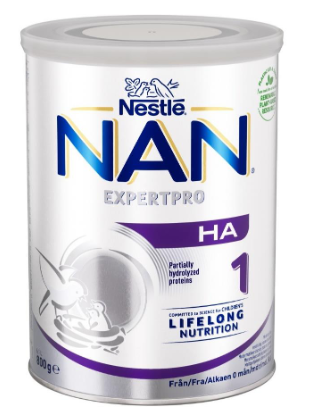
Image of product

Nestlé Danmark A/S is recalling NAN EXPERTPRO HA 1 infant formula, as there is a risk of Cronobacter sakazakii in one of the raw materials included in the product.

If you have the product, you should discard it or return it to the store where it was purchased.

Updated on 13/12/2023 with change in title.

Which food is recalled
NAN EXPERTPRO HA 1 Infant formula
Batch number: 33120742C2
Expiration date: 11.2025

Where is the product sold
The product is sold in grocery stores throughout the country and on webshops.

Why is the product being recalled?
There is a risk that one of the raw materials in the product contains the bacterium Cronobacter sakazakii.

What should you do as a consumer?
The Danish Veterinary and Food Administration advises consumers to return the product to the store where it was purchased, or to discard it. Cronobacter sakazakii generally does not cause serious illness in healthy individuals.

If you have any questions about your child’s symptoms or illness, you should contact your own doctor.

Who recalls the product
Nestlé Danmark A/S
Kay Fiskers Plads 10
2300 Copenhagen S

USA- Method Update ; BAM Chapter 29: Cronobacter

FDA

Revision History

  • November 2023:
    1) Removed the use of SmartCycler for qPCR.
    2) Removed the requirement to perform qPCR without IAC and to perform qPCR on two aliquots per sample.
    3) Updated the 7500 software version.
    4) Added ROX to the qPCR assay and revised the 7500 FAST analysis settings on threshold and baseline.
    5) Revised the stock concentrations and volumes of each qPCR component without changing their final concentrations.
    6) Added extra wash buffer to the pellet to improve the quality of the resultant DNA extract.
    7) Added temperature and time tolerance ranges for incubation of enrichment and agars.
    8) Added optional use of CCI agar and ESIA agar incubated at their respective temperatures as well as R&F agar incubated at 41.5°C.
    9) Added more figures and detailed phenotype description of the colony morphologies on different agars.
    10) Removed the option to use RAPID ID 32E for cultural confirmation.
    11) Revised the chapter with updated nomenclature of Cronobacter and non-Cronobacter species.
    12) Updated other part of the chapter to improve clarity and to provide detailed instructions with additional texts and figures.
  • April 2012: Sections D.1.a, D.1.b, D.2.3; Correction: The fluorescence is recorded at the end of each annealing step, not at the end of each extension step.
  • March 2012: New Chapter (This chapter has replaced the method for Isolation and Enumeration of Enterobacter sakazakii from Dehydrated Powdered Infant FormulaExternal Link Disclaimer.

FDA continues work on a plan to reduce infant illnesses from Cronobacter in formulas

Food Safety News

The Food and Drug Administration has released an update on its work to develop a strategy to help prevent Cronobacter sakazakii illnesses related to powdered infant formula.

The agency is working on the strategy as part of its response to an outbreak of illnesses and the subsequent temporary closure of the Abbott Nutrition production plant in Sturgis, MI. The closure led to a nationwide shortage of infant formula that lasted for months.

In response to the situation, the FDA initiated the development of a prevention strategy, with the draft released in November 2022.

“At the time, the FDA committed to using the strategy to guide its work to enhance the safety of powdered infants, including through engagements with the infant formula industry and other stakeholders,” according to an FDA statement. “These engagements further supported the strategy laid out, and at this time, the strategy will continue forward without further actions being added. As more information becomes available, the FDA may add additional actions over time.”

Infant formula firms are now required to develop, maintain, and implement, as appropriate, risk management plans to identify and evaluate risks to the supply of critical food, such as infant formula, and ways to mitigate such risks. This is a new requirement mandated by Congress in the Food and Drug Omnibus Reform Act of 2022.

USA – Cronobacter infections in babies are now a reportable disease

Food Safety News

The CDC has announced it will begin tracking infections caused by cronobacter, which was behind an outbreak in 2021-22 among babies and caused an infant formula shortage that plagued the nation for months.

The council is the body that recommends what diseases are “reportable.” That list already includes illnesses from other foodborne pathogens, including E. coli, Salmonella, and Listeria. About 120 other illnesses are on the list of “nationally notifiable” pathogens. The council and the CDC manage the list.

When the recommendation becomes active, cronobacter infections identified in infants less than 1-year-old will be reported by doctors and laboratories to state health departments. Those departments will then notify the CDC.