Category Archives: Virus

USA – Public Health Alert Concerning Hepatitis A Virus Contamination of Kroger Brand Frozen Blackberries

FDA

The FDA is alerting consumers to a hepatitis A virus (HAV) contamination of frozen blackberries under the Kroger grocery store “Private Selection” brand. This contamination was discovered by the FDA as a part of an ongoing frozen berry sampling assignment. The FDA is advising consumers not to eat and to throw away frozen fruit purchased from Kroger and other retail locations packaged under Kroger’s “Private Selection” brand. Here are the recalled products:

  • PRIVATE SELECTION FROZEN TRIPLE BERRY MEDLEY, 48 OZ (BEST BY: 07-07-20; UPC: 0001111079120);
  • PRIVATE SELECTION FROZEN TRIPLE BERRY MEDLEY, 16 OZ (BEST BY: 06-19-20; UPC: 0001111087808);
  • PRIVATE SELECTION FROZEN BLACKBERRIES, 16 OZ (BEST BY: 06-19-20, 07-02-20; UPC: 0001111087809)
Kroger Brand Frozen Blackberries

These products are available at Kroger and other retail locations and have a two-year shelf life. The FDA is working with the manufacturer on this matter. This posting will be updated with new information as it becomes available. The FDA is continuing to investigate to determine whether there are other implicated products.

At this time, the FDA and the Centers for Disease Control and Prevention (CDC) are not aware of any cases of hepatitis A linked to the consumption of Kroger Private Selection brand frozen blackberries. Hepatitis A virus (HAV) can result in a liver infection that may be inapparent. However, when symptoms occur, they can range in severity from a mild illness lasting a few weeks to a severe illness lasting several months. HAV is found in the stool and blood of people who are infected. HAV is spread when someone ingests the virus, usually through person-to-person contact or from eating contaminated food or drink. Contamination of food with the hepatitis A virus can happen at any point: growing, harvesting, processing, handling, and even after cooking.
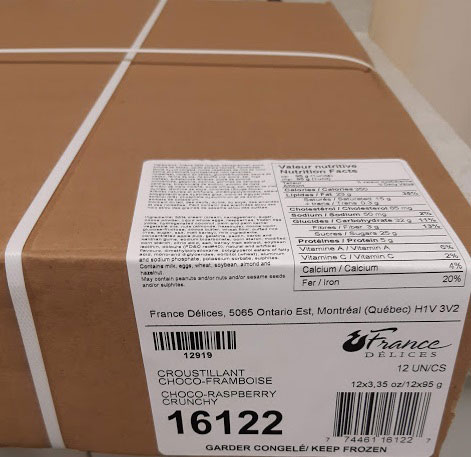
Canada -Food Recall Warning – France Délices brand Choco-Raspberry Crunchy recalled due to norovirus

CFIA

Recall details

Ottawa, June 4, 2019 – France Délices Inc. is recalling France Délices brand Choco-Raspberry Crunchy from the marketplace due to possible norovirus contamination of the raspberries used in this product. Consumers should not consume and retailers, should not sell, or serve the recalled product described below.

The following product has been sold in Ontario and Quebec from the following retailers:

Name Address
La maison du Kouign-Amman 101 Schneider Rd., Kanata, ON
Métro plus 875, Montée Masson, Mascouche, QC
Métro plus Élite St-Antoine 633, boul. des Laurentides, St-Antoine des Laurentides, QC
IGA Coteau du lac 100, Théophile Brassard, Coteau du Lac, QC
IGA Chaumont Bilodeau 1005, boul. Du Grand Héron, St-Jérôme, QC
IGA Extra Sept-Iles 1010, boul. Laure Uashat, Sept-Îles, QC
IGA St-Romuald 1060, boul. Guillaume-Couture, Lévis, QC

This product has been sold clerk-served from retail counters, with or without a label or coding, up to and including June 3, 2019. Consumers who are unsure if they have purchased the affected product are advised to contact their retailer.

Recalled products

Brand Name Common Name Size Code(s) on Product UPC
France Délices Choco-Raspberry Crunchy 95 g 12919 7 74461 16122 7

What you should do

If you think you became sick from consuming a recalled product, call your doctor.

Check to see if you have recalled products in your home. Recalled products should be thrown out or returned to the store where they were purchased.

People with norovirus illness usually develop symptoms of gastroenteritis within 24 to 48 hours, but symptoms can start as early as 12 hours after exposure. The illness often begins suddenly. Even after having the illness, you can still become re-infected by norovirus. The main symptoms of norovirus illness are diarrhea, vomiting (children usually experience more vomiting than adults), nausea and stomach cramps. Other symptoms may include low-grade fever, headache, chills, muscle aches and fatigue (a general sense of tiredness).  Most people feel better within one or two days, with symptoms resolving on their own, and experience no long-term health effects. As with any illness causing diarrhea or vomiting, people who are ill should drink plenty of liquids to replace lost body fluids and prevent dehydration. In severe cases, patients may need to be hospitalized and given fluids intravenously.

Background

This recall was triggered by findings by the Canadian Food Inspection Agency (CFIA) during its investigation into a foodborne illness outbreak. The CFIA is conducting a food safety investigation, which may lead to the recall of other products. If other high-risk products are recalled, the CFIA will notify the public through updated Food Recall Warnings.

The CFIA is verifying that industry is removing recalled product from the marketplace.

Illnesses

There have been no reported illnesses associated with the consumption of this product.

More information

France Délices Inc.: Christine Fortin, cfortin@francedelices.com

For more information, consumers and industry can contact the CFIA by filling out the online feedback form.

Product photos

Printer ready version of photos

  • France Délices - Choco-Raspberry Crunchy - case
  • France Délices - Choco-Raspberry Crunchy

USA – Possible Hepatitis A Exposure at Teriyaki Japan in North Augusta, SC

Food Poisoning Bulletin Virusds

Customers who ate at Teriyaki Japan on Edgefield Road in North Augusta, South Carolina may have been exposed to the hepatitis A virus, according to a news release by the South Carolina Department of Health and Environmental Control. Anyone who ate food or drank beverages between May 14 and May 28, 2019 could have been exposed to the virus.

RASFF Alert -Hepatitis A – Mixed Frozen Berries

RASFF-Logo

RASFF – hepatitis A virus (presence /25g) in mixed frozen berries from Italy, with raw material from Ukraine, Lithuania and Romania in Italy

USA – Possible Hepatitis A Exposure at Roy Moore’s Fish Shack in Rockport, MA

Food Poisoning Bulletin

The Massachusetts Department of Public Health is warning consumers that if they ate cold food or uncooked food at Roy Moore’s Fish Shack in Rockport, Massachusetts between April 21 and May 12, 2019 may have been exposed to hepatitis A. A food service employee of the restaurant who worked there during those dates has been confirmed as sick with hepatitis A.

UK – Challenges of investigating a large food-borne Norovirus outbreak across all branches of a restaurant group in the United Kingdom, October 2016

Eurosurveillance

During October and November 2016, over 1,000 customers and staff reported gastroenteritis after eating at all 23 branches of a restaurant group in the United Kingdom. The outbreak coincided with a new menu launch and norovirus was identified as the causative agent. We conducted four retrospective cohort studies; one among all restaurant staff and three in customers at four branches. We investigated the dishes consumed, reviewed recipes, interviewed chefs and inspected restaurants to identify common ingredients and preparation methods for implicated dishes. Investigations were complicated by three public health agencies concurrently conducting multiple analytical studies, the complex menu with many shared constituent ingredients and the high media attention. The likely source was a contaminated batch of a nationally distributed ingredient, but analytical studies were unable to implicate a single ingredient. The most likely vehicle was a new chipotle chilli product imported from outside the European Union, that was used uncooked in the implicated dishes. This outbreak exemplifies the possibility of rapid spread of infectious agents within a restaurant supply chain, following introduction of a contaminated ingredient. It underlines the importance of appropriate risk assessments and control measures being in place, particularly for new ingredients and ready-to-eat foods.

USA -FDA Sampling Frozen Berries for Harmful Viruses

FDA


Some people use frozen berries without first cooking them, increasing their risk of exposure to harmful viruses. The U.S. Food and Drug Administration reported three hepatitis A virus outbreaks and one norovirus outbreak linked to frozen berries in the United States from 1997 to 2016. The FDA began sampling frozen berries for each hazard as part of the agency’s efforts to protect consumers and ensure food safety.

The sampling assignment began in November and is estimated to last approximately 18 months. The agency is collecting domestic samples of frozen berries in retail packaging from processors, distribution centers, warehouses, and retail locations. The agency is also collecting import samples from ports of entry, importer warehouses, or other storage facilities where foreign goods are cleared for entry into the country. The FDA plans to collect and test 2,000 samples in all.

Frozen berries are used as ingredients in many foods without being cooked; cooking would reduce or eliminate potential contamination. Strawberries, raspberries and blackberries are delicate and may become contaminated with bacteria or viruses if handled by an infected worker who does not use appropriate hand hygiene, or if exposed to contaminated agricultural water or a contaminated surface, like a harvesting tote. Freezing preserves berries but generally does not kill viruses, which can survive at low temperatures.

If the FDA detects hepatitis A virus or norovirus in a sample, the agency will notify the firm of the finding(s) and work with the firm to take appropriate action to protect the public health. Upon detecting a positive test result, the FDA may also take actions such as placing a firm on an import alert, overseeing a recall, or issuing public warnings.

The FDA will post the sampling results on its FY 19-20 Frozen Berries Assignment page on a quarterly basis and will publish an analytical report once the assignment is complete.

USA – Norovirus Outbreak Associated with Dave and Buster’s in Auburn, WA

Food Poisoning Bulletin norovirus-1080x655

norovirus outbreak associated with Dave and Buster’s restaurant at 1101 Outlet Collection Way SW, Suite 1057, in Auburn, Washington has sickened at least 12 people, according to King County Public Health. Since April 5, 2019, five people from a single party reported illnesses after eating at that facility on March 31, 2019.

Research – Bacteria partners with virus to cause chronic wounds

Science Daily


A common bacterial pathogen called Pseudomonas aeruginosa produces a virus that substantially increases the pathogen’s ability to infect us, according to a study by investigators at the Stanford University School of Medicine.

P. aeruginosa weaponizes its resident virus to exploit the immune system’s distinct responses to bacterial versus viral infections.

This marks the first time a bacteria-infecting virus, otherwise known as a bacteriophage or just phage, has been observed inducing the immune system to mount an antiviral response and, in doing so, causing it to ignore the bacterial infection. When the scientists generated a vaccine directed at the virus, they showed that it dramatically lowered the bacteria’s ability to infect wounds in mice.

USA – Potential Hepatitis A Exposure from McDonalds Restaurant Worker

Food Poison Journal

The Georgia Department of Public Health Northwest Health District officials have confirmed a case of hepatitis A in a food handler at McDonald’s, 106 LaFayette Road, Chickamauga, GA. An investigation found that this employee worked at the restaurant while infectious, from March 4 through March 17. While it is relatively rare for restaurant patrons to become infected with hepatitis A virus due to an infected food handler, “there might be some risk to the public,” says District Health Director Dr. Unini Odama, “and therefore we are doing everything necessary to protect the public and anyone that might have been inadvertently exposed to the hepatitis A virus.”