Category Archives: Technology

Research – Role of blue light in bactericidal effect against meat-borne pathogens and freshness maintaining of beef 

Journal of Food Protection

Beef is rich in various nutrients while easily spoils due to contamination by pathogens, thus it is of great significance to develop a bactericidal method to inactivate meat-borne pathogens and meanwhile maintain the freshness of beef. For the first time, the present study investigated the bactericidal effect of blue light (BL) at 415 nm against four meat-borne pathogens (methicillin-resistant Staphylococcus aureus , Escherichia coli , Salmonella Typhimurium and Listeria monocytogenes ) in vitro and inoculated on the surface of fresh beef, respectively. When the non-illuminated beef was used as control, the population of the four pathogens did not change significantly ( P > 0.05), while BL-illuminated beef showed dose-dependent inactivation effect in both in vitro and in vivo studies. The experiments on beef cuts showed that 109.44 J/cm 2 of BL inactivated 90% of inoculated cells for the tested strains ( P < 0.05), and the impact of BL inactivation could be sustained in 7 days of cold storage. Notably, changes of lipid oxidation rate, water holding capacity and cooking loss value between the control and beef illuminated by 109.44 J/cm 2 at the same time were scarcely detected during the storage. BL had a minor but insignificant influence on surface color and free amino acid content. Moreover, the pH of illuminated beef increased slower ( P < 0.05) than that of non-illuminated beef. The present work demonstrated that BL could be a novel bactericidal and freshness-maintaining method for fresh beef.

Research – Effect of Plasma-Activated Solution Treatment on Cell Biology of Staphylococcus aureus and Quality of Fresh Lettuces

MDPI

This study aimed to investigate effects of plasma-activated solution (PAS) on the cell biology of Staphylococcus aureus and qualities of fresh lettuce leaves. PAS was prepared by dielectric barrier discharge plasma and incubated with S. aureus for 10–30 min or with lettuces for 10 min. Effects on cell biology were evaluated with microscopic images, cell integrity, and chemical modification of cellular components. Effects on lettuce quality were estimated with the viable microbial counts, color, contents of vitamin C and chlorophyll, and surface integrity. PAS reduced S. aureus population by 4.95-log and resulted in increased cell membrane leakage. It also resulted in increased contents of reactive oxygen species in cells, C=O bonds in peptidoglycan, and 8-hydroxydeoxyguanosine content in cellular DNA, and reduced ratios of unsaturated/saturated fatty acids in the cell membrane. PAS treatment reduced bacterial load on fresh lettuce and had no negative effects on the quality. Data suggest that PAS can be used for the disinfection of ready-to-eat fresh vegetables. View Full-Text

Research – Differential Survival of Generic E. coli and Listeria spp. in Northeastern U.S. Soils Amended with Dairy Manure Compost, Poultry Litter Compost, and Heat-Treated Poultry Pellets and Fate in Raw Edible Radish Crops

Journal of Food Protection

Composted or heat-treated Biological Soil Amendments of Animal Origin (BSAAO) can be added to soils to provide nutrients for fresh produce. These products lower the risk of pathogen contamination of fresh produce when compared with use of untreated BSAAO; however, meteorological conditions, geographic location, and soil properties can influence the presence of pathogenic bacteria, or their indicators (e.g., generic E. coli) and allow potential for produce contamination. Replicated field plots of loamy or sandy soils were tilled and amended with dairy manure compost (DMC), poultry litter compost (PLC), or no compost (NoC) over two different field seasons, and non-composted heat-treated poultry pellets (HTPP) during the second field season. Plots were inoculated with a three-strain cocktail of rifampicin-resistant E. coli (rE.coli) at levels of 8.7 log CFU/m2. Direct plating and most probable number (MPN) methods measured the persistence of rE.coli and Listeria spp. in plots through 104 days post-inoculation. Greater survival of rE. coli was observed in PLC plots in comparison to DMC plots and NoC plots during year 1 (P < 0.05). Similar trends were observed for year 2, where rE. coli survival was also greater in HTPP amended plots (P < 0.05). Survival of rE. coli was dependent on soil type, where water potential and temperature were significant covariables. Listeria spp. were found in NoC plots, but not in plots amended with HTPP, PLC or DMC. Radish data demonstrate that PLC treatment promoted the greatest level of rE.coli translocation when compared to DMC and NoC treatments (P  < 0.05). These results are consistent with findings from studies conducted in other regions of the US and informs Northeast produce growers that composted and non-composted poultry-based BSAAO supports greater survival of rE. coli in field soils. This result has the potential to impact the food safety risk of edible produce grown in BSAAO amended soils as a result of pathogen contamination.

Research – Bioactivity of Essential Oils for Mitigation of Listeria monocytogenes Isolated from Fresh Retail Chicken Meat

MDPI

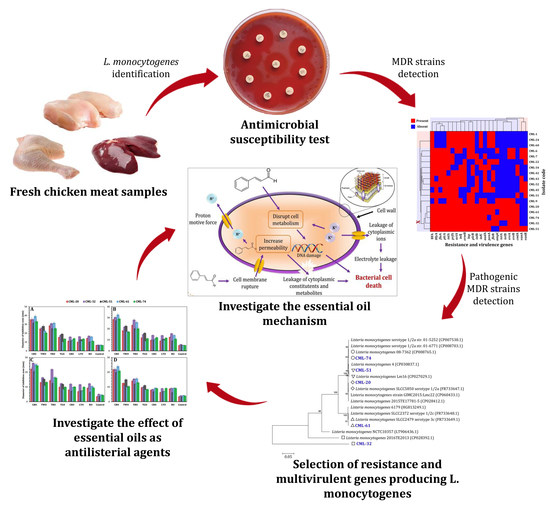
Listeria monocytogenes is one of the most severe foodborne pathogens found in several habitats. Therefore, this study aims to investigate the antilisterial activity of different essential oils (EOs) against multidrug-resistant (MDR) L. monocytogenes strains isolated from fresh chicken meat. Our results showed that the prevalence of L. monocytogenes in the examined samples was 48%. Seventy-eight isolates were identified as L. monocytogenes. Out of these, 64.1% were categorized as MDR and were categorized in 18 patterns with 50 MDR isolates. One isolate was selected randomly from each pattern to investigate their biofilm-forming ability, resistance, and virulence genes incidence. Out of 18 MDR isolates, 88.9% showed biofilm-forming ability. Moreover, the most prevalent resistance genes were ermB (72%), aadA (67%), penA (61%), and floR genes (61%). However, the most prevalent virulence genes were inlA (94.4%), prfA (88.9%), plcB (83.3%), and actaA (83.3%). The antilisterial activity of EOs showed that cinnamon bark oil (CBO) was the most effective antilisterial agent. CBO activity could be attributed to the bioactivity of cinnamaldehyde which effects cell viability by increasing the bacterial cell electrical conductivity, ion leakage, and salt tolerance capacity loss. Therefore, CBO could be an effective alternative natural agent for food safety applications. View Full-Text

Research – High-Pressure-Induced Sublethal Injuries of Food Pathogens—Microscopic Assessment

MDPI

High Hydrostatic Pressure (HHP) technology is considered an alternative method of food preservation. Nevertheless, the current dogma is that HHP might be insufficient to preserve food lastingly against some pathogens. Incompletely damaged cells can resuscitate under favorable conditions, and they may proliferate in food during storage. This study was undertaken to characterize the extent of sublethal injuries induced by HHP (300–500 MPa) on Escherichia coli and Listeria innocua strains. The morphological changes were evaluated using microscopy methods such as Scanning Electron Microscopy (SEM), Transmission Electron Microscopy (TEM), and Epifluorescence Microscopy (EFM). The overall assessment of the physiological state of tested bacteria through TEM and SEM showed that the action of pressure on the structure of the bacterial membrane was almost minor or unnoticeable, beyond the L. innocua wild-type strain. However, alterations were observed in subcellular structures such as the cytoplasm and nucleoid for both L. innocua and E. coli strains. More significant changes after the HHP of internal structures were reported in the case of wild-type strains isolated from raw juice. Extreme condensation of the cytoplasm was observed, while the outline of cells was intact. The percentage ratio between alive and injured cells in the population was assessed by fluorescent microscopy. The results of HHP-treated samples showed a heterogeneous population, and red cell aggregates were observed. The percentage ratio of live and dead cells (L/D) in the L. innocua collection strain population was higher than in the case of the wild-type strain (69%/31% and 55%/45%, respectively). In turn, E. coli populations were characterized with a similar L/D ratio. Half of the cells in the populations were distinguished as visibly fluorescing red. The results obtained in this study confirmed sublethal HHP reaction on pathogens cells. View Full-Text

Research – Uses of Bacteriophages as Bacterial Control Tools and Environmental Safety Indicators

Frontiers in Microbiology

Bacteriophages are bacterial-specific viruses and the most abundant biological form on Earth. Each bacterial species possesses one or multiple bacteriophages and the specificity of infection makes them a promising alternative for bacterial control and environmental safety, as a biotechnological tool against pathogenic bacteria, including those resistant to antibiotics. This application can be either directly into foods and food-related environments as biocontrol agents of biofilm formation. In addition, bacteriophages are used for microbial source-tracking and as fecal indicators. The present review will focus on the uses of bacteriophages like bacterial control tools, environmental safety indicators as well as on their contribution to bacterial control in human, animal, and environmental health.

Introduction

Bacteriophages, also known as phages, are prokaryotes viruses, being the most abundant life form, present in all environments and the predominant entities in the sea (Boehme, 1993Suttle, 2005). Several studies have demonstrated a 1:5 relative abundance between bacteria and bacteriophage (Fuhrman, 1999Balter, 2000Rohwer, 2003). They were discovered independently by Twort (1915), who isolated them from Staphylococcus spp., and from patients with dysentery. D’Herelle (1926) described bacteriophage as a virus that has the capability to parasitize bacteria (Twort, 1915Delbruck, 1942). Bacteriophages vary greatly in morphology and replicative characteristics, containing either RNA or DNA, being these parameters currently used by the International Committee on Taxonomy of Viruses (ICTV) for bacteriophage classification (King et al., 2012Table 1). However, the identification of bacteriophages is difficult since there are no universally conserved markers, unlike e.g., the bacterial 16S rRNA gene (Paul et al., 2002), with only minor parts of bacteriophage genomes being used to determine family specific makers, such as the viral capsid g20 of T4 (Fuller et al., 1998Marston and Sallee, 2003Sullivan et al., 2008).

Research – Impact of gas ultrafine bubbles on the potency of chlorine solutions against Listeria monocytogenes biofilms

Ultrafine bubble technology is a novel concept in food safety that can improve the potency of antimicrobials against biofilms. This study was conducted to evaluate the impact of gas (air, CO2, or N2) ultrafine bubbles incorporation in 100 and 200 ppm chlorine (Cl2) solutions to inactivate fresh Listeria monocytogenes biofilms on stainless steel. Listeria monocytogenes biofilms were grown on stainless steel coupons through static incubation at 37°C for 72 hr by immersing in L. monocytogenes inoculated brain heart infusion (BHI) broth. The coupons were treated by dipping in water or Cl2 solutions with or without ultrafine bubbles for 1 min. Random pre-determined areas on coupons were swabbed into Dey–Engley neutralizing broth before and after treatments and enumerated using BHI agar. Air and CO2 nanobubbles in 100 ppm Cl2 resulted in greater log reductions (5.0 and 4.9 log CFU/cm2, respectively) in L. monocytogenes biofilms compared with 100 ppm Cl2 without gas ultrafine bubbles (3.7 log CFU/cm2). Incorporation of air, CO2, and N2 ultrafine bubbles in water and 200 ppm Cl2 did not have any impact on the efficacy of biofilm inactivation.

Research – Ultrashort-pulse lasers kill bacterial superbugs, spores

Science Daily

Life-threatening bacteria are becoming ever more resistant to antibiotics, making the search for alternatives to antibiotics an increasingly urgent challenge. For certain applications, one alternative may be a special type of laser.

Researchers at Washington University School of Medicine in St. Louis have found that lasers that emit ultrashort pulses of light can kill multidrug-resistant bacteria and hardy bacterial spores. The findings, available online in the Journal of Biophotonics, open up the possibility of using such lasers to destroy bacteria that are hard to kill by other means. The researchers previously have shown that such lasers don’t damage human cells, making it possible to envision using the lasers to sterilize wounds or disinfect blood products.

“The ultrashort-pulse laser technology uniquely inactivates pathogens while preserving human proteins and cells,” said first author Shaw-Wei (David) Tsen, MD, PhD, an instructor of radiology at Washington University’s Mallinckrodt Institute of Radiology (MIR). “Imagine if, prior to closing a surgical wound, we could scan a laser beam across the site and further reduce the chances of infection. I can see this technology being used soon to disinfect biological products in vitro, and even to treat bloodstream infections in the future by putting patients on dialysis and passing the blood through a laser treatment device.”

Tsen and senior author Samuel Achilefu, PhD, the Michel M. Ter-Pogossian Professor of Radiology and director of MIR’s Biophotonics Research Center, have been exploring the germicidal properties of ultrashort-pulse lasers for years. They have shown that such lasers can inactivate viruses and ordinary bacteria without harming human cells. In the new study, conducted in collaboration with Shelley Haydel, PhD, a professor of microbiology at Arizona State University, they extended their exploration to antibiotic-resistant bacteria and bacterial spores.

The researchers trained their lasers on multidrug-resistant Staphylococcus aureus (MRSA), which causes infections of the skin, lungs and other organs, and extended spectrum beta-lactamase-producing Escherichia coli (E. coli), which cause urinary tract infections, diarrhea and wound infections. Apart from their shared ability to make people miserable, MRSA and E. coli are very different types of bacteria, representing two distant branches of the bacterial kingdom. The researchers also looked at spores of the bacterium Bacillus cereus, which causes food poisoning and food spoilage. Bacillus spores can withstand boiling and cooking.

In all cases, the lasers killed more than 99.9% of the target organisms, reducing their numbers by more than 1,000 times.

Viruses and bacteria contain densely packed protein structures that can be excited by an ultrashort-pulse laser. The laser kills by causing these protein structures to vibrate until some of their molecular bonds break. The broken ends quickly reattach to whatever they can find, which in many cases is not what they had been attached to before. The result is a mess of incorrect linkages inside and between proteins, and that mess causes normal protein function in microorganisms to grind to a halt.

“We previously published a paper in which we showed that the laser power matters,” Tsen said. “At a certain laser power, we’re inactivating viruses. As you increase the power, you start inactivating bacteria. But it takes even higher power than that, and we’re talking orders of magnitude, to start killing human cells. So there is a therapeutic window where we can tune the laser parameters such that we can kill pathogens without affecting the human cells.”

Heat, radiation and chemicals such as bleach are effective at sterilizing objects, but most are too damaging to be used on people or biological products. By inactivating all kinds of bacteria and viruses without damaging cells, ultrashort-pulse lasers could provide a new approach to making blood products and other biological products safer.

“Anything derived from human or animal sources could be contaminated with pathogens,” Tsen said. “We screen all blood products before transfusing them to patients. The problem is that we have to know what we’re screening for. If a new blood-borne virus emerges, like HIV did in the ’70s and ’80s, it could get into the blood supply before we know it. Ultrashort-pulse lasers could be a way to make sure that our blood supply is clear of pathogens both known and unknown.”


Story Source:

Materials provided by Washington University School of Medicine. Original written by Tamara Bhandari. Note: Content may be edited for style and length.

Research – Gaseous chlorine dioxide inactivation of microbial contamination on whole black peppercorns

Wiley Online

Black peppercorn is a common ingredient imported and used in uncooked or ready-to-eat foods in the United States. They might be exposed to fecal coliforms and other microbial contamination due to a lack of good agricultural and manufacturing practices in some developing countries under which they were grown and harvested, thus causing economic losses to the peppercorn industry in the United States. We investigated the effect of gaseous chlorine dioxide (ClO2) on reducing the microbial population levels of coliforms, aerobic bacteria, yeasts, and molds on unprocessed black peppercorns. Treatments on peppercorns were conducted in a 30-L airtight chamber, and equal amounts of dry media precursors were used to generate gaseous ClO2. Whole peppercorns (200 g) were exposed to 20, 30, and 40 g of precursor dose for up to 60 min at 21 ± 0.4°C and in combination with mild heat at 40 ± 2°C. Aerobic bacteria, coliforms, yeasts, and molds on peppercorns were enumerated before (7.4, 7.2, and 7.1 log CFU/g, respectively) and after treatments. Results after treatment demonstrated 0.8–1 log10 (90%) reduction for all the microbes post-treatment at 21 ± 0.4°C. The treatments conducted with a 30 g precursor dose for 60 min at 21 ± 0.4°C reduced statistically higher (p < .05) microorganisms than those at 40 ± 2°C. Our work demonstrated that gaseous ClO2 could be used as a part of an overall hurdle technology to reduce the coliforms, aerobes, yeasts, and molds on black peppercorns without affecting the visual quality.

Research – Israeli antimicrobial coating eliminates listeria 100% in factory pilot

Jpost

Israeli company Bio-Fence has created an antimicrobial coating that eliminated all traces of a deadly foodborne illness in a recent test.

An Israeli antimicrobial coating has managed to eliminate all traces of a deadly foodborne illness in a recent test conducted in a hot dog peeling room at a major sausage manufacturing facility in Israel.
The company, Bio-Fence, developed the coating, which was applied to the floor and lower part of the walls of the room which, despite repeated and strict disinfectant routines, had experienced high levels of listeria, particularly on the production floor.
Listeria is one of the deadliest foodborne illnesses. According to the US Food and Drug Administration, even if treated aggressively with antibiotics, as many as 30% of infected people die and more than 90% of people are hospitalized – often in intensive care units.
In the three weeks before the proof-of-concept (POC) pilot in which Bio-Fence’s coating was applied, listeria was detected in 21 out of 23 (91%) daily floor samples. After application, the bacteria were completely undetectable on the floor surface during day-to-day production.