Category Archives: Microbiology

Research – Wiping out MRSA: effect of introducing a universal disinfection wipe in a large UK teaching hospital

ARIC Journal

mrsa

Background

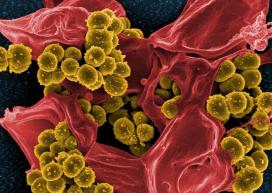
Contamination of the inanimate environment around patients constitutes an important reservoir of MRSA. Here we describe the effect of introducing a universal disinfection wipe in all wards on the rates of MRSA acquisitions and bacteraemias across a large UK teaching hospital.

Methods

A segmented Poisson regression model was used to detect any significant changes in the monthly numbers per 100,000 bed days of MRSA acquisitions and bacteraemias from April 2013 – December 2017 across QEHB.

Results

From April 2013 to April 2016, cleaning of ward areas and multi-use patient equipment by nursing staff consisted of a two-wipe system. Firstly, a detergent wipe was used, which was followed by a disinfection step using an alcohol wipe. In May 2016, QEHB discontinued the use of a two-wipe system for cleaning and changed to a one wipe system utilising a combined cleaning and disinfection wipe containing a quaternary ammonium compound. The segmented Poisson regression model demonstrated that the rate of MRSA acquisition/100,000 patient bed days was affected by the introduction of the new wiping regime (20.7 to 9.4 per 100,000 patient bed days; p <0.005).

Discussion

Using a Poisson model we demonstrated that the average hospital acquisition rate of MRSA/100,000 patient bed days reduced by 6.3% per month after the introduction of the new universal wipe.

Conclusion

We suggest that using a simple one wipe system for nurse cleaning is an effective strategy to reduce the spread and incidence of healthcare associated MRSA.

India – FSSAI issues guidance note on irradiated foods safety; busts myths around it

FNBNEWS

FSSAI has issued a guidance note on irradiated food titled Irradiated Food is Safe – Busting Myths Around It. It aims at making Food Business Operators (FBOs) understand the technological benefits, safety and wholesomeness of irradiated foods.

The note has detailed information on irradiation technology, its benefits, food irradiation facilities in India, public perception, commercial prospects in India and use of irradiation technology globally.


Irradiation is a physical process in which food commodities like bulk or pre-packaged are exposed to controlled doses of energy of ionising radiation such as gamma rays or X-rays to achieve different technological objectives.

The note stresses on the fact that radiation technology can be termed as one process with multiple uses. The application of food irradiation on the basis of dose requirements like low, medium and high can help in extension of shelf-life, destruction of storage and quarantine insect pests, and killing of parasites, pathogens and spoilage microorganisms.


In India, regulations on radiation processing have been notified under Food Safety and Standards (Food Products Standards and Food Additives) Amendment Regulations, 2016. Further, as per FSS (Food Products Packaging and Labelling) Regulations, 2011, irradiated products are labelled and can be identified with the ‘Radura’ logo in a typical label:


UK – Scots dog owners urged to check food now over Salmonella outbreak fears after traces of bacteria found in Just Natural products

The Scottish Sun Salmonella kswfoodworld

SCOTS dog owners have been urged to check their pooches’ food after a number of products were recalled when traces of salmonella were found.

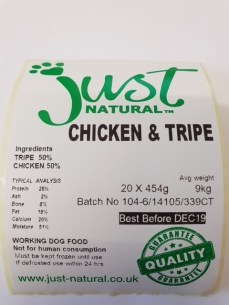
Avondale Pet Foods Ltd recalled Just Natural Chicken & Tripe as shoppers could unwittingly have bought the contaminated grub.

RASFF Alerts – Animal Feed – Salmonella – Fish Meal – Soybean Meal

RASFF-Logo

RASFF-Salmonella (presence /25g) in fish meal from the United States in Greece

RASFF-Salmonella enterica ser. Mbandaka (presence /25g) in soybean meal from Brazil in Belgium

New Zealand – Water at Christchurch’s Princess Margaret Hospital contaminated with E coli

STUFF ecoli

Staff, patients and visitors are unable to drink the water at a Christchurch hospital after it was found to be contaminated with E coli.

In an email to Princess Margaret Hospital staff on Sunday, the Canterbury District Health Board (CDHB) said people should avoid drinking the water until further notice.

“Everyone on the site should use bottled water where possible and do not use zips or plumbed in water coolers until further notice,” the email said.

CDHB chief of psychiatry Dr Peri Renison said on Monday evening the water supply had since tested negative for contaminants and no-one had been harmed.


Research – Pathogen predicament: How bacteria propel themselves out of a tight spot

Science Daily Salmonella kswfoodworld

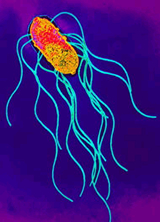
Scientists have deciphered how some types of ‘swimming’ bacteria have evolved to be able to escape when trapped in small spaces. The discovery could pave the way to finding new methods to stop the spread of certain bacteria, including species that cause food poisoning and stomach ulcers.

Many bacteria can swim, allowing them to seek out new sources of nutrients, or in the case of pathogenic bacteria, infect and spread.

Almost all swimming species of bacteria propel themselves forward using corkscrew-like propellers called “flagella.” Bacterial flagella are composed of thousands of protein building blocks arranged in spiralling chains.

A multidisciplinary team of scientists, including researchers from the University of York, has discovered that some types of bacteria have evolved complex flagella made up of many different types of proteins to enable them to manoeuvre themselves out of small spaces.

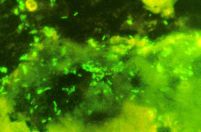
The scientists looked at a soil-dwelling species of bacteria called Shewanella putrefaciens and found that when they get stuck in a tight space their multi-component flagella buckle, wrapping around the cell bodies and allowing them to corkscrew free.

UK – Avondale Pet Foods Ltd recalls Just Natural Chicken & Tripe because Salmonella has been found in the product

FSA  Just_Chicken__Tripe

Avondale Pet Foods Ltd recalls Just Natural Chicken & Tripe because salmonella has been found in the product. This product has been sold in Scotland and England only.

Product details

Just Natural Chicken & Tripe

Pack size 20 x 454g and 8 x 1kg
Batch code 104-6/14105/339CT
Best before December 2019

No other Avondale Pet Foods Ltd products are known to be affected.


Food Standards Scotland

Risk: The presence of salmonella in the product listed above. Salmonella is a bacteria that can cause illness in humans and animals. The product could therefore carry a potential risk, because of the presence of salmonella, either through direct handling of the pet food, or indirectly, for example from pet feeding bowls, utensils or contact with the faeces of animals. In humans, symptoms caused by salmonella usually include fever, diarrhoea and abdominal cramps. Infected animals may not necessarily display signs of illness, but symptoms can include diarrhoea.

Our advice to consumers (pet owners):

When handling and serving raw pet food it is always advised to clean utensils and feeding bowls thoroughly after use. Consumers should wash hands thoroughly after handling raw pet food, bowls, utensils or after contact with the faeces of infected animals. Raw pet food should be stored separately from any food (especially ready to eat foods). Care should be taken when defrosting to avoid cross contamination of foods and surfaces. If you have bought any of the above product, return it to the store from where it was bought for a full refund.

Action taken by the company:  

Avondale Pet Foods Ltd is recalling the above product. Point of sale notices will be displayed in all retail stores that are selling this product. These notices explain to customers why the product is being recalled and tell them what to do if they have bought the product.

RASFF Alerts – Animal Feed – Salmonella – Dog Chews – Turkey Meat Meal

RASFF-Logo

RASFF-Salmonella enterica ser. Infantis (presence /25g) in dog chews from France, with raw material from Denmark, packaged in Germany in Germany

RASFF-Salmonella (presence /25g) and Salmonella enterica ser. Mbandaka (presence /25g) in turkey meat meal from Poland in Belgium

RASFF Alerts – Animal Feed – Aflatoxin – Gluten Corn

RASFF-Logo

RASFF-aflatoxins (B1 = 34 µg/kg – ppb) in gluten corn from China, via the Netherlands in Iceland

USA – Vibrio vulnificus in Florida in 2018

Outbreak News Today

CDC Vibrio

Florida state health officials have reported 39 Vibrio vulnificus cases through Dec. 14, down from last year’s total of 50. Of this total, nine fatalities have been reported.

Lee County saw the most with four cases, while nine counties reported two cases each. Deaths were reported from Hillsborough (2), Dade, Indian River, Jackson, Okaloosa, Sarasota, Volusia and Walton counties.

People can get infected with Vibrio vulnificus when they eat raw shellfish, particularly oysters. The bacterium is frequently isolated from oysters and other shellfish in warm coastal waters during the summer months. Since it is naturally found in warm marine waters, people with open wounds can be exposed to Vibrio vulnificus through direct contact with seawater. There is no evidence of person-to-person transmission of Vibrio vulnificus.

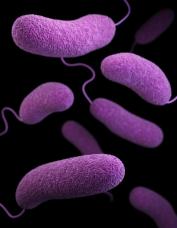
Vibrio vulnificus can cause disease in those who eat contaminated seafood or have an open wound that is exposed to warm seawater containing the bacteria. Ingestion of Vibrio vulnificus can cause vomiting, diarrhea and abdominal pain. Vibrio vulnificus can also cause an infection of the skin when open wounds are exposed to warm seawater; these infections may lead to skin breakdown and ulcers.