Category Archives: Microbiology

Research – 166 sick: Over half under 5 from Salmonella in pet bearded dragons

barf Blog 

We investigated an outbreak of human Salmonella infections resulting from serotypes Cotham and Kisarawe, predominately occurring among children. An outbreak of illnesses was identified in persons with exposure to pet bearded dragon lizards. Human and animal health officials, in cooperation with the pet industry, conducted epidemiologic, traceback and laboratory investigations. Onsite sampling was conducted at two US breeding facilities, one foreign breeding facility, and a large pet retail chain. A total of 166 patients in 36 states were identified with illness onset dates from 02/2012-06/2014. The median patient age was 3 years (range, <1-79 years), 57% were aged ≤5 years, and 37% were aged ≤1 year. Forty-four patients (37%) were hospitalized, predominantly children. Sampling at breeding facilities and a national pet store chain resulted in isolation of outbreak serotypes at each facility; isolation proportions ranged from 2%-24% of samples collected at each facility.
Research – Tips For Handling Flour Safely to Avoid Food Poisoning

Food Poisoning Bulletin

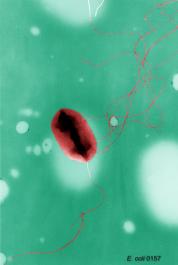
kswfoodworld E.coli O157

Image CDC


When an E. coli O157:H7 outbreak in 2009 was linked to the flour used in prepackaged cookie dough, many people were shocked. How could flour, which seems so innocuous, actually be contaminated with such a serious pathogen? Flour is dry. It seems inert and safe. But flour is a raw agricultural product, and can be contaminated with pathogens just like romaine lettuce. Learn some tips for handling flour safely to avoid food poisoning.

Europe – Large E. coli increase recorded for Europe in 2018

Food Safety News

The Shiga toxin-producing E. coli infection rate in Europe jumped by 40 percent in 2018 compared to the previous year, based on data from ECDC’s annual surveillance report.

After a stable period from 2014 to 2017, the rate increased by 41 percent in 2018. This made STEC the third most common zoonosis in Europe after Campylobacter and Salmonella.

A contributing factor may be the shift from culture to culture-independent diagnostic methods, with PCR more commonly used to diagnose cases, according to the European Centre for Disease Prevention and Control (ECDC).

STEC infection is mainly acquired through eating contaminated food and contact with animals and/or their feces. Adequate cooking of food, particularly beef, and use of pasteurized milk may reduce the risk of foodborne infections, added the agency.

Australia – The Kimchi Company — Kimchi Company Kimchi 300g and 600g

FSANZ

Photograph of Kimchi Company Kimchi 600g and 300g

Identifying features

Other
APN/EAN: 300g – 8809089 420158 and 600g – 8809089 420141

What are the defects?

The recall is due to potential microbial contamination due to under allocation of salt.

What are the hazards?

Food products with microbial contamination may cause illness if consumed.

What should consumers do?

Any consumers concerned about their health should seek medical advice and should return the products to the place of purchase for a full refund.

For further information, please contact The Kimchi Company Pty Ltd on 0449 051 894 or visit www.kimchicompany.com.au

Traders who sold this product

Harris Farm Markets in NSW

Where the product was sold
New South Wales
Dates available for sale
  • 23 April 2020 – 28 April 2020

Recall advertisements and supporting documentation

USA – Preliminary Incidence and Trends of Infections with Pathogens Transmitted Commonly Through Food — Foodborne Diseases Active Surveillance Network, 10 U.S. Sites, 2016–2019

CDC

Summary

What is already known about this topic?

The incidence of most infections transmitted commonly through food has not declined for many years.

What is added by this report?

Incidence of infections caused by ListeriaSalmonella, and Shigella remained unchanged, and those caused by all other pathogens reported to FoodNet increased during 2019. Infections caused by Salmonella serotype Enteritidis, did not decline; however, serotype Typhimurium infections continued to decline.

What are the implications for public health practice?

New strategies that target particular serotypes and more widespread implementation of known prevention measures are needed to reduce Salmonella illnesses. Reductions in Salmonella serotype Typhimurium suggest that targeted interventions (e.g., vaccinating chickens and other food animals) might decrease human infections. Isolates are needed to subtype bacteria so that sources of illnesses can be determined.

Research- Data shows connection between unpasteurized milk and infections

Food Safety News 

After reviewing details of brucellosis illnesses from recent years, including a 19-state outbreak, researchers are saying their findings show a link between raw milk and such infections.

Although the researchers did not name the dairy farm associated with the multistate  outbreak, the CDC and the FDA investigated the those illnesses, which occurred during the period reviewed by the research team and were connected to raw milk from Miller’s Biodiversity Farm in Pennsylvania.

Information about the researchers’ work was published recently in the Morbidity and Mortality Weekly Report, which is posted by the U.S. Centers for Disease Control and Prevention. The group of researchers, made up of people from the CDC and a number of states’ agencies, says additional study is needed regarding the emerging health dangers of consuming raw milk.

Research – Offspring may inherit legacy of their father’s Toxoplasma infection

Science Daily Toxoplas

Australian researchers have revealed for the first time that males infected with the Toxoplasma parasite can impact their offspring’s brain health and behaviour.

Studying mice infected with the common parasite Toxoplasma, the team discovered that sperm of infected fathers carried an altered ‘epigenetic’ signature which impacted the brains of resulting offspring. Molecules in the sperm called ‘small RNA’ appeared to influence the offspring’s brain development and behaviour.

‘Intergenerational inheritance’ of similar epigenetic changes from men exposed to extreme trauma has been well documented. This latest research, published in Cell Reports, has raised the question of whether Toxoplasma infections — or even possibly other infections — in men before conception could impact the health of subsequent generations.

The research was led by Walter and Eliza Hall Institute researchers Dr Shiraz Tyebji and Associate Professor Chris Tonkin, in collaboration with Professor Anthony Hannan at the Florey Institute of Neuroscience and Mental Health

Research – Increased thermal tolerance in Cronobacter sakazakii strains in reconstituted milk powder due to cross protection by physiological stresses

Wiley Online 

Cronobacter sakazakii (C. sakazakii) is an opportunistic, neonatal, and food borne pathogen primarily associated with the contamination of powdered infant formula (PIF). The pathogen is reported to overcome the food safety barriers such as increased acidity, heat treatment, and so on. This study evaluates the thermal tolerance of C. sakazakii strains independently at 52, 55, and 58°C in reconstituted PIF after exposure to physiological stresses: refrigeration (4°C for 24 hr), starvation (37°C for 48 hr), and desiccation (25°C for 4 days). The Log10 CFU/ml and D‐values indicated that survival rate of all the strains decreased significantly (p < .05) after desiccation as compared to those of the control condition (without stress exposure). However, cold stress increased the thermal tolerance of all strains at all temperatures (52, 55, and 58°C) as indicated by increased D‐values. Among the tested strains, C. sakazakii strain N15 was found to be the most resistant to thermal treatment after each stress exposure as depicted by principal component analysis (PCA). No apparent correlation between thermal tolerance and starvation stress was observed. The findings indicate that prior exposure to stress conditions may induce cross protection to thermal treatment in C. sakazakii.

Research – New insight into bacterial structure to help fight against superbugs

Science Daily

Scientists from the University of Sheffield have produced the first high-resolution images of the structure of the cell wall of bacteria, in a study that could further understanding of antimicrobial resistance.

The research, published in Nature, revealed a new and unexpected structure of the outer bacterial layers of the bacterium Staphylococcus aureus.

The findings set a new framework for understanding how bacteria grow and how antibiotics work, overturning previous theories about the structure of the outer bacterial layers.

The images give unprecedented insight into the composition of the bacterial cell wall and will inform new approaches to developing antibiotics in order to combat antibiotic resistance. There are no other examples of studies of the cell wall in any organism at comparable resolution, down to the molecular scale.

Laia Pasquina Lemonche, a PhD Researcher from the University of Sheffield’s Department of Physics and Astronomy, said: “Many antibiotics work by inhibiting the bacteria’s production of a cell wall, a strong but permeable skin around the bacteria which is critical for its survival.

Research – Slovenian study reveals low levels of C. difficile in food

Food Safety News Clost

Researchers in Slovenia have described results from a long-term, national Clostridioides difficile food surveillance project. Positive results were found in meat, fresh produce and poultry.

The three-year period of testing revealed a low proportion of Clostridioides — formerly Clostridium — difficile contaminated food and high genotype variability. As the risk of infection associated with Clostridioides difficile contaminated food is unknown, no measures were recommended for positive results.

Because of an increasing association between Clostridioides difficile and food, in 2015, the Administration of the Republic of Slovenia for Food Safety, Veterinary Sector and Plant Protection (UVHVVR) included it in national food surveillance. In Slovenia, the number of cases increased from 316 in 2013 to 665 in 2017.

Retail minced meat and meat preparations such as beef, pork and poultry were sampled from 2015 to 2017. They were collected at food markets and grocery stores in all Slovenian regions. Selected raw retail vegetables, leaf salads and root vegetables, and ready-to-eat salads were sampled during 2016 and 2017 and seafood only in 2017.