Category Archives: Microbial Spoilage

Czech Republic – BILLA Schwarzwälder Schinken – Microbial Activity

Potravinynapranyri

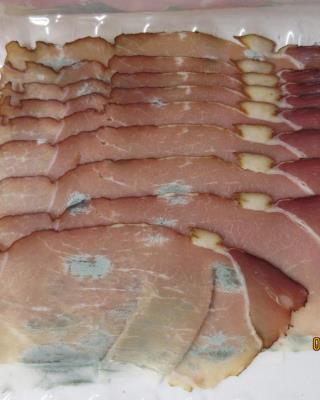
Illustrative photo #3

Place of inspection:
Brno ( Kounicova 966/67a, 602 00 Brno )
ID: 00685976
Food group: Meat and meat products Durable fermented products

BILLA Schwarzwälder Schinken
Category: Dangerous foods
Invalid parameter:

changes caused by microbial activity

Some of the packaging was found to contain mold visible to the naked eye. Food is not considered safe if it shows signs of spoilage.

Unsuitable storage temperatures of this product were not detected during the inspection. The food did not have an expiration date.

Expiration date: 28/02/2024
Packaging: 5 PP
Quantity of the product in the package: 0.1 kg
Manufacturer: MADE FOR: BILLA, spol. sro, Modletice 67, 251 01 Říčany u Prahy, Czech Republic
Date of sample collection: 2/5/2024
Reference number: 24-000152-SZPI-CZ
The sample was detected by the official control of the State Agricultural and Food Inspection.

Research – Leveraging Plasma-Activated Seawater for the Control of Human Norovirus and Bacterial Pathogens in Shellfish Depuration

MDPI

Abstract

Cold plasma is a promising alternative for water treatment owing to pathogen control and a plethora of issues in the agriculture and food sectors. Shellfish pose a serious risk to public health and are linked to large viral and bacterial outbreaks. Hence, current European regulations mandate a depuration step for shellfish on the basis of their geographical growth area. This study investigated the inactivation of relevant viral and bacterial pathogens of three plasma-activated seawaters (PASWs), and their reactive oxygen and nitrogen species (RONS) composition, as being primarily responsible for microbial inactivation. Specifically, F-specific (MS2) and somatic (φ174) bacteriophage, cultivable surrogate (murine norovirus, MNV, and Tulane virus, TV), and human norovirus (HuNoV GII.4) inactivation was determined using plaque counts and infectivity assays, including the novel human intestinal enteroid (HIE) model for HuNoV. Moreover, the kinetic decay of Escherichia coli, Salmonella spp., and Vibrio parahaemolyticus was characterized. The results showed the complete inactivation of phages (6–8 log), surrogates (5–6 log), HuNoV (6 log), and bacterial (6–7 log) pathogens within 24 h while preventing cytotoxicity effects and preserving mussel viability. Nitrites (NO2) were found to be mostly correlated with microbial decay. This research shows that PASWs are a suitable option to depurate bivalve mollusks and control the biohazard risk linked to their microbiological contamination, either viral or bacterial.

Research – Outbreaks hit record high in France in 2022

Food Poison Journal

France reported a record high number of foodborne outbreaks in 2022, according to recently released data.

Notified outbreaks were at their highest since the start of surveillance in 1987 and continued the upward trend observed before the COVID-19 pandemic.

In 2022, 1,924 outbreaks were declared, affecting 16,763 people, of whom 643 went to hospital, and 17 died, said Santé publique France.

For 376 outbreaks, a pathogen could be confirmed in the food or in at least one sick person. A pathogen was suspected without microbiological confirmation for 1,260 outbreaks. For 288 outbreaks, no infectious agent was identified or suspected.

Italy – VITEL TONNE – slices of cooked adult bovine meat in tuna sauce- Microbiological Risk

Salute

Brand : Gianni Negrini srl

Name : VITEL TONNE – slices of cooked adult bovine meat in tuna sauce

Reason for reporting : Recall due to microbiological risk

Publication date : 16 February 2024

Documentation

Documentation

Research – Tomato juice’s antimicrobial properties can kill Salmonella

Science Daily

Tomato juice can kill Salmonella Typhi and other bacteria that can harm people’s digestive and urinary tract health, according to research published this week in Microbiology Spectrum, a journal of the American Society for Microbiology. Salmonella Typhi is a deadly human-specific pathogen that causes typhoid fever.

“Our main goal in this study was to find out if tomato and tomato juice can kill enteric pathogens, including Salmonella Typhi, and if so, what qualities they have that make them work,” said principal study investigator Jeongmin Song, Ph.D., Associate Professor, Department of Microbiology & Immunology, Cornell University.

Research – The Investigation of Changes in Bacterial Community of Pasteurized Milk during Cold Storage

MDPI

Abstract

The quality of pasteurized milk is commonly assessed through microbiological analysis, with variations in storage conditions significantly impacting the suppression of bacterial growth throughout the milk’s shelf life. This study investigated the dynamics of total bacterial counts (TBCs) and bacterial community shifts in milk that underwent pasteurization at 80 °C for 15 s. The milk was subsequently stored at 4 °C for varying intervals of 1, 4, 7, 10, 13, and 16 days. Culture-based testing revealed a significant TBC increase during the storage period spanning 1 to 16 days (up to −log10 4.2 CFU/mL at day 16). The TBC in pasteurized milk exhibited accelerated microbial growth from day 13 onwards, ultimately peaking on day 16. Bacillus was detected through 16S rRNA identification. Principal component analysis demonstrated a significant impact of storage time on bacterial communities in pasteurized milk. Analysis of bacterial diversity revealed a negative correlation between the Shannon index and the duration of pasteurized milk storage. Using high-throughput sequencing, Streptococcus and Acinetobacter were detected as prevalent bacterial genera, with Streptococcus dysgalactiae and Streptococcus uberis showing as dominant taxa. The presence of Streptococcus dysgalactiae and Streptococcus uberis in pasteurized milk might be attributed to the initial contamination from raw milk with mastitis. This study offers new evidence of the prevalence of bacterial community in pasteurized milk, thereby adding value to the enhancement of quality control and the development of strategies for reducing microbial risks.

Research – Efficiency of Electronic Nose in Detecting the Microbial Spoilage of Fresh Sardines (Sardinella longiceps)

MDPI

Abstract

The assessment of microbial spoilage in fresh fish is a major concern for the fish industry. This study aimed to evaluate the efficiency and reliability of an electronic nose (E-nose) to detect microbial spoilage of fresh sardines (Sardinella longiceps) by comparing its measurements with Total Bacterial Count (TBC), Hydrogen Sulfide (H2S) producing bacterial count and Trimethylamine Oxide (TMAO) reducing bacterial count after variable storage conditions. The samples were stored at 0 °C (0, 2, 4, 6, and 8 days) and 25 °C (0, 3, 6, and 9 h), while day 0 was used as a control. The E-nose measurements were analyzed by Principal Component Analysis (PCA), Linear Discriminant Analysis (LDA) and Artificial Neural Network (ANN). Microbial counts increased significantly and simultaneously with the changes in E-nose measurements during storage. The LDA and ANN showed a good classification of E-nose data for different storage times at two storage temperatures (0 °C and 25 °C) compared to PCA. It is expected as PCA is based on linear relationships between the factors, while ANN is based on non-linear relationships. Correlation coefficients between E-nose and TBC, TMAO-reducing bacterial and H2S-producing bacterial counts at 0 °C were 0.919, 0.960 and 0.915, respectively, whereas at 25 °C, the correlation coefficients were 0.859, 0.945 and 0.849, respectively. These positive correlations qualify the E-nose as an efficient and reliable device for detecting microbial spoilage of fish during storage.

Risk ranking of foodborne diseases in Denmark: Reflections on a national burden of disease study

Science Direct

Abstract

National burden of foodborne disease (FBD) studies are useful for risk ranking and identifying priorities for food safety resource allocation. FBD are caused by microbiological and chemical hazards, which have different incidence and mortality, and lead to health-outcomes varying in severity and duration. Due to their different origins and characteristics, distinct prevention strategies can be implemented. We present the Danish initiative to estimate the burden of FBD caused by pathogens and chemicals. We describe the methodological approaches and data used, present an overview of results for the reference year 2019, and discuss lessons learned throughout more than seven years of the project. Our estimates show that the leading causes of FBD in Denmark include both pathogens and chemicals, suggesting that food safety strategies should be diversified to tackle different issues. The experiences with this national study are useful for other countries planning to implement a burden of FBD study.

Italy – Potential product spoilage as a result of an isolated production event – Glucerna Select 1.5

Salute

Brand : Glucerna

Name : Glucerna Select 1.5

Reason for reporting : Recall due to microbiological risk

Publication date : 30 January 2024

Documentation

Documentation

Research – Inhibition of Food-Borne Pathogen Growth and Biogenic Amine Synthesis by Spice Extracts

MDPI

Food-borne pathogens and their toxins cause significant health problems in humans. Formation of biogenic amines (BAs) produced by microbial decarboxylation of amino acids in food is undesirable because it can induce toxic effects in consumers. Therefore, it is crucial to investigate the effects of natural additives with high bioactivity like spice extracts to inhibit the growth of these bacteria and the formation of BAs in food. In the present study, the antibacterial effects of diethyl ether spice (sumac, cumin, black pepper, and red pepper) extracts at doses of 1% (w/v) on Gram-positive (Staphylococcus aureus and Enterococcus faecalis) and Gram-negative (Klebsiella pneumoniaePseudomonas aeruginosaCampylobacter jejuniAeromonas hydrophilaSalmonella Paratyphi A, and Yersinia enterocolitica) food-borne pathogen bacterial strains (FBP) were established. In addition, the accumulation of ammonia (AMN), trimethylamine (TMA), and biogenic amines (BAs) in tyrosine decarboxylase broth (TDB) was investigated by using high performance liquid chromatography (HPLC). Sumac extract exhibited the highest antibacterial potential against all FBPs, followed by cumin and peppers. AMN (570.71 mg/L) and TMA (53.66 mg/L) production were strongly inhibited by sumac extract in the levels of 55.10 mg/L for Y. enterocolitica and 2.76 mg/L for A. hydrophila, respectively. With the exception of S. aureus, black pepper dramatically reduced the synthesis of putrescine, serotonin, dopamine, and agmatine by FBP especially for Gram-negative ones. Furthermore, sumac extracts inhibited histamine and tyramine production by the majority of FBP. This research suggests the application of sumac extracts as natural preservatives for inhibiting the growth of FBPs and limiting the production of AMN, TMA, and BAs.