Category Archives: Listeria innocua

Information – Listeria, a deadly foodborne pathogen

Food Poison Journal

kswfoodworld

The deadliest foodborne pathogen in terms of fatality rates is often considered to be *Listeria monocytogenes*. While infections from Listeria are less common compared to other pathogens like Salmonella or E. coli, the consequences can be much more severe, especially for certain high-risk populations. Read more at  the link above.

Research – Innovative Hurdle Strategies for Listeria Control on Food-Contact Surfaces: A Peroxyacetic Acid–Steam Approach

MDPI

Abstract

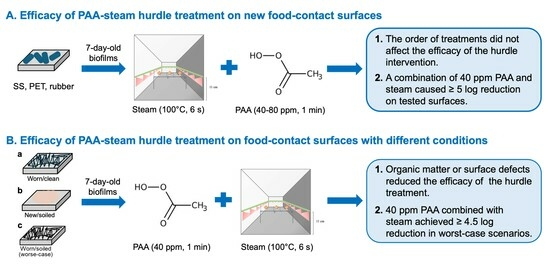
The persistence of Listeria monocytogenes biofilms on equipment surfaces poses a significant risk of cross-contamination, necessitating effective surface decontamination strategies. This study assessed the effectiveness of hurdle treatments combining peroxyacetic acid (PAA) and saturated steam against 7-day-old L. innocua (a non-pathogenic surrogate for L. monocytogenes) biofilms on stainless steel (SS), polyester (PET), and rubber surfaces. Results demonstrated >6 log10 CFU/coupon L. innocua reductions on SS and PET surfaces after PAA (40 ppm, 1 min) followed by steam treatment (100 °C, 6 s). On rubber surfaces, PAA (80 ppm, 1 min) followed by steam treatment (100 °C, 6 s) resulted in ~5 log10 CFU/coupon L. innocua reduction. The presence of apple juice soil reduced the efficacy of hurdle treatments, with PAA (40 ppm, 1 min) and steam exposure (6 s) resulting in 5.6, 5.8, and 4.2 log10 CFU/coupon reductions of L. innocua on SS, PET, and rubber, respectively. The efficacy of this antimicrobial combination was further reduced by surface defects, especially in the presence of organic matter. Nevertheless, the treatment still achieved >5 log10 CFU/coupon reductions of L. innocua on worn SS and PET soiled with apple juice and ~4.5 log10 CFU/coupon reduction on worn, soiled rubber surfaces. These findings highlight that PAA treatments followed by a brief steam exposure are effective strategies for controlling Listeria on food-contact surfaces.

Research – Analysis of Alternative Methods of Environmental Monitoring for Listeria in Food Production Facilities

Science Direct

Abstract

Validated alternative test methodologies may be used in place of culture-based methods recommended for environmental monitoring programs (EMPs) for Listeria in food production facilities. In order to help guide decisions on which testing method to use to simplify Listeria EMP implementation in food production facilities, alternative methods were compared to the culture-based method in actual EMPs for Listeria. Seventy-two samples collected from two facilities of souzai production businesses that use meat and meat products as ingredients, one facility of processed meat product production business, and one facility of processed meat product and souzai production business were applied to EMPs for Listeria using the culture-based method, 3MTM Molecular Detection System (MDS), and InSite L. mono Glo (InSite). The kappa coefficient in MDS was 0.65 for Listeria monocytogenes and 0.74 for Listeria spp., both of which were deemed substantial compared with the culture-based method. The kappa coefficient in InSite was −0.01 for L. monocytogenes and 0.50 for Listeria spp., which indicated poor and moderate reproducibility, respectively. When the medium of InSite was smeared on agar medium, 7 of the 19 samples tested positive only for Listeria spp. (negative for L. monocytogenes) but L. monocytogenes was cultured, indicating that the sensitivity of detecting L. monocytogenes via fluorescence may be low. MDS was considered a useful alternative for both L. monocytogenes and Listeria spp. as targets, and InSite was not possible as a substitute for detecting L. monocytogenes; however, it is considered a helpful alternative method for detecting Listeria spp. EMPs for Listeria often target Listeria spp. as an indicator of L. monocytogenes. The alternative methods studied in this study are rapid, simple, and useful in EMPs for Listeria. However, the data in this study were a comparatively small sample set and impacted by variability, so more robust comparisons are desirable in the future.

Research – Application of Ultrasound Treatments in the Processing and Production of High-Quality and Safe-to-Drink Kiwi Juice

MDPI

Abstract

This study explores the potential of thermosonication as an alternative to traditional heat treatments, such as pasteurization, in the processing of fruit juices. Conventional methods often lead to undesirable quality changes in fruit juices, whereas thermosonication offers promising results regarding microbial inactivation and quality preservation. This work focused on the inactivation kinetics of Listeria innocua 2030c, a surrogate for pathogenic L. monocytogenes, in kiwifruit juice using thermosonication at 45 °C, 50 °C, and 55 °C. These treatments were compared with equivalent heat treatments. Quality attributes of the juice were also evaluated to assess process efficiency. Survival data of L. innocua were fitted with the Weibull model, estimating first decimal reduction times (δ) and shape parameters (n). The results reveal temperature and process dependencies on δ, while n remains mostly temperature and treatment independent. Thermosonication outperforms heat treatment, achieving higher L. innocua reductions while retaining quality attributes like pH, soluble solid content, and total phenolics and chlorophylls. Thermosonication at 55 °C stands out, providing a 6.2-log-cycle reduction in just 3 min with superior quality retention. These findings highlight the synergistic effect of temperature and ultrasound, making mild heat processes feasible while enhancing product quality. Thermosonication, particularly at 55 °C, emerges as an effective alternative to traditional thermal treatments for fruit juices, offering improved microbial safety without compromising product quality.

EFSA – Story map on Listeria monocytogenes

EFSA

Listeria bacteria are widespread in the environment and they are worldwide commonly found in soil and water, as well as in animal digestive tracts. There are more than 15  species  of bacteria in this genus, but human cases of Listeria infection are almost always caused by Listeria monocytogenes (L. monocytogenes) while Listeria ivanovii is pathogenic in animals but rarely in humans. The other species are not considered to be pathogenic in humans or animals.

L. monocytogenes are able to form communities of bacteria called biofilms and are therefore resistant to a wide range of stresses. This capacity varies among  genotypes . They can tolerate acidic, dry and salty conditions, in the presence or absence of oxygen. Moreover, unlike most pathogenic bacteria, they are able to survive and multiply in refrigerated foods, making ready-to-eat foods of particular concern.

Research – Combining High-Pressure Processing and Supercritical Carbon Dioxide for Inactivation of Listeria innocua

MDPI

Abstract

The effect of high-pressure treatment with supercritical CO2 on the inactivation of Listeria innocua in a fish soup was investigated. The soup was inoculated with L. innocua, packaged in modified atmosphere with 50:50 or 95:5 CO2:N2, high-pressure processed (300, 350, 400 and 600 MPa, 2 min) under subcritical (T < 304 K) or supercritical conditions (T > 304 K) and stored at 4 °C for up to 53 days. Treatment at 400 and 600 MPa had a significant (p < 0.05) effect on L. innocua under both supercritical and subcritical conditions. In contrast, pressurization at 350 MPa and supercritical conditions were needed to significantly (p < 0.05) inactive L. innocua. Increased levels of CO2 in the headspace significantly (p < 0.05) reduced the bacterial load during processing, and supercritical conditions had a significant (p < 0.01) interaction with both CO2 levels and pressure. Increased storage time gave significantly increased levels of L. innocua at 400 and 600 MPa. In addition, high levels of CO2 significantly decreased (p < 0.001) growth. However, 350 MPa under supercritical conditions seemed to set the L. innocua in a permanent lag phase, with slow and steadily decreasing numbers of bacteria during storage. All the design variables resulted in significant inactivation of L. innocua, and supercritical conditions combined with high levels of CO2 inhibited the recovery of L. innocua to a large degree.

Research – The efficacy of preharvest application of electrolyzed water and chemical sanitizers against foodborne pathogen surrogates on leafy green vegetables


Wiley Online

Abstract

Preharvest control strategies, to reduce or eliminate pathogenic bacteria in leafy vegetables that may be consumed raw, may provide additional food safety protection and shelf life quality extension beyond what is possible to achieve with postharvest sanitation alone. The aim of this study was to characterize the efficacy and effect of contact time of electrolyzed water (e-water), 1-bromo-3-chloro-5-dimethylhydantoin (BCDMH), and peracetic acid (PAA) at 80 and 150 ppm against pathogen surrogates Escherichia coli M23 (E. coli M23)and Listeria innocua ATCC 33090 (L. innocua), and a representative spoilage microorganism Pseudomonas fluorescens (P. fluorescens) on leafy green vegetables (LGV) mizuna, rocket (arugula), and red chard. Each of the leafy vegetables has a distinctly different leaf architectures that could alter the effectiveness of preharvest sanitation treatments. e-Water, BCDMH and PAA were equally effective in inactivating plant total viable count, E. coli M23, L. innocua and P. fluorescens (reduction compared to water control—0.5–4.0 log CFU/g). On average an additional 0.8 (0.4–1.1) log CFU/g inactivation was obtained by increasing sanitizer contact time from 30 min to 2 h, whereas increasing sanitizer concentrations produced, at maximum, an extra 0.5 log CFU/g inactivation. These findings suggest that e-water, BCDMH, and PAA are all useful for in-field preharvest application on a wide range of plants and increasing contact time rather than concentration improves sanitation efficacy.


Research – High-Pressure-Induced Sublethal Injuries of Food Pathogens—Microscopic Assessment

MDPI

High Hydrostatic Pressure (HHP) technology is considered an alternative method of food preservation. Nevertheless, the current dogma is that HHP might be insufficient to preserve food lastingly against some pathogens. Incompletely damaged cells can resuscitate under favorable conditions, and they may proliferate in food during storage. This study was undertaken to characterize the extent of sublethal injuries induced by HHP (300–500 MPa) on Escherichia coli and Listeria innocua strains. The morphological changes were evaluated using microscopy methods such as Scanning Electron Microscopy (SEM), Transmission Electron Microscopy (TEM), and Epifluorescence Microscopy (EFM). The overall assessment of the physiological state of tested bacteria through TEM and SEM showed that the action of pressure on the structure of the bacterial membrane was almost minor or unnoticeable, beyond the L. innocua wild-type strain. However, alterations were observed in subcellular structures such as the cytoplasm and nucleoid for both L. innocua and E. coli strains. More significant changes after the HHP of internal structures were reported in the case of wild-type strains isolated from raw juice. Extreme condensation of the cytoplasm was observed, while the outline of cells was intact. The percentage ratio between alive and injured cells in the population was assessed by fluorescent microscopy. The results of HHP-treated samples showed a heterogeneous population, and red cell aggregates were observed. The percentage ratio of live and dead cells (L/D) in the L. innocua collection strain population was higher than in the case of the wild-type strain (69%/31% and 55%/45%, respectively). In turn, E. coli populations were characterized with a similar L/D ratio. Half of the cells in the populations were distinguished as visibly fluorescing red. The results obtained in this study confirmed sublethal HHP reaction on pathogens cells. View Full-Text

Research – Strategies for Nitrite Replacement in Fermented Sausages and Effect of High Pressure Processing against Salmonella spp. and Listeria innocua

MDPI

The development of nitrite-free meat products is a current industrial concern. Many efforts have been attempted to replace the nitrite effect in cured meats colour formation and pathogens control. Our previous work evidenced that lactic acid and a cold ripening were the best hurdle technologies for nitrite-free fermented sausages from metabolomics. In the first part of this work, we investigated the effect of lactic acid compared with both two alternative additives (glucono-D-lactone and a mix of sodium di-acetate/sodium lactate) and with low-nitrite sausages, all of them following either cold or traditional ripening. For this purpose, microbiological analysis, pH, water activity (aw), and a sensory study were performed. All nitrite-free sausages (cold or traditional ripened) showed quality and safety traits similar to low-nitrite traditionally ripened ones used as control. In addition, sensory study revealed that sausages with lactic acid were the most preferred cold ripened samples, supporting that this is an optimal strategy for the production of nitrite-free sausages. We selected this product for further studies. Indeed, in the second part, we evaluated the impact of ripening, and other hurdle technologies as High Pressure Processing (HPP) and under-vacuum storage against Listeria innocua and Salmonella spp. by a challenge test. Maximal declines were obtained for ripening along with HPP (i.e., 4.74 and 3.83 log CFU/g for L. innocua and Salmonella spp., respectively), suggesting that HPP might guarantee nitrite-free sausages safety. Although the quality of raw materials remains essential, these hurdle strategies largely contributed to nitrite-free sausages safety, offering a promising tool for the meat industry.

Research – Survival of Escherichia coli and Listeria innocua on Lettuce after Irrigation with Contaminated Water in a Temperate Climate

MDPI

Microbial disease outbreaks related to fresh produce consumption, including leafy green vegetables, have increased in recent years. Where contamination occurs, pathogen persistence may represent a risk for consumers’ health. This study analysed the survival of E. coli and L. innocua on lettuce plants watered with contaminated irrigation water via a single irrigation event and within stored irrigation water. Separate lettuce plants (Lactuca sativa var. capitata) were irrigated with water spiked with Log10 7 cfu/mL of each of the two strains and survival assessed via direct enumeration, enrichment and qPCR. In parallel, individual 20 L water microcosms were spiked with Log10 7 cfu/mL of the individual strains and sampled at similar time points. Both strains were observed to survive on lettuce plants up to 28 days after inoculation. Direct quantification by culture methods showed a Log10 4 decrease in the concentration of E. coli 14 days after inoculation, and a Log10 3 decrease in the concentration of L. innocua 10 days after inoculation. E. coli was detected in water samples up to 7 days after inoculation and L. innocua was detected up to 28 days by direct enumeration. Both strains were recovered from enriched samples up to 28 days after inoculation. These results demonstrate that E. coli and L. innocua strains are able to persist on lettuce after a single contamination event up until the plants reach a harvestable state. Furthermore, the persistence of E. coli and L. innocua in water for up to 28 days after inoculation illustrates the potential for multiple plant contamination events from stored irrigation water, emphasising the importance of ensuring that irrigation water is of a high quality. View Full-Text