Category Archives: Foodborne Illness

Canada – Salmonella Found in Caterers Products

Food Poisoning Bulletin 

According to CBC News, Salmonella was found in ground beef and Halal chicken samples from The Lunch Lady Catering service in Ottawa, Canada.

This links the caterer to the Salmonella outbreak that has sickened 50 people. One dozen schools and a day care center have been the epicenter of the outbreak.

Salmonella Typhimurium was found in frozen uncooked ground beef, and Salmonella Heidelberg was found in raw Halal chicken.

California Announces Raw Milk Recall – Campylobacter

Campy Blog

The California Department of Food and Agriculture (CDFA) today announced a recallof “raw milk, raw nonfat milk and raw cream produced by Claravale Farm of San Benito County.”

The action was based on results of testing that revealed the presence of Campylobacter bacteria in the company’s raw cream.


US – Update – E. coli O157:H7 Outbreak

BM Blog

The CDC reports as of March 21, 2012, 58 persons infected with the outbreak strain of E. coli O157:H7 were reported from 9 states. The number of ill persons identified in each state was as follows: Arizona (1), Arkansas (2), Illinois (9), Indiana (2), Kansas (2), Kentucky (1), Minnesota (2), Missouri (38), and Nebraska (1). Two cases were removed from the case count because advanced molecular testing determined that they were not related to this outbreak strain. Among persons for whom information was available, illnesses began from October 9, 2011 to November 7, 2011. Ill persons ranged in age from 1 to 94 years, with a median age of 28 years. Fifty-nine percent were female. Among the 49 ill persons with available information, 33 (67%) were hospitalized, and 3 developed hemolytic uremic syndrome (HUS). No deaths were reported

US – Salmonella Outbreak Live Chicks

Food Poisoning Bulletin

Are you thinking of getting some chicks so you can produce your own eggs? Have the recalls of eggs from Daizen Farms, Michael Foods Inc., and the huge outbreak of foodborne illness from Wright County Eggs in 2010have you forgoing eggs at the grocery store?

Your own hatchery may not be the answer. The CDC just released a study of an outbreak of Salmonella Altona and Salmonella Johannesburg infections linked to chicks and ducklings from a mail order hatchery last year.

Two clusters of human Salmonella infections from baby chicks were identified in 2011 through pulsed field gel electrophoresis (PFGE). From February 25, 2011 to October 10, 2011, 68 cases of Salmonella Altona and 17 cases of Salmonella Johannesburg had contact with live poultry the week before their illness developed

Texas Firm Recalls Beef Sausage Products Due To Possible Listeria Contamination

USDA 

WASHINGTON, March 21, 2012 – Southside Market & BBQ, an Elgin, Texas establishment, is recalling approximately 2,373 pounds of ready-to-eat beef sausage products that may have been contaminated with Listeria monocytogenes, the U.S. Department of Agriculture’s Food Safety and Inspection Service (FSIS) announced today.

The following products are subject to recall:

  • 16 oz. packages of “Southside Market & BBQ Original Beef Sausage,” Lot # 065-E
  • 16 oz. and 48 oz. packages of “Southside Market & BBQ Original Beef Sausage,” Lot #’s 065-A, 065-B, 065-C, and 065-D
  • 16 oz. packages of “Southside Market & BBQ 1882 Hot Recipe Beef Sausage,” Lot # 065-D

FSIS and the company have received no reports of illness due to consumption of these products. Anyone concerned about an illness should contact a health care provider.

US – Hens Fed on Salmonella Contaminated Feed – Rat Droppings

Washington State 

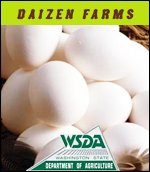
OLYMPIA — The Washington State Department of Agriculture (WSDA) recommends against eating any eggs produced by Daizen Farms of Burlington, WA. The eggs were produced by hens that ate feed contaminated with rodent droppings. Laboratory testing confirms that the feed contained Salmonella.

The eggs were also packaged under insanitary conditions on the farm. WSDA inspectors observed rodent droppings inside an egg-washing machine during use.

To date, public health officials have linked no human illnesses to the eggs. Consumers are reminded to thoroughly cook all eggs, regardless of source, to reduce the risk of food borne illness.

Food Poisoning Could Have Lifelong Consequences

Two stories from the Mail Online, one about the long term consequences of foodborne illness and the other about Selfridges ‘Raw Milk’ sales.

Mail Online 

Stomach bugs may not only make you feel miserable at the time. Salmonella, E coli and other types of food poisoning may have lifelong consequences.

Studies have shown that people caught up in food poisoning outbreaks are more likely to develop a host of lengthy illnesses, including diabetes, arthritis, kidney failure, high blood pressure and even heart attacks and strokes.

Some, such as kidney damage thought to be caused by powerful poisons released by the bugs and arthritis triggered by a faulty immune response, occur within weeks. Others, such as high blood pressure, take years to appear.

Mail Online – Raw Milk

Upmarket store Selfridges has been accused of potentially putting customers at risk and breaking the law by selling ‘raw’ milk.

It is selling the milk, produced on an organic farm in Sussex, from a vending machine and insists it is hugely popular and regularly sells out.

Many traditionalists enjoy raw milk, believing it tastes nicer and may even be better for them.

However the Government’s Food Standards Agency (FSA) and its experts insist that raw milk, which is not heat-treated or pasteurised to kill off harmful bugs, is a public health threat.

Euro 2012 – Clostridium botulinum Warning

Irish Independant

Irish fans planning to travel to the Euro 2012 championships have been warned about the dangers of botulism.

Poland has a particularly high incidence of the serious food poisoning, which can be food-borne if the dish is improperly canned or preserved.

Up to 12,000 fans are expected to travel to the championship where rip-off hotel prices could be the least of their worries.

The World Health Organisation (WHO), which has issued a health checklist for football fans who plan to follow their national teams to the championships in June and July, has warned of the perils of improperly prepared food.

CIFA – More on the E.coli O157 Recall – Beef

CIFA Fact Sheet

CIFA Recall List

CIFA Article

To date, the CFIA has provided details of over 135 affected products under various brand names and codes that may be contaminated with E. coli O157:H7.  These products have been distributed nationally.

As the CFIA continues its investigation, it will immediately advise consumers if additional affected products are found.

The affected products can also be identified by the Establishment number that appears on the packages, cartons or cases. The products made at this facility bear Establishment number (EST) 761.

The affected products involved in this recall may be identified by one of the following codes:

  • bearing a Best Before date from BB 2012 JA 01 up to and including to BB 2013 FE 15;
  • bearing a production code with a format of 11 JL 01 up to and including 12 FE 15;  
  • bearing a 5 digit lot code where the last four digits are 1831 or greater.

If you have any of the affected products, or have products that you are not certain falls under the recall, do not consume these products.

You should throw out the product or contact the point of purchase about their return policy.

NZ – Campylobacter 200 Cases

The Press NZ

Cases of campylobacter have been on the rise since December, hitting a peak last month, with almost 200 reported cases in Canterbury and the West Coast.

In some weeks, the number of reported cases has been double that of weeks in previous years.

Canterbury District Health Board (CDHB) medical officer of health Ramon Pink said campylobacter rates in Canterbury used to be “right up there with global rates”.

“Over the last few years a lot of work has gone into reducing those rates and we had definitely seen a decline but, for some reason, this year numbers have increased again,” he said.

“This rise could be due to a number of things – maybe because of the earthquakes and subsequent damage to infrastructure, but I am just speculating.”

The bacterial disease is transmitted from contaminated food or water and can infect the gastrointestinal tract and cause diarrhoea, fever and cramps.