Category Archives: Food Virus

Canada – Updated Food Recall Warning – France Délices brand Choco-Raspberry Crunchy recalled due to Norovirus

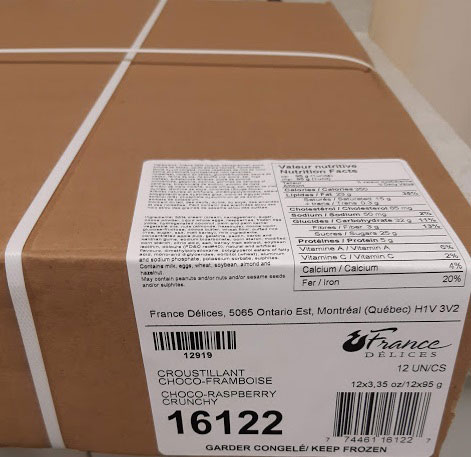
CFIA France Délices - Choco-Raspberry Crunchy - case

Recall details

Ottawa, June 21, 2019 – The food recall warning issued on June 4, 2019 has been updated to include additional product and distribution information. This additional information was identified during the Canadian Food Inspection Agency’s (CFIA) food safety investigation.

France Délices Inc. is recalling France Délices brand Choco-Raspberry Crunchy from the marketplace due to possible norovirus contamination of the raspberries used in this product. Consumers should not consume and retailers, should not sell, or serve the recalled product described below.

The following product has been sold in Alberta and Quebec from the following retailers:
Name Address
European Foods Inc. 8705 53 Avenue NW, Edmonton, AB
Fruit & Légumes Tardif Inc. 559, chemin St-Jean, Laprairie, QC
Hospitality Corner 1650, avenue Cedar, Montréal, QC
IGA Vanier 1035, boul. Wilfrid Hamel, Vanier, QC
IGA Boischatel 5114, avenue Royale, Boischatel, QC
IGA Alimentation Famille Gaouette Inc. 2020, route 112, St-Césair, QC
IGA 17010, boul. Henri-Bourassa, Québec, QC
IGA Baie-Comeau 1500, rue de Bretagne, Baie-Comeau, QC
IGA Crevier Terrebonne 1115, Montée des Pionniers, Terrebonne, QC
Métro Plus St-Zotique 350, rue Principale, St-Zotique , QC
Métro Plus Supermarché Boucher 341, chemin de Joliette, St-Félix de Valois, QC
Metro Gatineau 214, boul. de la Cité des Jeunes, Gatineau, QC
Métro Turgeon 1550, boul. Talbot, Chicoutimi, QC
Provigo Lorraine 95, boul. de Gaulle, Lorraine, QC
Trésors Sucrés 3640, Jean Talon Est, Montréal, QC

This product has been sold clerk-served from retail counters, with or without a label or coding, up to and including June 21, 2019. Consumers who are unsure if they have purchased the affected product are advised to contact their retailer.

Recalled products

Brand Name Common Name Size Code(s) on Product UPC
France Délices Choco-Raspberry Crunchy 95 g 08519 7 74461 16122 7

What you should do

If you think you became sick from consuming a recalled product, call your doctor.

Check to see if you have recalled products in your home. Recalled products should be thrown out or returned to the store where they were purchased.

People with norovirus illness usually develop symptoms of gastroenteritis within 24 to 48 hours, but symptoms can start as early as 12 hours after exposure. The illness often begins suddenly.


USA – Missouri Jack in the Box link in Hepatitis A scare

Food Poison Journal

The Franklin County Health Department is planning mass vaccinations after learning an employee who works at the Jack in the Box located at the Bourbeuse River Access in Union, Missouri had Hepatitis A while serving customers.

The Missouri Department of Health and Senior Services said the employee handled food on June 9 and June 10.

Hepatitis A  is a viral infection of the liver that can cause loss of appetite, nausea, tiredness, fever, and stomach pain. It’s usually spread when a person unknowingly ingests the virus from objects, food, or drinks that have been contaminated. Franklin County health officials have conducted several inspections of the Jack in the Box since the problem was discovered.

Health officials said it is uncommon for restaurant customers to become infected with Hepatitis A due to an infected food handler. However, anyone who consumed food or drinks at the restaurant on June 9 or June 10 is recommended to receive vaccination by June 23 as further protection from becoming ill.

RASFF Alert – Norovirus – Raspberries

RASFF-Logo

RASFF – norovirus (GII /25g) in raspberries from Morocco in Spain


USA – WinCo Frozen Red Raspberries Recalled For Norovirus

Food Poisoning Bulletin norovirus-1080x655

WinCo Foods of Boise, Idaho is recalling frozen red raspberries that were manufactured by Rader Farms of Bellingham, Washington, because the product may be contaminated with norovirus. Norovirus is highly contagious, and causes symptoms of vomiting, watery diarrhea, abdominal cramps, and nausea. No  illnesses have been reported to date in connection with this recall.

Research – Norovirus structures could help develop treatments for food poisoning

Science Direct

Noroviruses are a leading cause of food-borne illness outbreaks, accounting for 58% of all outbreaks and cause 685 million cases worldwide each year. There is no effective therapeutic against them. Having knowledge of the intricate structure of the outer layer of noroviruses, the capsid, which allows the virus to attach to its human host, could help in vaccine development.

In vaccines, specific antibodies recognize the capsids and bind to them so they can no longer interact with human cells. “We need to understand what the norovirus capsid shapes actually look like, and the shape differences between different strains,” said James Jung, a postdoctoral fellow in Dr. Leemor Joshua-Tor’s lab at Cold Spring Harbor Laboratory (CSHL).

Jung and Joshua-Tor led a team to solve the high-resolution structures of four different strains of noroviruses using a cryo-electron microscope. This allowed them to see the intricate architecture of virus shells in high-definition. Their findings are published in the journal PNAS.

Jung gleaned new insights that could help in guiding the development of therapeutics to fight norovirus infection. “Previously, it was thought that the norovirus shells exist in single-sized assemblies consisting of 180 building blocks and 90 surface spikes. What we found was an unexpected mixture of different shell sizes and shapes. We found a smaller form, which consists of just 60 building blocks with 30 surface spikes placed further apart. We also found larger shells made out of 240 building blocks with 120 surface spikes that are lifted significantly above the base of the shell and form a two-layered architecture that could interact differently with the human cells,” he said.

The spikes on the shell interact with the host. Jung found that the distance and orientation of the spikes varied across the different strains of noroviruses. “That means each strain will interact differently with human cells,” Jung explained. “The way the antibodies bind is also going to be different. Vaccines should be formulated to take into account the variations across strains and structural forms.”

Story Source:

Canada – Norovirus prompts recall of raspberries cakes in Quebec

Outbreak News Today Norovirus Food Safety kswfoodworld

The Ministry of Agriculture, Fisheries and Food (MAPAQ) in Quebec announced this week (computer translated) the recall of certain products due to possible norovirus contamination.

The products that are the subject of this alert may have been prepared with lots of frozen raw raspberries from Chile that are being recalled by the Canadian Food Additives Agency. food inspection.These foods were available for sale until June 7, 2019 inclusive. They were sold in a chilled or frozen state or at room temperature, with or without a label.

USA – Townsend Farms, Inc., Notifies Costco of Possible Health Risk and Recalls Conventional Frozen Kirkland Three Berry Blend – Hepatitis A

FDA

Out of an abundance of caution, Townsend Farms, Inc. has notified Costco that a recent FDA test indicated that a domestic conventional frozen blackberry product manufactured by Townsend Farms, Inc., may be contaminated with Hepatitis A. Townsend Farms, Inc. used the domestic conventional frozen blackberry to manufacture the Kirkland Signature Three Berry Blend product with Best By Dates between February 16, 2020, and May 4, 2020. Costco only sold the product in stores located in San Diego and Los Angles, California and Hawaii. No product manufactured for Costco by Townsend Farms has tested positive for Hepatitis A. Costco has no product in its current inventory. Costco has been notifying its members about the potential health risk.

USA – Public Health Alert Concerning Hepatitis A Virus Contamination of Kroger Brand Frozen Blackberries

FDA

The FDA is alerting consumers to a hepatitis A virus (HAV) contamination of frozen blackberries under the Kroger grocery store “Private Selection” brand. This contamination was discovered by the FDA as a part of an ongoing frozen berry sampling assignment. The FDA is advising consumers not to eat and to throw away frozen fruit purchased from Kroger and other retail locations packaged under Kroger’s “Private Selection” brand. Here are the recalled products:

  • PRIVATE SELECTION FROZEN TRIPLE BERRY MEDLEY, 48 OZ (BEST BY: 07-07-20; UPC: 0001111079120);
  • PRIVATE SELECTION FROZEN TRIPLE BERRY MEDLEY, 16 OZ (BEST BY: 06-19-20; UPC: 0001111087808);
  • PRIVATE SELECTION FROZEN BLACKBERRIES, 16 OZ (BEST BY: 06-19-20, 07-02-20; UPC: 0001111087809)
Kroger Brand Frozen Blackberries

These products are available at Kroger and other retail locations and have a two-year shelf life. The FDA is working with the manufacturer on this matter. This posting will be updated with new information as it becomes available. The FDA is continuing to investigate to determine whether there are other implicated products.

At this time, the FDA and the Centers for Disease Control and Prevention (CDC) are not aware of any cases of hepatitis A linked to the consumption of Kroger Private Selection brand frozen blackberries. Hepatitis A virus (HAV) can result in a liver infection that may be inapparent. However, when symptoms occur, they can range in severity from a mild illness lasting a few weeks to a severe illness lasting several months. HAV is found in the stool and blood of people who are infected. HAV is spread when someone ingests the virus, usually through person-to-person contact or from eating contaminated food or drink. Contamination of food with the hepatitis A virus can happen at any point: growing, harvesting, processing, handling, and even after cooking.

Canada -Food Recall Warning – France Délices brand Choco-Raspberry Crunchy recalled due to norovirus

CFIA

Recall details

Ottawa, June 4, 2019 – France Délices Inc. is recalling France Délices brand Choco-Raspberry Crunchy from the marketplace due to possible norovirus contamination of the raspberries used in this product. Consumers should not consume and retailers, should not sell, or serve the recalled product described below.

The following product has been sold in Ontario and Quebec from the following retailers:

Name Address
La maison du Kouign-Amman 101 Schneider Rd., Kanata, ON
Métro plus 875, Montée Masson, Mascouche, QC
Métro plus Élite St-Antoine 633, boul. des Laurentides, St-Antoine des Laurentides, QC
IGA Coteau du lac 100, Théophile Brassard, Coteau du Lac, QC
IGA Chaumont Bilodeau 1005, boul. Du Grand Héron, St-Jérôme, QC
IGA Extra Sept-Iles 1010, boul. Laure Uashat, Sept-Îles, QC
IGA St-Romuald 1060, boul. Guillaume-Couture, Lévis, QC

This product has been sold clerk-served from retail counters, with or without a label or coding, up to and including June 3, 2019. Consumers who are unsure if they have purchased the affected product are advised to contact their retailer.

Recalled products

Brand Name Common Name Size Code(s) on Product UPC
France Délices Choco-Raspberry Crunchy 95 g 12919 7 74461 16122 7

What you should do

If you think you became sick from consuming a recalled product, call your doctor.

Check to see if you have recalled products in your home. Recalled products should be thrown out or returned to the store where they were purchased.

People with norovirus illness usually develop symptoms of gastroenteritis within 24 to 48 hours, but symptoms can start as early as 12 hours after exposure. The illness often begins suddenly. Even after having the illness, you can still become re-infected by norovirus. The main symptoms of norovirus illness are diarrhea, vomiting (children usually experience more vomiting than adults), nausea and stomach cramps. Other symptoms may include low-grade fever, headache, chills, muscle aches and fatigue (a general sense of tiredness).  Most people feel better within one or two days, with symptoms resolving on their own, and experience no long-term health effects. As with any illness causing diarrhea or vomiting, people who are ill should drink plenty of liquids to replace lost body fluids and prevent dehydration. In severe cases, patients may need to be hospitalized and given fluids intravenously.

Background

This recall was triggered by findings by the Canadian Food Inspection Agency (CFIA) during its investigation into a foodborne illness outbreak. The CFIA is conducting a food safety investigation, which may lead to the recall of other products. If other high-risk products are recalled, the CFIA will notify the public through updated Food Recall Warnings.

The CFIA is verifying that industry is removing recalled product from the marketplace.

Illnesses

There have been no reported illnesses associated with the consumption of this product.

More information

France Délices Inc.: Christine Fortin, cfortin@francedelices.com

For more information, consumers and industry can contact the CFIA by filling out the online feedback form.

Product photos

Printer ready version of photos

  • France Délices - Choco-Raspberry Crunchy - case
  • France Délices - Choco-Raspberry Crunchy

USA – McDonalds hit twice with Hepatitis A scares

Food Poison Journal

A few days ago, in Florida, ABC Action News I-Team uncovered an employee who worked inside McDonald’s at 8006 Osceola-Polk Line Road in Davenport had a confirmed case of Hepatitis A last week.

McDonald’s released the following statement:

“We were informed by the Polk County Health Department that one of our employees has become ill. We are fully cooperating with the health department in their review of this matter, an isolated instance at this restaurant, to ensure the health and safety of all our employees and customers. Today and always, we are committed to a safe and clean restaurant environment, and we have taken proactive steps to again completely sanitize our restaurant.”

In Indiana News 10 reported this morning that Sullivan County health officials are investigating a case of Hepatitis A at a local food handler and say the risk of infection is low for patrons who recently visited.