Category Archives: Decontamination Microbial

UK – M&S Campylobacter Results Q2 – 2021

Click to access campylobacter-q2-2021.pdf

Research – Reduction of Escherichia coli O157:H7, Listeria monocytogenes, and Salmonella on Whole Yellow Onions (Allium cepa) Exposed to Hot Water

Journal of Food Protection

In-home or food service antimicrobial treatment options for fresh produce are limited. Hot water treatments for whole (unpeeled) produce have been proposed, but data to support this practice for onions are not available. Separate cocktails of rifampin-resistant Escherichia coli O157:H7, Listeria monocytogenes, and Salmonella were cultured on agar and suspended in sterile water. The outer papery skin at the equator or root or stem ends of the whole yellow onions was spot inoculated at 6 log CFU per onion. After drying for 30 min and, in some cases, storage at 4°C for 6 days, onions were immersed in water at ca. 100°C for 5 s or 85°C for 10 to 180 s. No significant difference (P > 0.05) in the mean decline of Salmonella was found on onions that were exposed to hot water after drying the inoculum for 30 min or after storage at 4°C for 6 days. Exposure of whole onions at 100°C for 5 s reduced E. coli O157:H7 and L. monocytogenes populations by >5 log CFU per onion at all inoculum sites and Salmonella populations by >5 log CFU per onion at the stem end and equator but not consistently at the root end. Mean root-end reductions of ≥5 log CFU per onion of E. coli O157:H7, L. monocytogenes, and Salmonella were achieved consistently when the root end was fully immersed in 85°C hot water for 45 or 60 s except in a small number of cases (4 of 57; 7%) when the root end was oriented upward and above the water line during treatment. When onions were held at 85°C for 180 s with the root end above the water line in an uncovered water bath, no significant declines in Salmonella populations were observed; significant mean declines in Salmonella were achieved (mean, 5 log CFU per onion; range, 3.49 to 6.25 log CFU per onion) when the water bath was covered. Short exposure to hot water can significantly reduce pathogens on the surface of whole onions. Reductions are more consistent when the root end is submerged and when the water bath is covered.

HIGHLIGHTS
  • Short hot-water exposure significantly reduces pathogen populations on whole onions.
  • Salmonella reductions were greater at the stem and equator than at the root end.
  • Pathogen reduction was greater for fully submerged root ends in covered water baths.

UK – Aldi Tackling Campylobacter

Aldi

Facing up to the challenge

We understand that we have a role to play to reduce the level of Campylobacter in the supply chain and to help raise awareness with our customers as to how they can handle fresh poultry in a safe manner.

The Food Standards Agency (FSA) has identified Campylobacter as a key priority and is working with those directly in the industry to tackle it. Aldi is dedicated to supporting the FSA in this goal, which is why we are a signatory of the Acting on Campylobacter Together (ACT) campaign.

As well as working with the FSA (and other industry bodies), we understand that we need to take a lead with our suppliers to deliver against the FSA target.

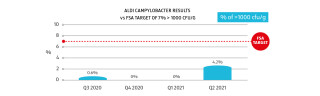
Aldi monitors the levels of Campylobacter carefully by compiling regular sets of independently verified data which is shared with the FSA via the BRC for the purposes of industry reporting. The results for Q2 2021 (April to June) show that 4.2% of birds were in the >1,000 cfu/g category. Our results are below the FSA target of less than 7% of birds in the >1,000 cfu/g category.

UK – Tesco Plan to Tackle Campylobacter

Lasted updated: August 2021

Campylobacter is a naturally occurring bacterium found in raw poultry that has the ability to cause food poisoning if the product is not cooked or handled correctly. Customers can keep safe by following the handling and cooking instructions provided on all Tesco raw poultry.

Providing high quality, safe food is always our absolute priority. It has long been our commitment to reduce levels of Campylobacter in our poultry and we are now seeing real progress at all stages of the supply chain, in tackling the issue through the work we have done with our suppliers.

Our Plan

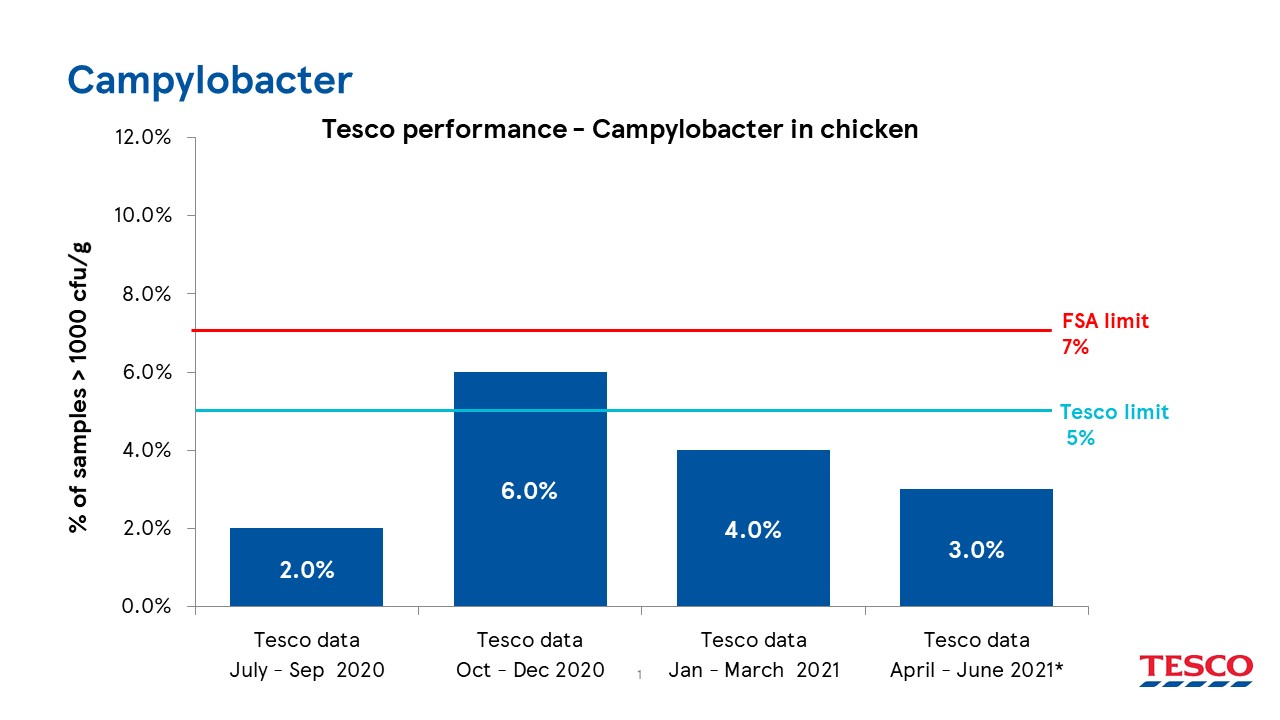
We aim to remain at the forefront of progress on Campylobacter reduction and to ensure we deliver this we have introduced our own industry leading target- that at least 95% of chickens supplied to Tesco will have minimal levels of Campylobacter (less than 1000 cfu/g). This will enable us to help our customers be a safe as possible, whilst handling and cooking poultry.

  • All of our raw poultry contains safe handling information on packaging and cooking instructions are checked to ensure thorough cooking. For further information please visit our Real Food website: Food Safety in the Home

Our Performance

UK – Lidl Tackling Campylobacter

Lidl

Safety and satisfaction are close to our hearts, which is why our quality assurance team accepts nothing short of perfection. Food safety is at the heart of what we do and underpins our purchasing policy across food and non-food items.

We work hard to ensure our suppliers meet national, European and Global safety standards and implement a strict internal Quality Management System comprising of rigorous product testing and supplier auditing.

Campylobacter

Food safety is the highest priority at Lidl UK, and together with our suppliers and the Food Standards Agency (FSA) we are committed to tackling Campylobacter in chicken. This is being achieved through several initiatives throughout the process, from the farm and processing stages to supply chain and in-store, too. These initiatives are demonstrated in our plan below.

What is Campylobacter?

Campylobacter is the most common cause of food poisoning in humans. Campylobacter is naturally occurring in the environment and lives inside many animals including chickens.

The most common ways Campylobacter is spread is through cross-contamination and undercooked chicken.

Customer advice

Lidl strongly advises all our customers to follow the FSA’s advice when handling and cooking raw chicken:

  • Cover and chill raw chicken, store it at the bottom of the fridge so juices cannot drip on to other foods.
  • Don’t wash raw chicken.
  • Thoroughly wash and clean all utensils, chopping boards and surfaces used to prepare raw chicken. Wash hands thoroughly with soap and warm water after handling raw chicken.
  • Cook chicken thoroughly, making sure it is steaming hot throughout, with no pink meat and all the juices running clear.

Lidl UK’s actions on Campylobacter

  • Lidl joined the new Acting on Campylobacter Together (ACT) board in 2015 as a joint way of tackling Campylobacter between retailers, processors and the FSA.
  • Our poultry suppliers are working hard on increased bio-security on-farm to reduce Campylobacter in poultry flocks.
  • Our poultry suppliers have implemented innovative factory interventions to reduce Campylobacter through the process of slaughtering and production.
  • All of our flavoured birds are sold as roast-in-bag, reducing the need for customers to touch raw chicken.
  • All of our raw poultry contains hygiene information on the packaging advising customers of good practice.

Lidl Campylobacter Results > 1000 cfu/g

Lidl Campylobacter Results

Research – Prevalence of Listeria Species and Listeria monocytogenes on Raw Produce Arriving at Frozen Food Manufacturing Facilities

Journal of Food Protection

The ubiquity of Listeria monocytogenes in the environment affects the food industry and presents concerns for frozen food facilities. This study determined the prevalence and numbers of Listeria species and L. monocytogenes on raw produce arriving at frozen food facilities. Raw produce was collected using multilevel blinding protocols to ensure anonymity of participants and avoid traceback. Five raw vegetables were selected: corn, carrots, green beans, peas, and spinach. Raw products were collected after arrival at the facilities but before cleaning or other preprocessing steps that are typically performed inside the facility. The U.S. Food and Drug Administration’s Bacteriological Analytical Manual method for detection of Listeria spp. and L. monocytogenes was followed, with PCR screening followed by selective plating methods. Listeria numbers were estimated from positive samples using the most-probable-number (MPN) methodology. A total of 290 samples were collected, with 96 and 17 samples positive for Listeria spp. (33.1%) and L. monocytogenes (5.9%), respectively. Enumeration data for the 96 Listeria spp. samples indicated 82 samples had greater than 100 MPN of Listeria spp. per g and 14 samples had less than 100 MPN Listeria spp. per g. The prevalence of Listeria spp. varied by commodity: spinach (66.7%), peas (50%), corn (32.2%), green beans (22.2%), and carrots (13%). L. monocytogenes prevalence was determined in corn (13.6%), peas (6.3%), and green beans (4.2%) arriving at processing facilities. Such data were previously unavailable to frozen vegetable processors and are valuable in implementing process control standards. The prevalence and pathogen concentration data from raw commodities found in this study can provide the industry with information to conduct more accurate quantitative risk assessments and a baseline to model and target appropriate pathogen reduction steps during processing.

HIGHLIGHTS
  • Prevalence of Listeria spp. and L. monocytogenes in raw produce was determined.
  • 96 Listeria spp. and 17 L. monocytogenes samples were found from 290 produce samples.
  • 82 produce samples had >100 MPN/g and 14 samples had <100 MPN/g for Listeria spp.

Research – Impact of gas ultrafine bubbles on the potency of chlorine solutions against Listeria monocytogenes biofilms

Ultrafine bubble technology is a novel concept in food safety that can improve the potency of antimicrobials against biofilms. This study was conducted to evaluate the impact of gas (air, CO2, or N2) ultrafine bubbles incorporation in 100 and 200 ppm chlorine (Cl2) solutions to inactivate fresh Listeria monocytogenes biofilms on stainless steel. Listeria monocytogenes biofilms were grown on stainless steel coupons through static incubation at 37°C for 72 hr by immersing in L. monocytogenes inoculated brain heart infusion (BHI) broth. The coupons were treated by dipping in water or Cl2 solutions with or without ultrafine bubbles for 1 min. Random pre-determined areas on coupons were swabbed into Dey–Engley neutralizing broth before and after treatments and enumerated using BHI agar. Air and CO2 nanobubbles in 100 ppm Cl2 resulted in greater log reductions (5.0 and 4.9 log CFU/cm2, respectively) in L. monocytogenes biofilms compared with 100 ppm Cl2 without gas ultrafine bubbles (3.7 log CFU/cm2). Incorporation of air, CO2, and N2 ultrafine bubbles in water and 200 ppm Cl2 did not have any impact on the efficacy of biofilm inactivation.

Norway – Monitoring program 2021: Listeria in salmon slaughterhouses and on salmonids

Mattilsynet

The Norwegian Food Safety Authority has taken listeria samples from 60 slaughterhouses that the Institute of Marine Research has analyzed. The results show that Listeria is present in both the production environment and on fish in some salmon slaughterhouses.

Surveillance program is a measure that the Norwegian Food Safety Authority initiated to gain more knowledge about the segment following a salmonella outbreak in 2019 where 58 became ill after eating exotic dried fruit mixture.

What did we investigate? Listeria in the production environment in the salmon slaughterhouse and from fish that came in and went out of the slaughterhouse.

358 samples from 60 different salmon slaughterhouses (49 establishments and 11 boats):

  • 108 from the production environment
  • 47 from the surface to fish entering
  • 59 from the surface to fish at the last stage of production
  • 144 from raw material at the last stage of production
Period: September 1, 2020 – September 1, 2021
What were we looking for? Listeria monocytogenes
What did we find? Listeria monocytogenes was detected in 22 samples from nine of 49 salmon slaughterhouses (18%), of which 5 had several positive samples.

The 22 positive tests included:

  • 9 samples from the production environment
  • 4 samples of the surface of fish on their way into the slaughterhouse
  • 5 samples of the surface of fish
  • 4 product samples at the last stage of production.

Detection in end product at 6 of 49 (12%) salmon slaughterhouses. The product samples had low concentrations of L. monocytogenes (<10 CFU / g)

None of the slaughter boats had samples with findings of L. monocytogenes .

Norway – It is important to monitor and have effective measures against Listeria in salmon slaughterhouses

Mattilsynet

The hygienic standard in Norwegian salmon slaughterhouses is generally good. At the same time, the Norwegian Food Safety Authority’s sampling shows that Listeria is present in both the production environment and in small quantities of fish in some salmon slaughterhouses.

– It is therefore important that the salmon slaughterhouse continuously monitors Listeria and at all times has effective hygiene measures, says Inge Erlend Næsset, director of the regulations and control department in the Norwegian Food Safety Authority.

Supervision and sampling

In 2021, the Norwegian Food Safety Authority carried out an inspection campaign in which 63 establishments and vessels that slaughter salmonids were inspected for measures and routines to prevent the fish from becoming contaminated with the listeria bacterium.

The background was the serious listeriosis outbreaks that were reported from the EU in 2018 and 2019. The outbreaks were related to the consumption of smoked, digged and marinated salmon and aura, where the raw materials were Norwegian.

Listeria monocytogenes can cause listeriosis. Most people do not get sick from the bacterium, but pregnant women, children, the elderly and people with weakened immune systems are at risk. Listeria multiplies at cooling temperature, survives freezing, salting and smoking, but is killed by adequate heat treatment.

– Since salmon and aura are largely eaten without heat treatment and used for ready-to-eat products such as sushi, sashimi, smoked and digged fish, it is important that producers have effective measures against Listeria. The Norwegian Food Safety Authority therefore saw a need for a better overview of the status of fresh salmon and Listeria, Næsset said.

The Norwegian Food Safety Authority also took listeria samples from 60 slaughterhouses which were analyzed by the Institute of Marine Research .

Uncover relatively few deficiencies

18 companies received a decision. These mainly concerned the management system, including hazard analysis, sampling plan and measures for the detection of Listeria. One business was closed due to lack of reindeer husbandry and maintenance.

Otherwise, relatively few deficiencies were revealed in the hygienic practices of premises and equipment at the operations, where this was controlled.

– Our general impression after the campaign is that most salmon slaughterhouses have a good hygienic standard, says Næsset.

Listeria in both production environments and on fish

The results from the analyzes carried out by the Institute of Marine Research showed findings of Listeria monocytogenes in 18% of salmon slaughterhouses, and in small quantities of finished whole, gutted fish in 12% of salmon slaughterhouses.

– If Listeria is allowed to develop at later process stages, the product can entail a serious health risk for vulnerable consumers. These findings confirm that it is important that the salmon slaughterhouse continuously monitors Listeria, and has consistently good routines for hygiene, Næsset concludes.

Report after the inspection campaign: Inspection of listeria measures in salmon slaughterhouse 2021

Report from the Institute of Marine Research: Monitoring program 2021: Listeria in salmon slaughterhouses and on salmonids

Information – Cleaning your refrigerator after a food recall

Food Safety News

Recalls happen in the U.S. almost daily. Most consumers know not to eat or drink the recalled products and to throw them out, but one thing that’s easy to forget about is cross-contamination.

Products that have been recalled often have been placed in consumers’ refrigerators, on their counters or in their cupboards. This means that cross-contamination could have occurred in any of these areas.

Harmful germs in the recalled product can easily spread to drawers or shelves in your refrigerator through from packaging or spills or leaks.

Recalled food is often contaminated with harmful pathogens, such as Salmonella, Listeria or E. coli. This means that after a recalled product has sat in your fridge, it could contaminate other items in your fridge with one of these dangerous pathogens.

Food poisoning can lead to being hospitalized, and for certain vulnerable people, the illnesses can be fatal.

There are some tips in the link above from the Centers for Disease Control and Prevention (CDC) on how to clean your fridge and counters, and keep your family safe and healthy after removing a recalled product. Use paper towels when possible.

Click to access 5-steps-to-clean-your-refrigerator.pdf