Category Archives: water microbiology

Information – Controlling Legionella on Ships, Ferries & Maritime Vessels

Legionella Control

This expert guide from our water safety specialists looks at the control of legionella on ships, ferries and other maritime vessels. The guide considers the water safety risks that can arise on-board different vessels, the need to consider dry dock safety, why a detailed risk assessment and Water Safety Plan are essential, and concludes by outlining the potential consequences following an outbreak of Legionnaires’ disease.

When we hear about outbreaks of Legionnaires’ disease, we tend to associate them with scenarios that occur on land – in hotels, hospitals, leisure centres etc. However, there are similar opportunities for Legionella bacteria to grow and spread at sea too. Ships, ferries, cruise liners and other maritime vessels of all shapes and sizes can be affected, and as such must take suitable precautions to make sure their water systems are safe for those who use them or are exposed to them.

Research – How Temperature Influences Legionella Growth

Legionella Control

CDC legionella

Image CDC

In this review the experts at Legionella Control International look at how water temperatures influence legionella growth and how this information can be used to control the risks from the bacteria.

Under certain circumstances Legionella bacteria can lead to serious illness and fatalities in humans. Since Legionella bacteria can exist in man-made water systems, it is imperative to ensure the water is stored, maintained and distributed at temperatures that do not encourage the growth and spread of the bacteria.

There are three temperature ranges that have an influence on the growth and proliferation of Legionella bacteria. We’ll look at each of these in the link above.

Research – Prediction of Salmonella presence and absence in agricultural surface waters by artificial intelligence approaches

Wiley Online Salmonella kswfoodworld

The purpose of this study was to evaluate the performance of artificial intelligence tools for the prediction of Salmonella presence and absence in agricultural surface waters based on the population of microbiological indicators (total coliform, generic Escherichia coli, and enterococci) and physicochemical attributes of water (air and water temperature, conductivity, ORP, pH, and turbidity). Previously collected data set from six agricultural ponds monitored for two growing seasons were used for analysis. Classification algorithms including artificial neural networks (ANNs), the nearest neighborhood algorithm (kNN), and support vector machines (SVM) were trained and tested with a 539‐point data set for optimum prediction accuracy. Classification accuracy performances were validated with data set (400 samples) collected from different agricultural surface water sources. All tested algorithms yielded the highest accuracy around 75 ± 1% for generic Ecoli followed by enterococci (65 ± 5%) and total coliform (60 ± 10%). Classifiers calculated 6–15% higher accuracy ranging from 62 to 66% for turbidity than all other tested physicochemical attributes. Based on Ecoli populations measured in other water sources, trained algorithms predicted the presence and absence of Salmonella with an accuracy between 58.15 and 59.23%. The classification performance of ANN, kNN, and SVM algorithms are encouraging for the prediction of Salmonella in agricultural surface waters.

Research – Can Hard Water & Limescale Increase Legionella Risks?

Legionella Control

CDC legionella

Image CDC

This specialist guide has been written by the water safety experts at Legionella Control International and asks if the presence of hard water and limescale increases the risks from Legionella bacteria and Legionnaires’ disease. The guide looks at the formation of scale in water systems, fittings and appliances and how it can encourage the growth of biofilm and bacteria including legionella. It concludes by reviewing what practical measures can be taken to prevent, or at least reduce the risks that limescale brings with it.

USA – 170 people ill in possible Norovirus outbreak at Yosemite National Park

The Hill norovirus-1080x655

Around 170 people who visited Yosemite National Park this month have reported becoming ill with gastrointestinal illnesses, with at least two confirmed cases of norovirus, park officials said Thursday.

The National Park Service began investigating after visitors and employees reported being sick and are continuing to investigate the circumstances surrounding the illness and conduct interviews with affected people.

“The overwhelming majority of the reported cases are consistent with norovirus,” park officials said in a statement.

The majority of those who became ill spent time in Yosemite Valley around the first week of January. Park officials say there has been a decline in new cases in the past several days. While those who reported becoming ill had symptoms of norovirus, park officials say some might have had food poisoning or the flu.

USA – Illinois: Legionnaires’ Disease reported at Quincy Veterans home

Outbreak News Today

CDC legionella

Image CDC

The Illinois Department of Veterans’ Affairs (IDVA) and the Illinois Department of Public Health (IDPH) are investigating a single case of Legionnaires’ disease in a resident at the Illinois Veterans Home – Quincy (IVHQ). The resident has received medical treatment and is recovering at IVHQ. No other cases have been identified and IVHQ continues to follow its plans to monitor residents for respiratory illness. The last case of Legionnaires’ disease at IVHQ was February 2018.

IDPH infectious disease staff are working with the facility to collect information and further investigate the resident’s illness. IVHQ has notified residents, staff, and families or power-of-attorneys. IVHQ continues to operate a robust water management program and is implementing best practices to control the growth and spread of waterborne pathogens. IVHQ provides additional water treatment, including filtration and disinfection, prior to use on its campus. IVHQ also maintains point of use filters on all fixtures in residential areas to reduce the possibility of transmission to susceptible individuals. IVHQ continues to conduct active surveillance for Legionella by monitoring residents and reviewing water quality data on an ongoing basis.

Research – Infectivity of Norovirus GI and GII from Bottled Mineral Water during a Waterborne Outbreak, Spain

CDC

Abstract

During a waterborne outbreak of norovirus in Spain, we estimated 50% illness doses for a group of exposed (secretor) persons to be 556 (95% CI 319–957) genome copies/day for norovirus GI and 2,934 (95% CI 1,683–5,044) genome copies/day for norovirus GII. Use of a propidium monoazide viability assay reduced these values.

Research – Salmonella sensitivity to sodium hypochlorite and citric acid in washing water of lettuce residues

Wiley Online Salmonella kswfoodworld

Salmonella spp. is one of the main lettuce pathogens and should be inactivated during the disinfection of these vegetables before consumption. In minimally processed vegetable industries, residues of organic matter can prevent the inactivation of this pathogen by disinfectants. The objective of the present work was to evaluate the inactivation of Salmonella isolated from organic lettuce to sodium hypochlorite (25 and 50 ppm) and citric acid (0.5 and 1%) in washing water added with lettuce residues. To do so, a washing water with lettuce residues was elaborated, and Salmonella was added in the order of 106 CFU/ml. Thereafter, each sanitizer was added separately to evaluate its effect on reducing Salmonella counts. After 1, 2, 3, 4, 5, 10, and 15 min of contact with the sanitizers, serial dilutions using neutralizer (0.5% sodium thiosulfate) were performed and each dilution was sown in Xylose‐Lysine‐Desoxycholate medium. Total aerobic mesophilic counts of wash water with lettuce residues before testing (without Salmonella) and after 15 min of exposure to each sanitizer (with Salmonella) were also performed. In addition, the free chlorine still present in the samples after the contact of sodium hypochlorite with lettuce residues for 15 min. The results demonstrated that 50 and 25 ppm sodium hypochlorite could reduce 6 log CFU/ml of Salmonella in 1 and 3 min of contact, respectively, while 0.5 and 1% citric acid was able to reduce 1.26 and 1.74 log CFU/ml respectively from the same microorganism within 15 min of contact. The total aerobic mesophilic counts of the wash water before being tested were, on average, 1.5 log CFU/ml. After addition of Salmonella, with 15 min of contact with the sanitizer, the results of total counts showed the same magnitude as the Salmonella counts. Organic matter may have reacted with the free chlorine present, reducing chlorine concentrations, since values of 30.4 ppm were observed when the initial concentration should be 50 and 17.1 ppm when the initial concentration should be 25 ppm. Based on the results, sodium hypochlorite demonstrated a greater microbial reduction capacity in wash water with lettuce residues, indicating that it is more appropriate to avoid cross‐contamination between batches during sanitation of lettuce in washing tanks.


USA – Legionnaires’ Disease: Cases may be linked to Central DuPage Hospital

Outbreak News Today

CDC legionella

Illinois state and local health officials report investigating three cases of Legionnaires’ disease in individuals who were patients at Northwestern Medicine Central DuPage Hospital.

One individual was an inpatient, and the second and third individuals had outpatient visits. These patients could have acquired the infection at the hospital, but they also had other possible sources of exposure during the 10 days before they started showing symptoms.

The Illinois Department of Public Health (IDPH), the DuPage County Health Department (DCHD) and the hospital are working to information and further investigate these cases, which will include another on-site visit by IDPH to test the facility’s water. Central DuPage Hospital is working with IDPH to strengthen its water management plan and implement multiple control measures.

Sweden – Sweden ‘crypto’ outbreak update: Nearly 400 cases, Cases declining

Outbreak News Today

crypto

Image CDC


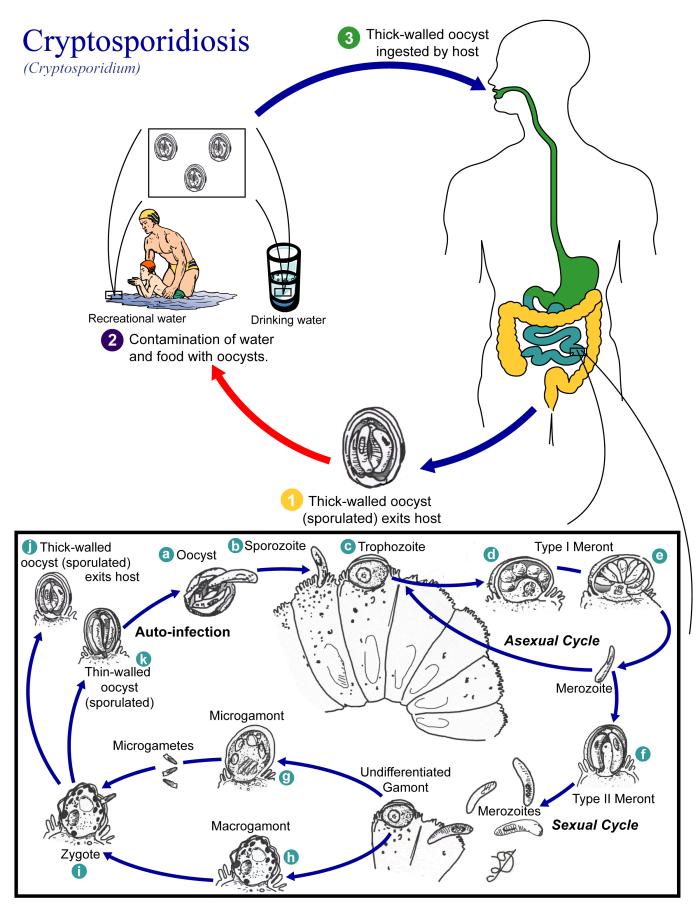
Since the last report on the Cryptosporidium outbreak in Sweden about two weeks ago, health officials say the number of reported cases has decreased in recent weeks.

Cryptosporidium life cycle/CDC

While cases are declining, the number of cases reported per week remains slightly higher compared to the same period in previous years. To date, some 400 Cryptosporidium cases have been recorded.

Most cases have been reported from Stockholm, Östergötland, Västra Götaland, Halland, Jönköping and Uppsala.

The Public Health Authority analyzes samples from the cases to determine what type of cryptosporidium they have become ill from. Of the 202 samples analyzed so far, 93 have been shown to belong to subtype (A) and 58 belong to subtype B of Cryptosporidium parvum. In addition to this subtype, a number of different subtypes have been detected.