Category Archives: Microbiological Risk Assessment

Canada – Notice not to consume products packaged in glass jars and sold by the company Les Délices de Pa pis Ma (SENC)

MAPAQ

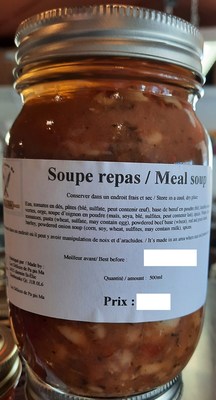
Meal soup (CNW Group/Ministry of Agriculture, Fisheries and Food)

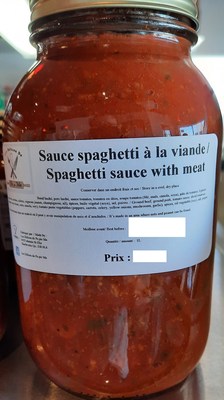
Meat Spaghetti Sauce (CNW Group/Ministry of Agriculture, Fisheries and Food)

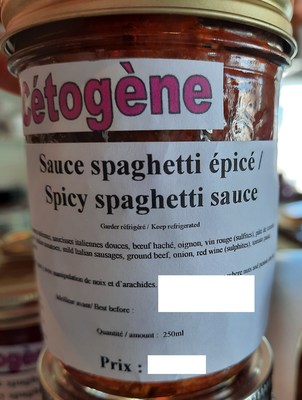
Spicy spaghetti sauce (CNW Group/Ministry of Agriculture, Fisheries and Food)

QUEBEC CITY, Jan. 25, 2022 /CNW Telbec/ – The Ministry of Agriculture, Fisheries and Food (MAPAQ), in collaboration with Les Délices de Pa pis Ma (SENC), located at 6025, chemin de Saint-Élie, in Sherbrooke , advises the public not to consume the products indicated in the table below, because they have not been packaged in such a way as to ensure their safety.

Product name

Format

Affected lot


“ MEAT SPAGHETTI SAUCE ”

500ml

1 litre

Units sold until
January 24, 2022

“MEAL SOUP”

500ml

“SPICY SPAGHETTI SAUCE”

125ml

250ml

The products that are the subject of this warning were offered for sale until January 24, 2022, and this, only at the establishment designated above. The products were packaged in Mason-type glass jars with metal lids and sold at room temperature. The label of the products includes, in addition to their name, the mention “Les délices de Pa pis Ma”.

The operator is voluntarily recalling the products in question. It has agreed with MAPAQ to issue this warning as a precautionary measure. Also, people who have any of these products in their possession are advised not to consume it. They must return it to the establishment where they bought it or throw it away. Even if the affected products show no signs of tampering or suspicious odors, their consumption may represent a health risk. It should be noted that no case of illness associated with the consumption of these foods has been reported to MAPAQ to date.

Additional information

The Ministry publishes various information documents concerning food safety. Interested persons can consult them in the “Food Consumption” section of the MAPAQ website: www.mapaq.gouv.qc.ca/consommation . They also have the possibility of registering online, by visiting www.mapaq.gouv.qc.ca/rappelsfoods , to receive, by e-mail, the food recall press releases published by the Ministry. Finally, it is possible to follow “MAPAQfoods” on Twitter at the following address: www.twitter.com/MAPAQfoods .
Hong Kong – CFS urges public not to consume one kind of butter product from Australia with potential microbial contamination

CFS

Issue Date 25.1.2022
Source of Information The Department of Agriculture, Water and the Environment of Australia
Food Product One kind of butter product imported from Australia
Product Name and Description Product name: MG Brand Butter, Unsalted 25KG
Brand: MG
Place of origin: Australia
Net weight: 25 kilograms
Date of manufacture: April 21, 2021
Shelf life: Two years
Importer: Foodgears Industrial International Ltd
Reason For Issuing Alert
  • The Centre for Food Safety (CFS) received a notification from the Department of Agriculture, Water and the Environment of Australia that the above-mentioned product might have been microbiologically contaminated and is being recalled.
Action Taken by the Centre for Food Safety
  • l   According to the information provided by the Department of Agriculture, Water and the Environment of Australia, the affected batch of the product has been imported into Hong Kong. Upon learning of the incident, the CFS immediately contacted the local importer concerned for follow-up.
  • A preliminary investigation found that the local importer, Foodgears Industrial International Ltd, had imported the affected batch of the product into Hong Kong. The importer concerned has initiated a recall according to the CFS’ instructions.
Advice to the Trade
  • Stop using or selling the product concerned immediately if they possess it.
Advice to Consumers
  • Not to consume the affected batch of the product if they have bought any.
Further Information The CFS press release

Enquiries about the recall can be made to the hotline at 3999 5706 during office hours.

Centre for Food Safety
Food and Environmental Hygiene Department
2022-1-25

Research – What Is Listeria Meningitis? Causes, Treatment, and More

Healthline

Listeria meningitis is a type of bacterial meningitis that is a serious complication of a listeria infection. Without prompt treatment, it can quickly become life threatening. After recovering from meningitis, some people are left with permanent disabilities.

Meningitis involves inflammation and swelling of the protective membranes, called meninges, that surround the brain and spinal cord. This can happen for many reasons, including injury and infection.

Listeria infection, also called listeriosis, is a rare disease caused by the bacteria called Listeria monocytogenes. According to the Food and Drug Administration (FDA)Trusted Source, almost all cases stem from consuming contaminated food. It’s most likely to affect pregnant people, newborns, and those with a weakened immune system.

We’ll overview what causes listeria meningitis to occur, how to treat it, prevention, and more.

Research – Food Poisoning Treatment

Food Poisoning News

While the effects of food poisoning are usually not life-threatening, they can be very unpleasant and result in additional health conditions that require medical attention. Some patients may be at risk for more serious complications depending on their overall health condition and the type of bacteria or virus causing the illness.

Research – Preventing Food Poisoning

Food Poisoning News

Food poisoning is a common, yet potentially serious environmental health issue. The occurrence of food poisoning can be reduced by following some simple rules while preparing, cooking, and serving food.

The most common causes of food poisoning are bacteria, viruses, or parasites that are present in foods that are contaminated with human or animal feces or their toxins. Most of the food poisoning cases are due to the consumption of foods that have not been thoroughly cooked or properly stored.

All these micro-organisms that cause food poisoning can be killed if they are exposed to adequate heat for a sufficient time, as in cooking or pasteurization.

Research – Researchers discover way to disarm potentially deadly Listeria bacteria

UQ EDU

University of Queensland researchers have unlocked a way of fighting Listeria infections, which can cause severe illness in pregnant women and people with compromised immune systems.

During the study, researchers discovered a way to block Listeria from making the proteins that allow bacteria to survive and multiply in immune cells.

UQ Diamantina Institute’s Professor Antje Blumenthal said using a small, drug-like inhibitor has improved their understanding of the Achilles heel of Listeria.

“Listeria is found in the soil and sometimes in raw foods. Once ingested it can hide from the immune system and multiply inside immune cells,” Professor Blumenthal said.

“Instead of killing the bacteria, the immune cells are used by the bacteria to multiply and are often killed by Listeria growing inside them.

“Our study showed the bacteria could be cleared with a small drug-like inhibitor that targets the ‘master regulator’ of the proteins that help Listeria grow in immune cells. The inhibitor helped the immune cells survive infection and kill the bacteria.”

Until now, studies into the ‘master regulator’ – which controls critical proteins that make Listeria virulent ­­– have mostly been based on engineered bacteria, or mutated versions of these proteins.

“By using a drug-like inhibitor, we were able to use molecular imaging and infections studies to better understand what happens to Listeria when the bacteria cannot effectively grow inside immune cells and hide from immune defence mechanisms,” Professor Blumenthal said.

“We hope that our discovery, together with recent research into the master proteins’ molecular structure and functions, could guide the development of inhibitors and new drugs to treat Listeria infection.”

Listeria infection does not cause disease in most people, but can be deadly for the immunocompromised and is also a major health concern during pregnancy and can lead to miscarriage, stillbirth and premature birth.

“Our findings could also inform design of inhibitors against related proteins that are found in different bacteria,” Professor Blumenthal said.

The study has been published in the journal PLOS Pathogens (DOI: 10.1371/journal.ppat.1010166).

This study, led by researchers at The UQ Diamantina Institute, included collaborations with Umeå University, Sweden; UQ School of Chemistry and Molecular Biosciences; Australian Infectious Diseases Research Centre; Institute for Molecular Bioscience; Mater Research Institute; Telethon Kids Institute, University of Western Australia; Monash University; University of Melbourne at the Peter Doherty Institute for Infection and Immunity and Hudson Institute of Medical Research.

Media: PRofessor Antji Blumenthal, a.blumenthal@uq.edu.au; UQ Communications, Angie Trivisonno, med.media@uq.edu.au, +61 (0)7 3365 5118, +61 (0)436 368 746.

Cambodia – Mass food poisoning reported with more than 30 falling ill

Khmer Times

A joyful party ended in a hospital visit for 34 guests due to food poisoning.

The party took place on January 21 at a water treatment plant in Snom Prampi Village, Mak Prang Commune, Teuk Chhou District, Kampot.

According to the authorities at around 6 p.m. there were reports of mass food poisoning. The party was reportedly hosted by the water treatment plant. After the report came to the authorities, those suffering were sent to the hospital to be treated. A total of 34 people ended up in the emergency room.

Authorities said that 26 of the victims were admitted to Kampot Provincial Referral Hospital and eight other people were sent to a private clinic for treatment. As of January 22, all victims have recovered.

Malaysia -60+ Primary School Students Get Food Poisoning From School Food Programme

TRP

More than 60 students from a primary school in Taman Medan, Petaling Jaya got food poisoning and had to be admitted to Hospital Shah Alam last Thursday, according to Majoriti.

It is believed that the food provided by the school under the supplementary meal plan (RMT) is the cause of the food poisoning. Allegedly, all the students had eaten the food provided, and many later showed signs of food poisoning such as vomiting.

Students from Year 1 to Year 6, including those in the Special Education Integration Program (PPKI), who are part of the supplementary meal plan programme were affected.

Research – What Is Cyclospora?

Food Poisoning News

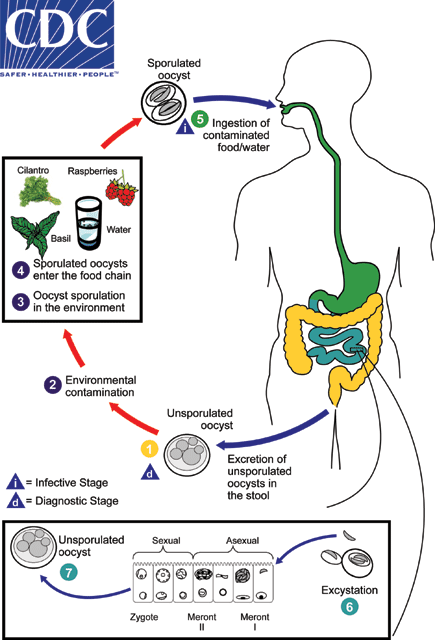
Cyclospora cayetanensis is a protozoan parasite that causes the diarrheal illness known as cyclosporiasis. People acquire this infection by consuming food or water contaminated with feces containing Cyclospora. Cyclosporiasis was not previously a reportable disease in the U.S., so its rise in prevalence is due in large part to the increased availability of tests that can detect Cyclospora. It is now a nationally notifiable disease, so physicians are required to report cases of this infection.

The first three cases of cyclosporiasis were reported in 1977 and 1978, but the parasite that was causing the illnesses could not at that time be identified as Cyclospora cayetanensis; it was not until 1979 that the correct identification was made.

USA – Sewage release prompts shellfish harvesting ban for Upper Machodoc Creek

WTVR

RICHMOND, Va. —Health officials announced Saturday night that a release of partially treated sewage has closed all shellfish harvesting in Upper Machodoc Creek in King George County.

As a result, shellfish, which include bivalve mollusks like oysters and clams, from impacted areas are not safe to eat because of “potential microbiological pollution hazards,” officials with the Virginia Department of Health said.