Category Archives: LAB

Research – Antifungal Preservation of Food by Lactic Acid Bacteria

MDPI

Aflatoxin

Image CDC

Fungal growth and consequent mycotoxin release in food and feed threatens human health, which might even, in acute cases, lead to death. Control and prevention of foodborne poisoning is a major task of public health that will be faced in the 21st century. Nowadays, consumers increasingly demand healthier and more natural food with minimal use of chemical preservatives, whose negative effects on human health are well known. Biopreservation is among the safest and most reliable methods for inhibiting fungi in food. Lactic acid bacteria (LAB) are of great interest as biological additives in food owing to their Generally Recognized as Safe (GRAS) classification and probiotic properties. LAB produce bioactive compounds such as reuterin, cyclic peptides, fatty acids, etc., with antifungal properties. This review highlights the great potential of LAB as biopreservatives by summarizing various reported antifungal activities/metabolites of LAB against fungal growth into foods. In the end, it provides profound insight into the possibilities and different factors to be considered in the application of LAB in different foods as well as enhancing their efficiency in biodetoxification and biopreservative activities. View Full-Text
Research – Lactic Acid Bacteria as Antimicrobial Agents: Food Safety and Microbial Food Spoilage Prevention

MDPI

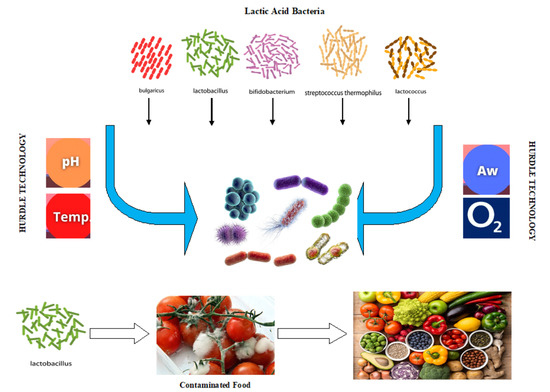
In the wake of continual foodborne disease outbreaks in recent years, it is critical to focus on strategies that protect public health and reduce the incidence of foodborne pathogens and spoilage microorganisms. Currently, there are limitations associated with conventional microbial control methods, such as the use of chemical preservatives and heat treatments. For example, such conventional treatments adversely impact the sensorial properties of food, resulting in undesirable organoleptic characteristics. Moreover, the growing consumer advocacy for safe and healthy food products, and the resultant paradigm shift toward clean labels, have caused an increased interest in natural and effective antimicrobial alternatives. For instance, natural antimicrobial elements synthesized by lactic acid bacteria (LAB) are generally inhibitory to pathogens and significantly impede the action of food spoilage organisms. Bacteriocins and other LAB metabolites have been commercially exploited for their antimicrobial properties and used in many applications in the dairy industry to prevent the growth of undesirable microorganisms. In this review, we summarized the natural antimicrobial compounds produced by LAB, with a specific focus on the mechanisms of action and applications for microbial food spoilage prevention and disease control. In addition, we provide support in the review for our recommendation for the application of LAB as a potential alternative antimicrobial strategy for addressing the challenges posed by antibiotic resistance among pathogens. View Full-Text

Research – The Influence of Environmental Conditions on the Antagonistic Activity of Lactic Acid Bacteria Isolated from Fermented Meat Products

MDPI

The aim of this study was to determine the impact of environmental conditions on the antimicrobial properties of 21 lactic acid bacteria strains in the selected indicator bacteria. To assess the antimicrobial activity of the whole bacteria culture (WBC), the agar well diffusion method was used. The interference of LAB strains with the growth of the selected indicator bacteria was evaluated by incubating co-cultures in the food matrix. Based on the conducted research, it was found that environmental conditions have a significant impact on the antimicrobial activity of lactic acid bacteria strains. The highest antimicrobial activity was recorded under optimal conditions for the development of LAB, the incubation time being different depending on the indicator strain used. The tested LAB strains were characterized by a high ability to inhibit indicator strains, especially in the food matrix. These results led us to further characterize and purify the antimicrobial compound produced by lactic acid bacteria taking into account changing environmental conditions. View Full-Text

Denmark – Gas evolution in tomato ketchup – Lactic Acid Bacteria

DVFA

Scandic Food A / S is recalling REMA1000 Tomato Ketchup, as a few bottles have been found with growth of lactic acid bacteria, which cause gas evolution.

Recalled Foods , Published: September 27, 2021

What foods:
REMA1000 Tomato ketchup
Net content: 1,000 grams
Best before date: 03/25/2022

Sold in:
REMA1000

Company withdraws:
Scandic Food A / S

Reason:
The company has found gas development in some of the products. Gas evolution is due to unwanted growth of lactic acid bacteria.

Risk:
The unwanted growth of lactic acid bacteria and gas evolution make the product unfit for human consumption.

Advice for consumers: The Danish
Veterinary and Food Administration advises consumers to deliver the product back to the store where it was purchased or to discard it.

Research – Presumptive probiotic bacteria from traditionally fermented African food challenge the adhesion of enteroaggregative E. coli

Wiley Online

E.coli

Colonization of intestinal tract with the potential to exclude, displace, and inhibit enteric pathogens is principally dependent on the adhesion ability of probiotics. Therefore, probiotic efficacy is considered to be mainly determined by their adhesion ability. The current study reports the antagonistic effect of four lactic acid bacteria (LAB) on the adhesion profile of four diarrhoeagenic and one non‐diarrhoeagenic enteroaggregative Escherichia coli (EAEC). All the bacterial strains investigated adhered to the Caco‐2 cells. All the LAB tested competitively excluded, displaced, and inhibited at least three (non‐) diarrhoeagenic EAEC strains from adhesion (p < 0.05). In all, Lactobacillus plantarum, FS2 exhibited the strongest adhesion to the Caco‐2 cells, competitive exclusion (CE), displacement, and inhibition against most of the EAEC strains. Additionally, the competence to exclude, displace, and inhibit the EAEC from adhesion depended on both the pathogens and the LAB strains tested; signifying the participation of several mechanisms. Contrary to all the EAEC strains, gastro‐intestinal stress factors such as low pH (2.5) had no effect on the adhesion of the LAB. Unlike the gastro‐intestinal acidic conditions, bile salt conditioning (at pH 6.5) had no effect on the adhesion of both EAEC and LAB. In conclusion, all the LAB tested showed specific anti‐adherence effects including CE, displacement, and inhibition against the selected EAEC. The results indicate that all the LAB, particularly, the L. plantarum, FS2 had a good ability for exerting antagonistic effects against the selected EAEC for the prevention of gastrointestinal infection.