Research – The influence of organic load and free chlorine on Salmonella cross-contamination of tomatoes in a model flume system

Journal of Food Protection

The process of washing tomatoes in dump (flume) tanks has been identified as a potential source of cross-contamination. This study’s objective was to assess the potential for Salmonella enterica cross-contamination at various inoculation levels at the presence of 0 and 25 mg/L free chlorine (HOCl) and organic matter.  Uninoculated tomatoes were introduced into a laboratory-based model flume containing tomatoes inoculated with a cocktail of five rifampicin-resistant Salmonella enterica serovars at 104, 106, or 108 CFU/tomato in water containing 0 or 25 mg/L HOCl and 0 or 300 mg/L chemical oxygen demand (COD). Uninoculated tomatoes were removed from the water at after 5, 30, 60, 120 s and were placed in bags containing tryptic soy broth supplemented with rifampicin and 0.1% sodium thiosulfate. Following incubation, enrichments were plated on tryptic soy agar supplemented with rifampicin and xylose lysine deoxycholate agar to determine the presence of Salmonella. HOCl and pH were measured before and after each trial. The HOCl in water containing 300 mg/L COD significantly (P≤0.05) declined by the end of each 120 s trial, most likely due to the increased demand for the oxidant. Higher inoculum levels and lower HOCl concentrations were (P≤0.05) significant factors that contributed to increased cross-contamination seen in this study. When HOCl levels were at 25 mg/L, no Salmonella was recovered on non-inoculated tomatoes under all conditions when inoculum levels were at 104 CFU/tomato. When the inoculum was increased to 106 and 108 CFU/tomato, cross-contamination was observed, independent of COD levels. The results from this study show that the currently required sanitizer level (e.g., 100 or 150 mg/L) for flume water may be higher than necessary and warrants re-evaluation.

Information – Lettuce, Other Leafy Greens, and Food Safety

CDC

Eurofins Food Testing UK

Vegetables are an important part of a healthy, balanced diet. Leafy vegetables (called leafy greens on this page) such as lettuce, spinach, cabbage, kale, and bok choy, provide nutrients that help protect you from heart disease, stroke, and some cancers.

But leafy greens, like other vegetables and fruits, are sometimes contaminated with harmful germs. Washing does not remove all germs because they can stick to the surfaces of leaves and even get inside them. If you eat contaminated raw (uncooked) leafy greens, such as in a salad, you might get sick. To prevent contamination, leafy greens should be grown and handled safely at all steps in the journey from farm to fork.

  • CDC estimates that germs on produce that is eaten raw cause a large percentage of U.S. foodborne illnesses (also called food poisoning).
  • Leafy greens and other vegetable row crops are a major source of E. coli O157 infections.
  • Other harmful germs found on leafy greens include norovirus, Salmonella, Listeria, and Cyclospora.

Although anyone can get food poisoning, these groups are more likely to get sick and to have a more serious illness:

  • Adults aged 65 and older
  • Children younger than 5 years
  • People who have health problems or take medicines that lower the body’s ability to fight germs and sickness (a weakened immune system)
  • Pregnant women
Image

Infographic- CDC

Information – Cold Food Storage Chart

Follow the guidelines below for storing food in the refrigerator and freezer. The short time limits for home-refrigerated foods will help keep them from spoiling or becoming dangerous to eat. The guidelines for freezer storage are for quality only—frozen foods stored continuously at 0 °F or below can be kept indefinitely.

Looking for a specific item? Check out FoodKeeper to find storage tips for over 650 food and beverages.

PDF Table

Food Type Refrigerator
(40 °F or below)
Freezer
(0 °F or below)
Salad Egg, chicken, ham, tuna, and macaroni salads 3 to 4 days Does not freeze well
Hot dogs Opened package 1 week 1 to 2 months
Unopened package 2 weeks 1 to 2 months
Luncheon meat Opened package or deli sliced 3 to 5 days 1 to 2 months
Unopened package 2 weeks 1 to 2 months
Bacon and sausage Bacon 1 week 1 month
Sausage, raw, from chicken, turkey, pork, or beef 1 to 2 days 1 to 2 months
Sausage, fully cooked, from chicken, turkey, pork, or beef 1 week 1 to 2 months
Sausage, purchased frozen After cooking, 3-4 days 1-2 months from date of purchase
Hamburger, ground meats and ground poultry Hamburger, ground beef, turkey, chicken, other poultry, veal, pork, lamb, and mixtures of them 1 to 2 days 3 to 4 months
Fresh beef, veal, lamb, and pork Steaks 3 to 5 days 4 to 12 months
Chops 3 to 5 days 4 to 12 months
Roasts 3 to 5 days 4 to 12 months
Ham Fresh, uncured, uncooked 3 to 5 days 6 months
Fresh, uncured, cooked 3 to 4 days 3 to 4 months
Cured, cook-before-eating, uncooked 5 to 7 days or “use by” date 3 to 4 months
Fully-cooked, vacuum-sealed at plant, unopened 2 weeks or “use by” date 1 to 2 months
Cooked, store-wrapped, whole 1 week 1 to 2 months
Cooked, store-wrapped, slices, half, or spiral cut 3 to 5 days 1 to 2 months
Country ham, cooked 1 week 1 month
Canned, labeled “Keep Refrigerated,” unopened 6 to 9 months Do not freeze
Canned, shelf-stable, opened

Note: An unopened, shelf-stable, canned ham can be stored at room temperature for 2 years.

3 to 4 days 1 to 2 months
Prosciutto, Parma or Serrano ham, dry Italian or Spanish type, cut 2 to 3 months 1 month
Fresh poultry Chicken or turkey, whole 1 to 2 days 1 year
Chicken or turkey, pieces 1 to 2 days 9 months
Eggs Raw eggs in shell 3 to 5 weeks Do not freeze in shell. Beat yolks and whites together, then freeze.
Raw egg whites and yolks

Note: Yolks do not freeze well

2 to 4 days 12 months
Raw egg accidentally frozen in shell

Note: Toss any frozen eggs with a broken shell

Use immediately after thawing Keep frozen, then
refrigerate to thaw
Hard-cooked eggs 1 week Do not freeze
Egg substitutes, liquid, unopened 1 week Do not freeze
Egg substitutes, liquid, opened 3 days Do not freeze
Egg substitutes, frozen, unopened After thawing, 1 week or refer to “use by” date 12 months
Egg substitutes, frozen, opened After thawing, 3 to 4 days or refer to “use by” date Do not freeze
Casseroles with eggs After baking, 3 to 4 days After baking, 2 to 3 months
Eggnog, commercial 3 to 5 days 6 months
Eggnog, homemade 2 to 4 days Do not freeze
Pies: Pumpkin or pecan After baking, 3 to 4 days After baking, 1 to 2 months
Pies: Custard and chiffon After baking, 3 to 4 days Do not freeze
Quiche with filling After baking, 3 to 5 days After baking, 2 to 3 months
Soups and stews Vegetable or meat added 3 to 4 days 2 to 3 months
Leftovers Cooked meat or poultry 3 to 4 days 2 to 6 months
Chicken nuggets or patties 3 to 4 days 1 to 3 months
Pizza 3 to 4 days 1 to 2 months
Image

Infographic – CDC

Information – Food Safety and Eating Out

CDC

Going out to eat? Choose a restaurant that keeps food safety on the menu. Here are some tips to protect yourself from food poisoning while eating out.

Tips to Avoid Food Poisoning While Eating Out

  • Check inspection scores. Check a restaurant’s score at your health department’s website, ask the health department for a copy of the report, or look for it when you get to the restaurant.
  • Look for certificates that show kitchen managers have completed food safety training. Proper food safety training can help improve practices that reduce the chance of spreading foodborne germs and illnesses.
  • Look for safe food-handling practices. Sick food workers pdf icon[PDF – 2 pages] can spread their illness to customers. If you can see food being prepared, check to make sure workers are using gloves or utensils to handle foods that will not be cooked further, such as deli meats and salad greens.
  • Order food that’s properly cooked. Certain foods, including meat, poultry, and fish, need to be cooked to a temperature high enough to kill harmful germs that may be present. If a restaurant serves you undercooked meat, poultry, seafood, or eggs, send it back to be cooked until it is safe to eat.
  • Avoid lukewarm food. Cold food should be served cold, and hot food should be served hot. If you’re selecting food from a buffet or salad bar, make sure the hot food is steaming and the cold food is chilled. Germs that cause food poisoning grow quickly when food is in the danger zone, between 40°F and 140°F.
  • Ask your server if they use pasteurized eggs in foods such as Caesar salad dressing, custards, tiramisu, and hollandaise sauce. Raw or undercooked eggs can make you sick unless they’re pasteurized to kill germs.
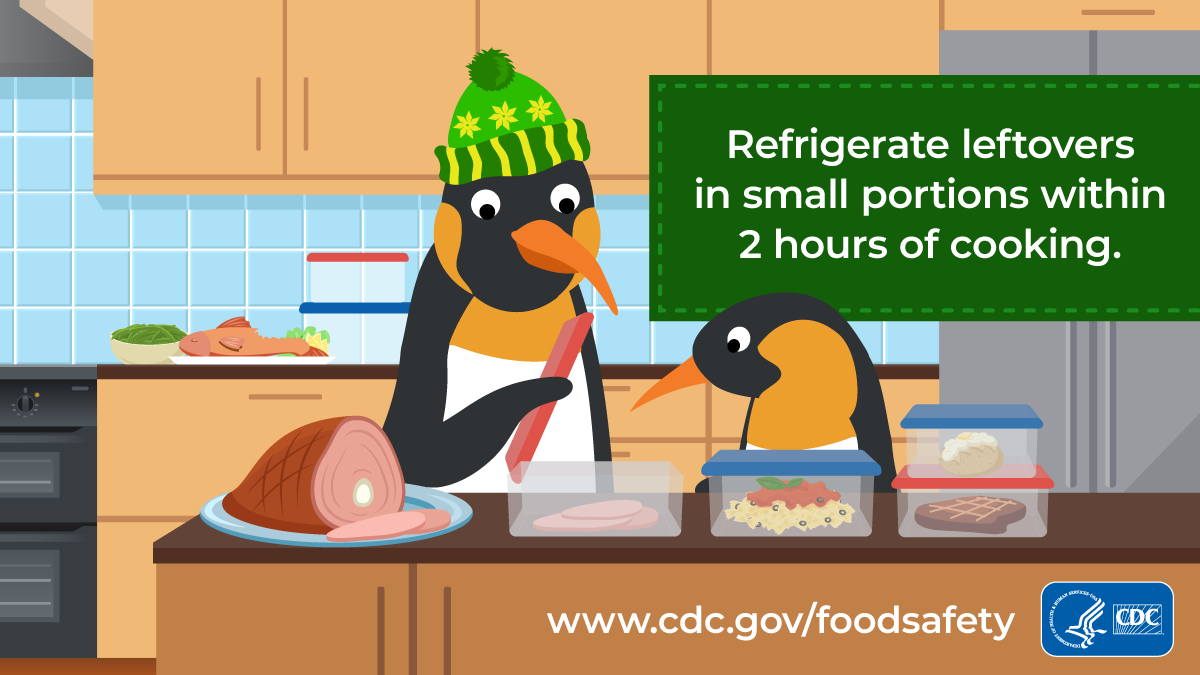
  • Take care of your leftovers quickly. Refrigerate leftovers within 2 hours of eating out. If it is above 90°F outside, refrigerate leftovers within 1 hour. Eat leftovers within 3 to 4 days. Throw them out after that time.

Information – Four Steps to Food Safety: Clean, Separate, Cook, Chill

CDC

Following four simple steps at home—Clean, Separate, Cook, and Chill—can help protect you and your loved ones from food poisoning.
Clean your hands

Clean: Wash your hands and surfaces often

  • Germs that cause food poisoning can survive in many places and spread around your kitchen.
  • Wash hands for 20 seconds with soap and water before, during, and after preparing food and before eating.
  • Wash your utensils, cutting boards, and countertops with hot, soapy water.
  • Rinse fresh fruits and vegetables under running water.
separate meats from vegetables don't cross contaminate

Separate: Don’t cross-contaminate

  • Raw meat, poultry, seafood, and eggs can spread germs to ready-to-eat foods—unless you keep them separate.
    • Use separate cutting boards and plates for raw meat, poultry, and seafood.
    • When grocery shopping, keep raw meat, poultry, seafood, and their juices away from other foods.
    • Keep raw meat, poultry, seafood, and eggs separate from all other foods in the fridge.
Cook to the right temperature

Cook: To the right temperature

  • Food is safely cooked when the internal temperature gets high enough to kill germs that can make you sick. The only way to tell if food is safely cooked is to use a food thermometer. You can’t tell if food is safely cooked by checking its color and texture.
  • Use a food thermometer to ensure foods are cooked to a safe internal temperature. Check this chart for a detailed list of foods and temperatures
    • 145°F for whole cuts of beef, pork, veal, and lamb (then allow the meat to rest for 3 minutes before carving or eating)
    • 160°F for ground meats, such as beef and pork
    • 165°F for all poultry, including ground chicken and turkey
    • 165°F for leftovers and casseroles
    • 145°F for fresh ham (raw)
    • 145°F for fin fish or cook until flesh is opaque
Refrigerate food promptly to avoid food poisoning

Chill: Refrigerate promptly

Bacteria can multiply rapidly if left at room temperature or in the “Danger Zone” between 40°F and 140°F. Never leave perishable food out for more than 2 hours (or 1 hour if it’s hotter than 90°F outside).

  • Keep your refrigerator at 40°F or below and know when to throw food out.
  • Refrigerate perishable food within 2 hours. (If outdoor temperature is above 90°F, refrigerate within 1 hour.)
  • Thaw frozen food safely in the refrigerator, in cold water, or in the microwave. Never thaw foods on the counter, because bacteria multiply quickly in the parts of the food that reach room temperature.
Image

Infographic – CDC

Image

Infographic – CDC

Research – Survival of Escherichia coli and Listeria innocua on Lettuce after Irrigation with Contaminated Water in a Temperate Climate

MDPI

Microbial disease outbreaks related to fresh produce consumption, including leafy green vegetables, have increased in recent years. Where contamination occurs, pathogen persistence may represent a risk for consumers’ health. This study analysed the survival of E. coli and L. innocua on lettuce plants watered with contaminated irrigation water via a single irrigation event and within stored irrigation water. Separate lettuce plants (Lactuca sativa var. capitata) were irrigated with water spiked with Log10 7 cfu/mL of each of the two strains and survival assessed via direct enumeration, enrichment and qPCR. In parallel, individual 20 L water microcosms were spiked with Log10 7 cfu/mL of the individual strains and sampled at similar time points. Both strains were observed to survive on lettuce plants up to 28 days after inoculation. Direct quantification by culture methods showed a Log10 4 decrease in the concentration of E. coli 14 days after inoculation, and a Log10 3 decrease in the concentration of L. innocua 10 days after inoculation. E. coli was detected in water samples up to 7 days after inoculation and L. innocua was detected up to 28 days by direct enumeration. Both strains were recovered from enriched samples up to 28 days after inoculation. These results demonstrate that E. coli and L. innocua strains are able to persist on lettuce after a single contamination event up until the plants reach a harvestable state. Furthermore, the persistence of E. coli and L. innocua in water for up to 28 days after inoculation illustrates the potential for multiple plant contamination events from stored irrigation water, emphasising the importance of ensuring that irrigation water is of a high quality. View Full-Text