Tag Archives: technology

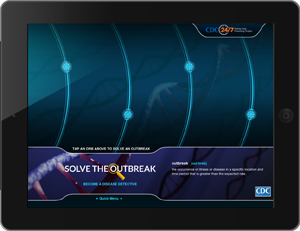
Play the Game – CDC iPAD Outbreak Detective

CDC iPad-STO-sm

Scientists and gamers alike can now play disease detective,  through “Solve the Outbreak,” a new iPad app from the Centers for Disease  Control and Prevention. The app lets users assume the role of a disease  outbreak investigator in the agency’s Epidemic Intelligence Service (EIS) by  navigating three fictional outbreaks based on real-life events. Users get  clues, review data, and make decisions to determine the cause of the outbreak.

“The goal is to use new technology to  provide an  engaging, interactive way for users to learn how CDC solves outbreaks, thereby  increasing general knowledge about real-life public health issues,” said CDC  Director Dr. Tom Frieden. “This application allows us to illustrate the  challenges of solving outbreaks and how our disease detectives work on the  front lines to save lives and protect people 24/7.”

In the game, participants also become familiar with health  tips, definitions and information about epidemiology, which is a science used to investigate outbreaks and to  monitor patterns, causes and effects of diseases on the public. Users  advance in rank as they earn points and can post their results on Facebook and  Twitter to challenge other participants.

“This is a great learning tool for science teachers, teens,  young adults, public health enthusiasts and mystery lovers,” said Carol  Crawford, branch chief, CDC’s Electronic Media Branch.  “The three  introductory scenarios are based on actual events EIS officers have  solved.  We also plan to add new outbreak cases.”

USA – “No Illness” Declaration Viewpoint

Food Safety News

Food companies that are voluntarily recalling a product usually use the language suggested by regulatory agencies that is then distributed electronically via the federal government websites. Recalls not connected to outbreaks almost always contain a line saying there are no reported illnesses associated with the recalled product.

William E. Keene, Oregon’s senior state epidemiologist, thinks it’s time for reporters and editors to “not let themselves be duped into amplifying press release boilerplate.”

Both the U.S. Food and Drug Administration (FDA) and USDA’s Food Safety and Inspection Service (FSIS) have templates for companies to use when writing a recall announcement. They are:

FDA: ”No illnesses have been reported to date.”

FSIS: “There have been no reports of illnesses associated with consumption of these products.”

“Until they have the isolate(s) serotyped, have PFGE’d (conducted a pulsed-field gel electrophoresis analysis), and compared to PulseNet or analogous data,” says Keene, “they are just blowing smoke.” He says that without subtyping data, the media should not fall for it. The only accurate report is that there is no way of knowing (at this time) if there are any associated illnesses.

UK – FSA – Christmas Food Safety Information

FSAfood_standards_agency_logo

The Food Standards Agency has traditionally used the festive season to remind consumers about food safety. This year, we are planning a twist on this tradition. During the run up to Christmas, we will be tweeting daily tips, hosting an online advent calendar and a festive infographic with all the tips you need to make sure your Christmas meal is fit for kings.

As we get closer to the big day itself, we will be encouraging you to share your Christmas food pictures, stories and questions regarding cooking at Christmas across our social networks including Facebook and Pinterest. We’re also teaming up with NHS Choices to host a series of tweet chats on 19, 20 and 21 December.

Join in the conversation this Christmas and follow us on Twitter @foodgov.

Research – Mobile Phones and Bugs

HACCPEUROPA

Our generation uses mobile phones and smartphones for work, college, making phone calls, reminders, sending messages, emails, music, photographs, games and the internet. Over 80% of the world citizens are in a possession of mobile phones.

With how attached people have become to their mobile phones or smartphones, it’s not a surprise that what we touch ends up on the screen. It’s what exactly ends up there that’s the real shocker.

Researchers from UW-Milwaukee’s Microbiology department tested heavily used mobile phones.

The tests found traces of E. coli and other coliforms. Coliforms are a bacteria indicating fecal contamination. They found between about 2,700 and 4,200 units of coliform bacteria on 8 phones.

Research Information on Food Preservation Download

Food Navigator Download

Preservatives are essential additives to prevent microbial spoilage and ensure food & beverage safety. This application note provides practical guidelines for the use of traditional preservatives as well as an introduction to clean label innovations.

FSA – Food Handlers Fitness to Work Advice

FSA

Food handlers who work while infected with certain bacteria or viruses can spread infection to other people through food they work with. This guidance helps managers and staff to prevent the spread of infection by advising which illnesses and symptoms staff should report and what managers should do in response.

Research – Listeria Control on Smoked Salmon by X – Ray

Science Direct

Abstract

In this study, smoked salmon fillets were artificially inoculated with L. monocytogenes (3.7±0.2 log CFU/g) and treated with X-ray irradiation generated by a RS 2400 X-ray machine (Rad Source Technologies Inc.) using doses of 0.0, 0.1, 0.5, 1.0, and 2.0 kGy. Unirradiated and irradiated samples were then stored at 5°C for 35 days and tested for L. monocytogenes count after 0, 5, 10, 15, 20, 25, 30, and 35 days. Also, uninoculated-untreated and uninoculated-treated samples with the lowest and highest X-ray doses (0.1 and 2.0 kGy) were stored at 5°C and examined for psychrotrophs and mesophiles counts after 0, 5, 10, 15, 20, 25, 30, and 35 days. The initial L. monocytogenes population (3.7 log CFU/g) was significantly (p<0.05) reduced to an undetectable level (< 1.0 log CFU/g) by treatment with 1.0 kGy X-ray. Treatment with 0.1 kGy X-ray significantly reduced the initial psychrotrophs and mesophiles counts from 5.3 and 3.0 to 3.3 and 2.3, respectively. However, L. monocytogenes, psychrotrophs and mesophiles counts were gradually increased during storage. Treatment with 2.0 kGy X-ray kept the L. monocytogenes population under detectable level until 35 days. Treatment with 2.0 kGy X-ray kept the mesophiles and psychrotrophs counts within the acceptable level until 35 days. These results revealed that treatment with X-ray irradiation can significantly reduce the risk of Listeriosis and extend the shelf life of smoked salmon during storage at 5°C.


Commercial Advert – Listeria Predictive Modelling – Purac

I have not checked this out yet I am just passing on the information for those of you that may have an interest.

Purac Listeria Control Model 2012 predicts the growth of Listeria monocytogenes in food products, with the use of eight food characteristics. Purac has already launched a number of editions of the model, yet the recently launched Purac Listeria Control Model 2012 is an online version on the forefront of Listeria growth modeling.

It is of great value during product development, as it has been developed using over 2500 individual growth curves of statistically designed experiments. It enables you to save valuable R&D cost and increase speed-to-market.

Purac

France – Sardine Recall – Histamine

Rappels

The retailer Casino announced Monday, June 11 a recall of batches of canned sardines contaminated with histamine, a compound that is resistant to cooking and can cause digestive disorders, skin problems and headaches.

The products that must be returned to store are boxes of 120g of sardines in vegetable oil brand “Every Day” with the lot number BJ.L 019F, and as expiration date, January 19, 2017. These boxes have the barcode 3700311820348 when they are sold individually and in sets of three 3700311820331.

Also recalled are 120g cans of sardines in tomato sauce, branded “Everyday”, bearing the lot number BJ.L 020E, and the expiration date of January 20, 2015. These boxes have the barcode 3700311820362 when they are sold individually and in sets of three 3700311820355.

Casino has told customers not to eat these sardines and return them to the store for refund. These foods have significant levels of histamine that can cause, soon after ingestion, digestive problems or skin rash, accompanied by headaches,” even after cooking.

People who have consumed the products mentioned above and are presenting these symptoms should consult their doctor and draw attention to the consumer,” he adds.

A free call on 0800 13 30 16 provides more information.

Oyster Sauce – From China – Staphylococcus saprophyticus

RASFF

Staphylococcus – coagulase negative (Staphylococcus saprophyticus) in oyster sauce from China, via Poland

   
Reference :2012.0605  
Notification date :02/05/2012  
Last update :02/05/2012  
Notification type : food  –  information for follow-up  –  consumer complaint  
Action taken : withdrawal from the market  
Notification from : CZECH REPUBLIC (CZ)  
Distribution status :information on distribution not (yet) available  
Product :oyster sauce  
Product category :soups, broths, sauces and condiments  
Follow-up :

Reference Follow-up from Date Follow-up type Info
Hazards :

Substance / Hazard Category Analytical result Units Sampling date
Staphylococcus – coagulase negative pathogenic micro-organisms Staphylococcus saprophyticus    
Distributed to :

| CZECH REPUBLIC  |
Origin :

| CHINA | POLAND  (VIA)  |