Category Archives: Pet Food Testing

USA – TFP Nutrition Initiated Voluntary Recall of 16 lb. Bags of HEB TEXAS PETS Indoor Complete Dry Cat Food Because of Possible Salmonella Health Risk

FDA

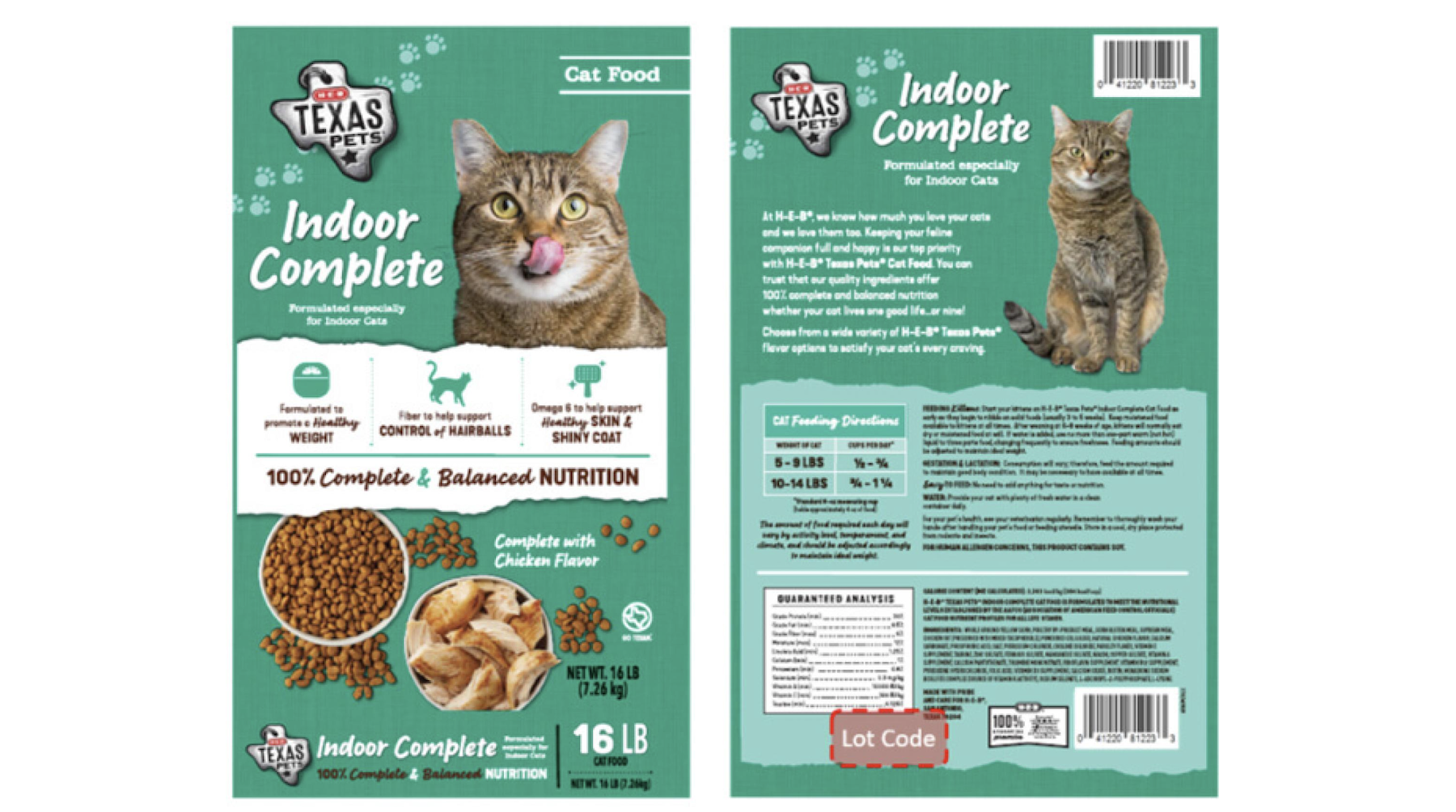
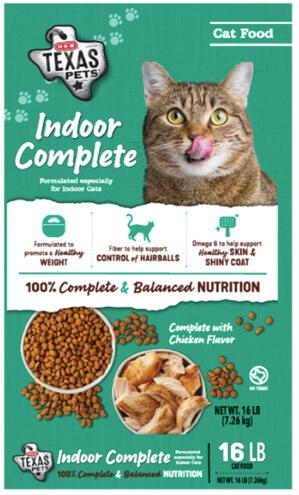
Front of bag, HEB TEXAS PETS Indoor Complete Dry Cat Food

Company Announcement Date:
FDA Publish Date:
Product Type:
Food & Beverages
Reason for Announcement:
Potential Salmonella contamination
Company Name:
TFP Nutrition
Brand Name:
HEB TEXAS PETS
Product Description:
HEB TEXAS PETS Indoor Complete Dry Cat Food

Company Announcement

TFP Nutrition announced today that it is issuing a voluntary recall of a dry cat food formulation manufactured on November 13, 2022, at its Nacogdoches, Texas facility. HEB Texas Pets Indoor Complete Dry Cat Food is being recalled due to potential Salmonella contamination. Salmonella can affect animals eating the products and there is risk to humans from handling contaminated cat products, especially if they have not thoroughly washed their hands after having contact with the products or any surfaces exposed to these products. No cat or human illness has been reported with respect to the recalled cat food to date.

Cats with Salmonella infections may be lethargic and have diarrhea or bloody diarrhea, fever, and vomiting. Some cats will have only decreased appetite, fever and abdominal pain. Infected but otherwise healthy cats can be carriers and infect other animals or humans. If your cat has consumed the recalled product and has these symptoms, please contact your veterinarian.

Healthy people infected with Salmonella should monitor themselves for some or all of the following symptoms: nausea, vomiting, diarrhea or bloody diarrhea, abdominal cramping and fever. Rarely, Salmonella can result in more serious ailments, including arterial infections, endocarditis, arthritis, muscle pain, eye irritation, and urinary tract symptoms. Consumers exhibiting these signs after having contact with this product should contact their healthcare providers.

This product was only distributed in the State of Texas and sold in HEB retail stores. All recalled product has been removed from store shelves and no other HEB products are affected by the voluntary recall. Affected product will contain “MFG 13 NOV 22” on the second line of the lot code located on the back of the bag.

Description Size Production Code
H-E-B Texas Pets Indoor Complete Dry Cat Food 16 lb. MFG 13 NOV 22

Cat owners who are unsure if the product they purchased is included in the recall, or would like a replacement product or refund, may contact TFP Nutrition via a toll-free call at 1-800-560-9197, Monday through Sunday, 8 am – 5pm CST. Consumers may also go to tfpnutrition.com/recallExternal Link Disclaimer for more information.


Company Contact Information

Consumers:
TFP Nutrition
 800-560-9197
Media:
 800-560-9197

USA – H-E-B Texas Pets Indoor Complete Dry Cat Food – Salmonella

Petful

Photos of the front and back of the package of H-E-B Texas Pets Indoor Complete Dry Cat Food that is being recalled.

Maker: TFP Nutrition
Cause: Potential salmonella contamination
Announcement: FDA recall notice dated Dec. 16, 2022 (archived here)
What was recalled: 16 lb. bags of H-E-B Texas Pets Indoor Complete Dry Cat Food with Production Code “MFG 13 NOV 22”

TFP Nutrition has announced a voluntary recall of a batch of its H-E-B Texas Pets Indoor Complete Dry Cat Food due to potential contamination with salmonella. The affected product was manufactured on Nov. 13, 2022, at the company’s facility in Nacogdoches, Texas, and was distributed only in that state and sold exclusively in H-E-B retail stores.

Salmonella can affect animals that consume contaminated products and also poses a risk to humans who handle the products, particularly if they do not wash their hands thoroughly after contact. No cases of illness in either cats or humans have been reported in relation to the recalled cat food at this time.

RASFF Alerts – Animal Feed – Salmonella – Pet Food – Rapeseed Mealt

RASFF

Salmonella Spp in processed animal proteins (SOA cat.3) for petfood from Czech Republic in Italy

RASFF

Salmonella Senftenberg in the post-extraction rapeseed meal from Ukraine in Poland

RASFF Alerts – Animal Feed – Enterobacteriaceae – Dog Chews

RASFF

High count of Enterobacteriaceae in dog chews from China in Sweden

RASFF

Too high count of Enterobacteriaceae in dog chews from Turkey in Germany

RASFF

Enterobacteriaceae in dog chews from Turkey in Germany

RASFF Alerts – Animal Feed – Salmonella – soy Cake – Soya Bean Meal – Poultry Meal – Lamb Meal

RASFF

Salmonella in organic soy cake in Denmark and Sweden

RASFF

Salmonella Orion in Soya bean meal, gmo from Germany in Switzerland and Finland

RASFF

Salmonella in poultry meal from Germany in Belgium

RASFF

Salmonella in lamb meal from Italy in the Czech Republic

Research – Salmonella rising in British raw meat pet food

Pet Food Industry

The occurrence of Salmonella in raw pet food seems to be rising in Great Britain. Raw meat pet food had the highest number of Salmonella contaminated samples of all the feeds tested by the UK’s Animal and Plant Health Agency scientists. The agency report “Salmonella in Animals and Feed in Great Britain 2021” documented an upward trend.

In 2021, the agency’s laboratories isolated 295 instances of Salmonella from raw pet food available on the British market. That’s up 8.1% from 2020’s 273 isolations, and 20.4% higher than 2019 with 245 isolations.

Some of these Salmonella bacteria were from strains with resistance to drugs used to fight infection. These potentially dangerous pathogens were found in 71 of the samples taken in 2021. These made up 57.3% of the total regulated varieties of Salmonella found by the Animal and Plant Health Agency in 2021 among all feeds and locations tested. The proportion of drug-resistant Salmonella in British raw meat pet food didn’t increase much over 2020, but did show an upward tendency compared to 2019.

“Contaminated raw meat pet food, which does not undergo any heat treatment to deactivate pathogens, may therefore represent a potential source of infection to both the dogs consuming it and people who handle it, especially if insufficient hygiene measures are adopted,” the report authors wrote.

RASFF Alerts – Animal Feed – Salmonella – Dog Chews

RASFF

Salmonella in dog chews from South Africa in the Netherlands and Belgium

RASFF Alert – Animal Feed – Salmonella – Frozen Fish

RASFF

Salmonella in frozen fish for pet food from Spain in Italy

RASFF Alert – Animal Feed – Enterobacteriaceae – Dog Chews

RASFF

High count of Enterobacteriaceae in dog chews from China in Sweden

Research – Salmonella in animals and feed in Great Britain 2021

Gov UK

This publication presents data on Salmonella reports from livestock species in Great Britain (England, Wales and Scotland) collected and collated by the Animal and Plant Health Agency (APHA) during 2021 and also provides data from previous years for comparative purposes.
The data in the first 12 chapters cover reports of Salmonella in animals, with separate chapters for the main livestock species, reports of Salmonella in dogs, reports of Salmonella in wildlife and reports of Salmonella in animal feeding stuffs.
The 13th chapter covers antimicrobial resistance data for Salmonella (England and Wales only).Since 1993, the date of a Salmonella incident has been recorded as the date it was reported to an Officer of the Minister. Under the present system, any Salmonella reports that are confirmed or identified after the publication of the annual report will be incorporated into the revised tables that appear in the following year’s publication. This may result in the number of incidents and/ or isolations differing from that previously given for a particular year.
The most recent version of the report should therefore always be used when comparing data from year to year. Revisions in the way that data have been compiled and presented since 1993 mean that, with the exception of the tables on Salmonella in animal feeding stuffs, data in this report cannot be compared directly with information published prior to 1993. A more detailed comparison can be generated, if required, for any Salmonella serovar, or phage type in the case of S.Enteritidis and S. Typhimurium. Requests for such data should be made to the Department of Epidemiological Sciences, APHA Weybridge who will be happy to assist with requests at Foodbornezoonoses@apha.gov.uk. Care should be taken when comparing data from one year to another as an increase or decrease in the number of isolations and incidents does not necessarily indicate a similar change in prevalence. This is because the total number of samples examined and their distribution are often not known.