Category Archives: Legionella

Information -Are Garden Water Butts Contaminated with Legionella Bacteria?

Legionella Control Legionella A

Recent investigations suggest 95% of UK garden water butts may be contaminated with Legionella bacteria, the bug responsible for the potentially deadly Legionnaires’ disease.

Scientists working on behalf of Public Health England at the Porton Down facility have discovered most of the water butts in British gardens are likely contaminated with the potentially deadly Legionella bacteria. As part of a recent survey, they obtained samples from 113 water butts to determine whether the bacteria were present. Just six water butts were discovered to be free from the potentially deadly bacteria.

USA – Legionnaires’ disease cluster reported in Manhattan neighborhood

Outbreak News Today legionellac

The New York City Health Department are investigating a community cluster of 14 confirmed cases of Legionnaires’ disease in the Lower Washington Heights area of Manhattan

Health officials are investigating these cases and testing the water from all cooling tower systems in this section of Washington Heights.Ages of the individuals ranged from under 40 to over 80, but most were ages 50 and above. There have been no deaths associated with this cluster.

Research – Are Fountains & Ornamental Water Features a Legionnaires’ Disease Risk?

Legionella Control legionellac

Are water features a Legionnaires’ disease risk?

Legionella bacteria, which causes Legionnaires’ disease is present in naturally-occurring water sources, but it can develop at alarming rates in fountains and ornamental water features if the conditions are right, and if they are not treated correctly.

If the premises you maintain or look after includes a decorative water fountain or other type of water feature, it is essential you are aware of the potential dangers such water systems pose to you, your colleagues and visitors. This awareness ensures you can take appropriate steps to minimise the risks and so keep people safe.

UK – BUPA care home fined £3m after Legionnaires’ disease death

Legionella Control

A fatal case of Legionnaires’ disease at an Essex care home in 2015 has resulted in a £3 million fine for health insurance company BUPA after the Health and Safety Executive prosecuted the company for a series of management failings.

Kenneth Ibbetson was admitted to a BUPA Care Homes’ residential home in Essex in 2015, with his family paying £1000 per week for his care. The 86 year old had only been in the home for 12 weeks before contracting Legionnaires’ disease, which resulted in his death.

Research – Cryptosporidium, Pseudomonas and Legionella responsible for most outbreaks in swimming venues including hotel swimming pools

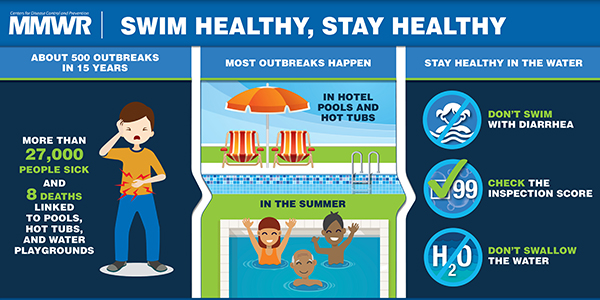
The figure is a visual abstract that details illnesses associated with recreational water and recommends how to stay healthy when swimming.

CDC-Outbreaks Associated with Treated Recreational Water — United States, 2000–2014

Outbreaks associated with exposure to treated recreational water can be caused by pathogens or chemicals in venues such as pools, hot tubs/spas, and interactive water play venues (i.e., water playgrounds). During 2000–2014, public health officials from 46 states and Puerto Rico reported 493 outbreaks associated with treated recreational water. These outbreaks resulted in at least 27,219 cases and eight deaths. Among the 363 outbreaks with a confirmed infectious etiology, 212 (58%) were caused by Cryptosporidium (which causes predominantly gastrointestinal illness), 57 (16%) by Legionella (which causes Legionnaires’ disease, a severe pneumonia, and Pontiac fever, a milder illness with flu-like symptoms), and 47 (13%) by Pseudomonas (which causes folliculitis [“hot tub rash”] and otitis externa [“swimmers’ ear”]). Investigations of the 363 outbreaks identified 24,453 cases; 21,766 (89%) were caused by Cryptosporidium, 920 (4%) by Pseudomonas, and 624 (3%) by Legionella. At least six of the eight reported deaths occurred in persons affected by outbreaks caused by Legionella. Hotels were the leading setting, associated with 157 (32%) of the 493 outbreaks. Overall, the outbreaks had a bimodal temporal distribution: 275 (56%) outbreaks started during June–August and 46 (9%) in March. Assessment of trends in the annual counts of outbreaks caused by Cryptosporidium, Legionella, or Pseudomonas indicate mixed progress in preventing transmission. Pathogens able to evade chlorine inactivation have become leading outbreak etiologies. The consequent outbreak and case counts and mortality underscore the utility of CDC’s Model Aquatic Health Code (https://www.cdc.gov/mahc) to prevent outbreaks associated with treated recreational water.

Hlavsa MC, Cikesh BL, Roberts VA, et al. Outbreaks Associated with Treated Recreational Water — United States, 2000–2014. MMWR Morb Mortal Wkly Rep 2018;67:547–551. DOI: http://dx.doi.org/10.15585/mmwr.mm6719a3

Research – Legionella Conference 2018: Controlling This Deadly Bacteria Will Take a Village

Outbreak News Today legionellac

Controlling Legionnaires’ disease will require a universal, preventive-based approach by a bevy of stakeholders ranging from building owners to hospital administrators, from public health officials to policymakers, and from scientists to water system engineers.

In other words, it’s going to take a village to get a handle on the deadliest waterborne disease in the United States, participants heard recently at Legionella Conference 2018 in Baltimore, co-sponsored by NSF International and the National Science Foundation.

Incidence of Legionnaires’ disease – a severe lung illness caused by Legionella bacteria inhaled from water distribution and premise plumbing systems – has jumped more than 300 percent since 2000. Yet preventative efforts, conference speakers said, are being hampered by a lack of awareness and inconsistent planning, testing and management of building water systems. There are more than 5 million commercial buildings in the United States.

Information – HSE Legionella ebulletin

HSE Legionella A

HSE Prosecution

On 20 April 2018, Royal United Hospitals Bath NHS Foundation Trust was fined by Bristol Crown Court for failing to control the risk to patients from exposure to legionella bacteria in its water systems.  After the death of one of its patients from Legionnaires’ disease, HSE started an investigation and found that existing control measures were ineffective.  The Trust pleaded guilty to breaching Section 3 (1) of the Health and Safety at Work etc Act 1974 and has been fined £300,000 and ordered to pay costs of £37,451.78.  Full details of the case may be found at :

http://press.hse.gov.uk/2018/nhs-trust-fined-after-exposing-patients-to-legionella-risk/


Cooling Tower Regulatory Intervention Programme

HM Principal Specialist Inspector of Health & Safety, Mr Duncan Smith will be giving an update on the findings of HSE’s latest cooling tower intervention programme to the Water Management Society Conference on 19 June 2018.  Details of the conference and how to register may be found at:

https://www.wmsoc.org.uk/conferences.php?id=627.

USA – Bronx: Legionnaires’ disease cases being investigated in Co-op City

Outbreak News Today Legionella A

New York City health officials announced Wednesday that they are investigating three Legionnaires’ disease cases in three connected buildings at Co-op City in the Bronx. One person has died and to others in connecting buildings have been treated and released from the hospital.

Health officials urged residents of these buildings to seek treatment if they experience symptoms of Legionnaires’ disease. In addition, residents who are over 50 or have underlying medical conditions should avoid showering until the investigation is completed.

“We are in the process of undertaking an examining the water system, a process we take very seriously”, a top health officials noted.

Legionnaires’ disease is the cause of pneumonia where a non productive cough is typical. In addition, it is typified by headache, fever, body aches and occasionally abdominal pain and diarrhea.

Legionella bacteria are widely distributed, and normally grow best in warm water environments. They have been found in creeks and ponds, water taps (primarily hot water taps), hot water tanks, cooling towers and evaporative condensers, whirlpool spas, and decorative fountains.


UK – Scotland- Legionella control in evaporative cooling systems

HPS Scotland legionellac

Evaporative cooling systems, such as cooling towers and evaporative condensers, are susceptible to colonisation by Legionella bacteria. Previous evidence has demonstrated that they can be responsible for sporadic outbreaks of infection, ranging in scale both in terms of numbers infected and severity. When such outbreaks occur, they frequently infect members of the public rather than workers and, in many cases, are a source of major public health concern.

Between 1 April 2013 and 31 August 2014, the Health and Safety Executive (HSE) inspected 1,906 premises with evaporative cooling systems. While the majority of sites required no enforcement, material breaches were found at 625 sites (33% of those inspected), including 409 Improvement Notices (INs) and 12 Prohibition Notices (PNs) served at 229 sites (12.0% of those inspected).

A recently published HSE Research Report analyses the underlying causes of breaches of health and safety compliance. The main ones were :

  • lack of training;
  • failure to maintain the cleanliness of cooling towers and the water within them;
  • absence of, or inadequate, risk assessments; and
  • absence of, or insufficiently detailed, written control schemes.

Further analysis looked into the reasons why cooling towers were not cleaned properly.
HSE considers that these results provide a valuable resource which can be used to focus future strategies to improve dutyholder compliance. Research Report 1118 ‘Legionella control in evaporative cooling systems: underlying causes of breaches in health and safety compliance’ can be accessed at http://www.hse.gov.uk/research/rrhtm/rr1118.htm.

USA – Crackers Recall – Salmonella

Food Safety News Salm

Glutino, a division of GFA Brands Inc. based in Paramus, NJ, is voluntarily recalling Glutino Rosemary and Olive Oil Snack Crackers because the seasoning supplier, Kerry Ingredients, recalled the seasoning blend due to possible Salmonella contamination.

The recalled Glutino Rosemary and Olive Oil Snack Crackers were distributed nationally through retail and warehouse club stores. The product affected is sold in a 4.25-ounce and a 20-ounce opaque white box with a “Best By” date of Oct. 26, 2014, stamped on the top of the box.

No illnesses have been reported to date with consumption of this product.