Category Archives: Eurofins Laboratories

Listeria monocytogenes – Canadian Recall

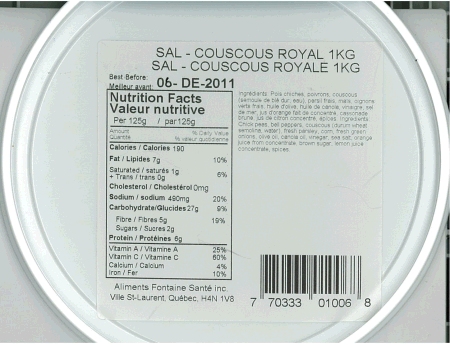
The Canadian Food Inspection Agency (CFIA) and Aliments Fontaine Santé Inc. are warning the public and retailers not to sell, use or consume the 1 kg “Sal-Couscous Royale” (Royal Couscous Salad) described below because the product may be contaminated with Listeria monocytogenes.

This product has been distributed in Quebec and Ontario and may also have been distributed nationally. There have been no reported illnesses associated with the consumption of this product.
US National Research Council Report – Public Posting of Enforcement Data

Publicly posting enforcement and testing data corresponding to specific meat, poultry, and egg products’ processing plants on the Internet could have “substantial benefits,” including the potential to favorably impact public health, says a new report from the National Research Council.  The report adds that the release of such data could contribute to increased transparency and yield valuable insights that go beyond the regulatory uses for which the data are collected. From my point of view I agree with the public should know, but great care would have  to be taken on the data released. As we have seen from information released in recent outbreaks that information is not always clear or correct.

This was also reported in an article in Food Quality News.

Norovirus Legal Limits and Control

An article in Food Production Daily has reported on a statement from the FSA that UK food safety authorities are not considering introducing new industrial processing techniques safety for oysters, despite over 75% grown in the UK containing the norovirus. The FSA are waiting in legal limits to be introduced by the EFSA.

USDA -Kitchen Companion – Food Safety

The USDA have a Food Safety PDF for Food Safety in the Kitchen that some of you may find interesting. It is of course american based, but the principles are still the same. Kitchen Companion

USDA – FSIS – Discussion on non O157 Toxin Producing Ecoli

The United States Department of Agriculture, Food Safety and inspection Service have announced that it will hold a public meeting on Dec. 1, 2011, from 1 p.m. to 3 p.m. (EST), to discuss the implementation plans and methods for controlling non-O157 Shiga toxin-producing E. coli (STEC) in raw beef products. The Agency also announced the comment period, originally scheduled to end on Nov. 21, 2011, has been extended until Dec. 21, 2011.
This meeting will be available via teleconference, on a toll-free number. Pre-registration for this meeting is strongly suggested. To pre-register, access the FSIS website, at www.fsis.usda.gov/News/Meetings_&_Events/. Call-in information will be provided via e-mail to pre-registered participants. Anyone interested in making a public comment during the teleconference should indicate so on the registration form.

China Contaminated Frozen Food – Staph. aureus

An article in Food Navigator Asia has reported on products made by Wanchai Ferri have been removed from the shelf in Nanjing. The frozen dumplings are said to have high levels of ‘golden staph’ AKA Staphylococcus aureus.

A further report can be found at China Org

Norovirus in Oysters – FSA

FSA Link

Research published today by the Food Standards Agency shows that a significant proportion (76%) of oysters tested from UK oyster growing beds contained norovirus. The virus was detected at low levels in more than half of the positive samples (52%).

It is difficult to assess the potential health impact of these findings, as the available research techniques are not able to differentiate between infectious and non-infectious norovirus material within the oysters. Furthermore, a safe limit for norovirus has not been established.

Unregulated Mycotoxin – Ergot – 12% – Cereals

Ergot alkaloids are produced by the fungus Claviceps purpurea and related Claviceps species and can infect cereals such as rye. Although there are currently no maximum levels for ergot alkaloids in EU legislation, it has been demonstrated that they may exert various toxic effects in certain animals. The European Commission is currently in the process of publishing a Recommendation on monitoring for these toxins. Ergot alkaloids were detected in 12 (12%) of the samples with total concentrations ranging from 2 to 169 μg/kg. There are currently no maximum permitted levels for ergot alkaloids in food. The data from this survey has been submitted to the European Food Safety Authority (EFSA) in advance of an opinion on the risks to human and animal health on the presence of ergot alkaloids in food and feed. The full report has details about other mycotoxins in food.

FSA REPORT

Canadian Food Recall – Trout – Botulinum

The Canadian Food Inspection Agency (CFIA) and Milford Bay Trout Farm Inc. are warning the public not to consume the Milford Bay Trout Farm Inc. Smoked Trout Filet, described below, because this product may be contaminated with Clostridium botulinum. Toxins produced by this bacteria may cause botulism, a life-threatening illness there have been no reported illness yet.


HPA – 2010 UK Salmonella Outbreak – Green Salad Vegetables

Food Production Daily has an article reporting on the HPA findings that the UK 2010 outbreak of Salmonella was likely to have been caused by green salad vegetables.

Full HPA Report