
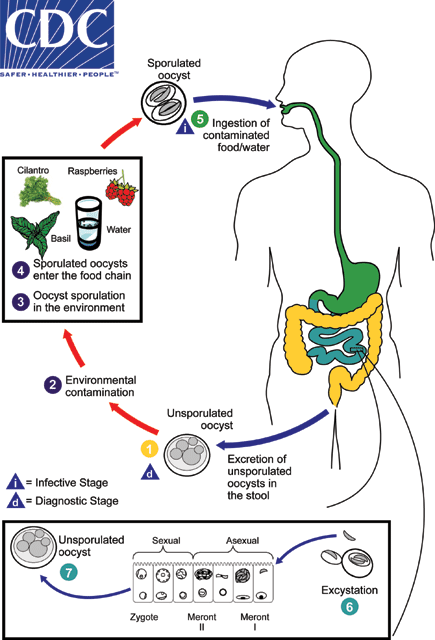
The U.S. Food and Drug Administration (FDA) recently updated its constituents about the agency’s ongoing Cyclospora cayetanensis prevention and research efforts. In 2021, FDA released its “Cyclospora Prevention, Response and Research Action Plan.” The action plan was developed by the agency’s Cyclospora Task Force and details FDA’s strategy for reducing the public health burden of foodborne cyclosporiasis in the U.S. It also defines the agency’s priorities for Cyclospora food safety research and supports ongoing efforts to combat foodborne illness in alignment with FDA’s New Era of Smarter Food Safety initiative.
Since releasing the Cyclospora action plan, FDA has made progress on several goals. The agency’s activities related to the Cyclospora action plan include:
- Collaboration with the National Advisory Committee on Microbiological Criteria for Foods to develop a charge document that will inform FDA’s prioritization of Cyclospora research and propose novel food safety research projects in collaboration with stakeholders
- Implementation of a genotyping approach for Cyclospora in environmental and food samples based on the same method published by the U.S. Centers for Disease Control and Prevention (CDC)
- Implementation of a distance learning plan and a series of Cyclospora methodology training webinars on the “Bacteriological Analytical Manual (BAM) Chapter 19b – Detection of C. cayetanensis in Fresh Produce” using a real-time PCR-analytical method in Spanish for regulatory lab personnel at food safety authorities in Mexico through the FDA-SENASICA-Cofepris Food Safety Partnership
- Collaborated with the U.S. Centers for Disease Control and Prevention (CDC) to publish an article in Food Safety Magazine summarizing the data on all cyclosporiasis outbreaks from 2013 to 2020
- Delivered eight webinars directed to the fresh produce industry, regulators, and other stakeholders for Cyclospora outreach and educational purposes
- Completed a microbial survey of fresh herbs that included over 800 samples tested for C. cayetanensis.

 FoodWorld