Science Direct – To purchase full report
Chlorine dioxide (CIO2) gas has the capacity to completely inactivate Listeria monocytogenes (LM) on ready-to-eat (RTE) meat processing equipment, according to new research.

Science Direct – To purchase full report
Chlorine dioxide (CIO2) gas has the capacity to completely inactivate Listeria monocytogenes (LM) on ready-to-eat (RTE) meat processing equipment, according to new research.
Eliminating the most common cause of food poisoning from the food chain is the aim of new research funded by the Biotechnology and Biological Sciences Research Council (BBSRC) and the world-leading UK-based poultry breeding company Aviagen.
Campylobacter is responsible for more than 300,000 cases of food poisoning a year in England and Wales and is estimated to cost the UK economy up to £600M a year. It is usually passed to humans via poultry meat which has not been cooked or handled properly. While good hygiene and thorough cooking kills the bug, preventing it entering the food chain in the first instance woul dramatically reduce the risk of infection. To this end, BBSRC and Aviagen have awarded Scottish researchers £1.3M to map genes responsible for resistance to the bug with the view to being able to breed Campylobacter-resistant chickens in the future.
Posted in Campylobacter, Food Safety, Food Technology, Food Testing, Microbiology
Tagged poultry meat
UV and hydrogen peroxide combo most effective listeria reducing treatment, claims study. A combination of ultraviolet-light (UV) and hydrogen peroxide (HP) is the best treatment to reduce listeria during brining, according to a study.
Postprocessing contamination of the products in a processing plant has been identified as one of the major reasons for food contamination with Listeria; brining is one such postprocessing area. Our previous study has shown that the combinations of UV and antimicrobials reduces the number of this organism significantly in fresh brine, but brine is usually recycled from days to weeks depending on its use. Therefore, this study is focused on the reduction of L. monocytogenes in recycled chill brine (obtained from a frankfurter processor) using the combinations of UV and antimicrobial agents, such as citric acid (CA), hydrogen peroxide (HP) and dimethyl dicarbonate (DMDC). Results show that the combinations of UV and 2000 ppm and 4000 ppm HP were the most effective treatments in reducing the Listeria population with the total processing time of 120 min. Both of these treatments were found to be more effective than UV or HP alone. Additionally, all other treatments, such as the combinations of UV and CA (0.2 and 0.5%) and UV and DMDC (250 and 500 ppm) were comparatively less effective. This may be due to the presence of organic matter in spent brine, which may have reduced the penetration of UV and availability of antimicrobials for microbial interaction.
Posted in Food Technology, Listeria, Listeria monocytogenes, Microbiology, Pathogen
Tagged antimicrobial agents
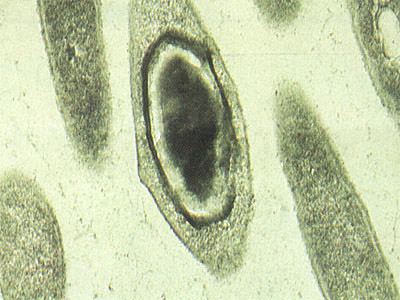
Some bacteria can form spores (survival capsules) that are particularly resistant to heat. Since sporogenous bacteria can also cause food poisoning and a reduction in food quality, they constitute a significant threat to the food industry.
If spores are to pose a risk, they have to “wake up” from a state of hibernation and return to their normal growth cycle through a process called germination.
Refrigerated foods with a shelf-life of several weeks are often heat-processed at temperatures between 65 – 95 C. This kills the majority of bacteria, but Bacillus spores can survive, germinate and develop into growing bacteria. Thermal treatment of this kind will in fact improve the growth potential of sporogenous bacteria because the heat kills competing bacteria flora and stimulates the surviving spores so that germination can commence more rapidly. The thermal treatment can increase the risk of spore germination in food and result in subsequent bacterial growth and a risk of quality deterioration and food poisoning.
Løvdal has investigated how the germination characteristics of the spores of four different Bacillus species are affected by heat treatment. She has used knowledge about the spores’ response to temperature to experiment with a method which can reduce the spore level without increasing the overall thermal treatment of the food product.
Posted in Bacillus, Bacillus cereus, Food Technology, Food Testing, Pathogen
Robotic sampling of meat quality on slaughterhouse production lines could be commercially available next year, as a result of a £1M research project.
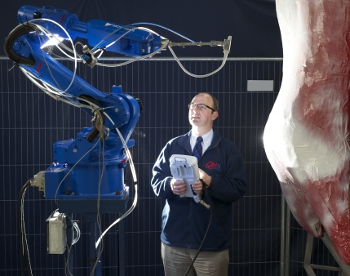
A cutting-edge robot has been installed at meat processing plant Scotbeef, as part of an ongoing research project into measuring meat quality.
The research, which was funded by Quality Meat Scotland and the Scottish Government, forms part of the Integrated Measurement of Eating Quality (IMEQ) project. Now in its second year, it is being led by the Scottish Agricultural College (SAC) and other partners.
After a series of off-line trials, the robotic system has been installed in the meat processing plant in order to test the machine’s technical robustness and how it can be developed for integration into the processing line.
The cutting-edge technology is being used to determine carcase pH, temperature and surface-based ultrasound probes at certain positions on the carcase. It uses a robotic manipulator with novel camera technology and special end-of-arm tools. The camera scans the carcase and generates an automatic three-dimensional contour map, which allows the robot to guide the pH/temperature probe to the target muscle in the half-carcase online.
Indian spice traders and producers are facing challenges like food safety, sustainability and traceability. Food safety regulations are affecting spice exports especially to the countries like Germany, France, England, Japan and Australia. India is biggest producer and exporter of spices in the world. As the regulations varies from country-to-country, it is becoming hard to maintain all the required standards.
Geemon Korah, CEO, Kancor Ingredients Ltd said, “These regulations are badly hitting our export markets. Therefore sustainability is a major issue.
The maximum containers are rejected from European countries, Japan and Australia. We are largest exporter of chilli and ginger to these countries.”
Among the major spices exported from India, chilli contributes 132,500 tonnes occupies the first place. Other major spices that are exported from India include turmeric (58,000 tonnes), Cumin (26,500 tonnes), Coriander (18,200 tonnes), Pepper (17,000) , Fenugreek (14,700 tonnes), Ginger (11, 250 tonnes) , Fennel (5,100 tonnes ), Nutmeg & mace (2,550 tonnes), celery (2,450 tonnes) , Cardamom small (3,100 tonnes) and Cardamom Large (475 tonnes), Garlic (1075 tonnes).
The Food & Drink Federation (FDF) is to hold a series of job workshops as part of its pledge to double the number of apprenticeships to 3,400 by the end of 2012. During 2012, FDF will be working with its key partners – the National Apprenticeship Service and the National Skills Academy for food and drink – to run events across the UK, including the West Midlands, the North West and Yorkshire. Its first event will be held at the William Reed-organised Food and Drink Expo at the NEC Birmingham on the afternoon of Monday 26 March.
Detection technology being developed nanoRETE, a Michigan-based company, in conjunction with Michigan State University, will allow producers to test their products themselves, and to do it in under an hour.