Category Archives: Food Safety

Information – Meat and Poultry Roasting Charts

Food Safety.GOV

Raw meat and poultry should always be cooked to a safe minimum internal temperature. Always use a food thermometer to assure that meat and poultry have reached a safe minimum internal temperature. When roasting meat and poultry, set the oven temperature to 325 °F or higher. Explore the charts below to learn how to get great results every time you cook.

Note: The information on this page does not include foods containing ground meat and poultry, including meatloaf and sausage. Check the safe minimum internal temperature chart for safe cooking temperatures and rest times for all meat and poultry, seafood, and other cooked foods.

PDF Table

Information – Foods That Can Cause Food Poisoning

CDC

Some foods are more associated with foodborne illnesses and food poisoning than others. They can carry harmful germs that can make you very sick if the food is contaminated.

  • Raw foods of animal origin are the most likely to be contaminated, specifically raw or undercooked meat and poultry, raw or lightly cooked eggs, unpasteurized (raw) milk, and raw shellfish.
  • Fruits and vegetables also may get contaminated.
  • While certain foods are more likely to make you sick, any food can get contaminated in the field, during processing, or during other stages in the food production chain, including through cross-contamination with raw meat in kitchens.

Learn more about the foods that are more associated with food poisoning and how to avoid getting sick from them:

Information – Cleaning Your Refrigerator Because of a Food Recall

CDC

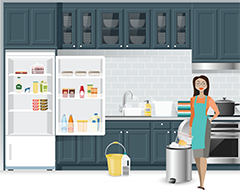
If you have a recalled food item in your refrigerator, it’s important to throw out the food and clean your refrigerator. Germs in the recalled food could spread to drawers or shelves in your refrigerator.

How to Clean Your Refrigerator After a Food Recall

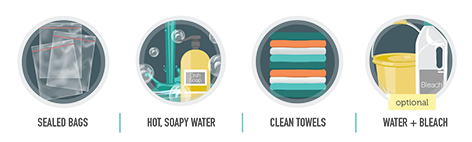
Items needed to clean your refrigerator:

items needed to clean refrigerator

  • Sealed bags
  • Hot, soapy water
  • Clean towels
  • Optional: water + bleach

Step 1 – Throw out recalled food

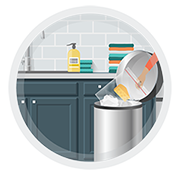
  • Throw out the recalled food, and any other foods stored with it or touching it.
  • Put it in a sealed bag in the garbage.
  • If the recalled food was stored in a reusable container, wash it with hot, soapy water before reusing.
Step 1 to cleaning your fridge throw out recalled food

Step 2 – Empty your refrigerator

  • Empty the rest of the items in your refrigerator and put them on a counter or table while you clean.
  • Take out shelving, drawers, and any other removable parts.
  • Don’t leave unrefrigerated food out for more than 2 hours.

Step 3 – Wash removable parts

  • Wash shelving, drawers, and any other removable parts by hand with hot, soapy water.
  • Dry with a clean towel.
  • Don’t run cold glass shelves or drawers under hot water because the glass could crack. Let them come to room temperature first.

Step 4 – Clean and sanitize inside the refrigerator

  • Wipe the inside of the empty refrigerator with hot, soapy water; then wipe with clean water to rinse off soap.
  • Dry with a clean towel.
  • Don’t forget to wipe inside the doors and any drawers that cannot be removed.
Step 2 of cleaning fridge wash shelving and removable parts with soap and water

* Optional step

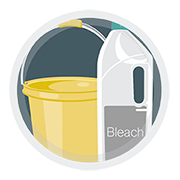
Use a solution of 1 tablespoon of liquid bleach in 1 gallon of water to sanitize your refrigerator. Do this after cleaning the refrigerator with hot, soapy water.

Picture of bleach and bucket

Step 5 – Return shelves, drawers, and food

  • Put the shelves, drawers, and other removable parts back in the refrigerator, along with the other items you took out.
  • Wipe food containers and drink containers with hot, soapy water before returning to the clean refrigerator.

And don’t forget!

  • Wash your hands with water and soap once you’ve finished cleaning.
  • Use hot, soapy water to wipe kitchen counters that held food, drinks, refrigerator parts, and any cleaning materials.
  • Wash any towels you used to dry the refrigerator before using them again.

Information – Lettuce, Other Leafy Greens, and Food Safety

CDC

Eurofins Food Testing UK

Vegetables are an important part of a healthy, balanced diet. Leafy vegetables (called leafy greens on this page) such as lettuce, spinach, cabbage, kale, and bok choy, provide nutrients that help protect you from heart disease, stroke, and some cancers.

But leafy greens, like other vegetables and fruits, are sometimes contaminated with harmful germs. Washing does not remove all germs because they can stick to the surfaces of leaves and even get inside them. If you eat contaminated raw (uncooked) leafy greens, such as in a salad, you might get sick. To prevent contamination, leafy greens should be grown and handled safely at all steps in the journey from farm to fork.

  • CDC estimates that germs on produce that is eaten raw cause a large percentage of U.S. foodborne illnesses (also called food poisoning).
  • Leafy greens and other vegetable row crops are a major source of E. coli O157 infections.
  • Other harmful germs found on leafy greens include norovirus, Salmonella, Listeria, and Cyclospora.

Although anyone can get food poisoning, these groups are more likely to get sick and to have a more serious illness:

  • Adults aged 65 and older
  • Children younger than 5 years
  • People who have health problems or take medicines that lower the body’s ability to fight germs and sickness (a weakened immune system)
  • Pregnant women

Information – Cold Food Storage Chart

Follow the guidelines below for storing food in the refrigerator and freezer. The short time limits for home-refrigerated foods will help keep them from spoiling or becoming dangerous to eat. The guidelines for freezer storage are for quality only—frozen foods stored continuously at 0 °F or below can be kept indefinitely.

Looking for a specific item? Check out FoodKeeper to find storage tips for over 650 food and beverages.

PDF Table

Food Type Refrigerator
(40 °F or below)
Freezer
(0 °F or below)
Salad Egg, chicken, ham, tuna, and macaroni salads 3 to 4 days Does not freeze well
Hot dogs Opened package 1 week 1 to 2 months
Unopened package 2 weeks 1 to 2 months
Luncheon meat Opened package or deli sliced 3 to 5 days 1 to 2 months
Unopened package 2 weeks 1 to 2 months
Bacon and sausage Bacon 1 week 1 month
Sausage, raw, from chicken, turkey, pork, or beef 1 to 2 days 1 to 2 months
Sausage, fully cooked, from chicken, turkey, pork, or beef 1 week 1 to 2 months
Sausage, purchased frozen After cooking, 3-4 days 1-2 months from date of purchase
Hamburger, ground meats and ground poultry Hamburger, ground beef, turkey, chicken, other poultry, veal, pork, lamb, and mixtures of them 1 to 2 days 3 to 4 months
Fresh beef, veal, lamb, and pork Steaks 3 to 5 days 4 to 12 months
Chops 3 to 5 days 4 to 12 months
Roasts 3 to 5 days 4 to 12 months
Ham Fresh, uncured, uncooked 3 to 5 days 6 months
Fresh, uncured, cooked 3 to 4 days 3 to 4 months
Cured, cook-before-eating, uncooked 5 to 7 days or “use by” date 3 to 4 months
Fully-cooked, vacuum-sealed at plant, unopened 2 weeks or “use by” date 1 to 2 months
Cooked, store-wrapped, whole 1 week 1 to 2 months
Cooked, store-wrapped, slices, half, or spiral cut 3 to 5 days 1 to 2 months
Country ham, cooked 1 week 1 month
Canned, labeled “Keep Refrigerated,” unopened 6 to 9 months Do not freeze
Canned, shelf-stable, opened

Note: An unopened, shelf-stable, canned ham can be stored at room temperature for 2 years.

3 to 4 days 1 to 2 months
Prosciutto, Parma or Serrano ham, dry Italian or Spanish type, cut 2 to 3 months 1 month
Fresh poultry Chicken or turkey, whole 1 to 2 days 1 year
Chicken or turkey, pieces 1 to 2 days 9 months
Eggs Raw eggs in shell 3 to 5 weeks Do not freeze in shell. Beat yolks and whites together, then freeze.
Raw egg whites and yolks

Note: Yolks do not freeze well

2 to 4 days 12 months
Raw egg accidentally frozen in shell

Note: Toss any frozen eggs with a broken shell

Use immediately after thawing Keep frozen, then
refrigerate to thaw
Hard-cooked eggs 1 week Do not freeze
Egg substitutes, liquid, unopened 1 week Do not freeze
Egg substitutes, liquid, opened 3 days Do not freeze
Egg substitutes, frozen, unopened After thawing, 1 week or refer to “use by” date 12 months
Egg substitutes, frozen, opened After thawing, 3 to 4 days or refer to “use by” date Do not freeze
Casseroles with eggs After baking, 3 to 4 days After baking, 2 to 3 months
Eggnog, commercial 3 to 5 days 6 months
Eggnog, homemade 2 to 4 days Do not freeze
Pies: Pumpkin or pecan After baking, 3 to 4 days After baking, 1 to 2 months
Pies: Custard and chiffon After baking, 3 to 4 days Do not freeze
Quiche with filling After baking, 3 to 5 days After baking, 2 to 3 months
Soups and stews Vegetable or meat added 3 to 4 days 2 to 3 months
Leftovers Cooked meat or poultry 3 to 4 days 2 to 6 months
Chicken nuggets or patties 3 to 4 days 1 to 3 months
Pizza 3 to 4 days 1 to 2 months

Information – Food Safety and Eating Out

CDC

Going out to eat? Choose a restaurant that keeps food safety on the menu. Here are some tips to protect yourself from food poisoning while eating out.

Tips to Avoid Food Poisoning While Eating Out

  • Check inspection scores. Check a restaurant’s score at your health department’s website, ask the health department for a copy of the report, or look for it when you get to the restaurant.
  • Look for certificates that show kitchen managers have completed food safety training. Proper food safety training can help improve practices that reduce the chance of spreading foodborne germs and illnesses.
  • Look for safe food-handling practices. Sick food workers pdf icon[PDF – 2 pages] can spread their illness to customers. If you can see food being prepared, check to make sure workers are using gloves or utensils to handle foods that will not be cooked further, such as deli meats and salad greens.
  • Order food that’s properly cooked. Certain foods, including meat, poultry, and fish, need to be cooked to a temperature high enough to kill harmful germs that may be present. If a restaurant serves you undercooked meat, poultry, seafood, or eggs, send it back to be cooked until it is safe to eat.
  • Avoid lukewarm food. Cold food should be served cold, and hot food should be served hot. If you’re selecting food from a buffet or salad bar, make sure the hot food is steaming and the cold food is chilled. Germs that cause food poisoning grow quickly when food is in the danger zone, between 40°F and 140°F.
  • Ask your server if they use pasteurized eggs in foods such as Caesar salad dressing, custards, tiramisu, and hollandaise sauce. Raw or undercooked eggs can make you sick unless they’re pasteurized to kill germs.
  • Take care of your leftovers quickly. Refrigerate leftovers within 2 hours of eating out. If it is above 90°F outside, refrigerate leftovers within 1 hour. Eat leftovers within 3 to 4 days. Throw them out after that time.

Information – Four Steps to Food Safety: Clean, Separate, Cook, Chill

CDC

Following four simple steps at home—Clean, Separate, Cook, and Chill—can help protect you and your loved ones from food poisoning.
Clean your hands

Clean: Wash your hands and surfaces often

  • Germs that cause food poisoning can survive in many places and spread around your kitchen.
  • Wash hands for 20 seconds with soap and water before, during, and after preparing food and before eating.
  • Wash your utensils, cutting boards, and countertops with hot, soapy water.
  • Rinse fresh fruits and vegetables under running water.
separate meats from vegetables don't cross contaminate

Separate: Don’t cross-contaminate

  • Raw meat, poultry, seafood, and eggs can spread germs to ready-to-eat foods—unless you keep them separate.
    • Use separate cutting boards and plates for raw meat, poultry, and seafood.
    • When grocery shopping, keep raw meat, poultry, seafood, and their juices away from other foods.
    • Keep raw meat, poultry, seafood, and eggs separate from all other foods in the fridge.
Cook to the right temperature

Cook: To the right temperature

  • Food is safely cooked when the internal temperature gets high enough to kill germs that can make you sick. The only way to tell if food is safely cooked is to use a food thermometer. You can’t tell if food is safely cooked by checking its color and texture.
  • Use a food thermometer to ensure foods are cooked to a safe internal temperature. Check this chart for a detailed list of foods and temperatures
    • 145°F for whole cuts of beef, pork, veal, and lamb (then allow the meat to rest for 3 minutes before carving or eating)
    • 160°F for ground meats, such as beef and pork
    • 165°F for all poultry, including ground chicken and turkey
    • 165°F for leftovers and casseroles
    • 145°F for fresh ham (raw)
    • 145°F for fin fish or cook until flesh is opaque
Refrigerate food promptly to avoid food poisoning

Chill: Refrigerate promptly

Bacteria can multiply rapidly if left at room temperature or in the “Danger Zone” between 40°F and 140°F. Never leave perishable food out for more than 2 hours (or 1 hour if it’s hotter than 90°F outside).

  • Keep your refrigerator at 40°F or below and know when to throw food out.
  • Refrigerate perishable food within 2 hours. (If outdoor temperature is above 90°F, refrigerate within 1 hour.)
  • Thaw frozen food safely in the refrigerator, in cold water, or in the microwave. Never thaw foods on the counter, because bacteria multiply quickly in the parts of the food that reach room temperature.

Information – Selecting and Serving Produce Safely

FDA

As you enjoy fresh produce, follow these safe handling tips to help protect yourself and your family.

Fruits and vegetables are an important part of a healthy diet. Your local markets carry a wide variety of nutritious fresh fruits and vegetables. However, harmful bacteria that may be in the soil or water where produce grows can come in contact with fruits and vegetables and contaminate them. Fresh produce may also become contaminated after it is harvested, such as during storage or preparation.

Eating contaminated produce can lead to foodborne illness, often called “food poisoning.” So as you enjoy fresh produce, follow these safe handling tips to help protect you and your family.

Information – Fruits and Vegetable Safety

Click to access fruit-veggie-safety-H.pdf

USA – CDC- Fruit and Vegetable Safety

CDC

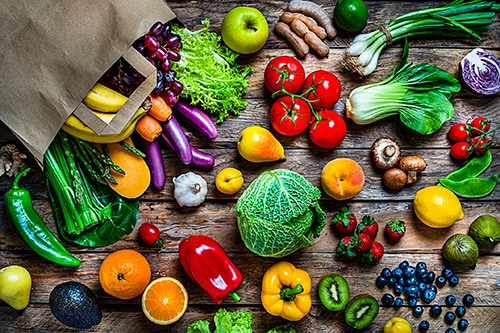
Grocery bag and food items on a wood table

Eating a diet with plenty of fruits and vegetables gives important health benefits. But it’s important to select and prepare them safely.

Fruits and vegetables add nutrients to your diet that help protect you from heart disease, stroke, and some cancers. In addition, choosing vegetables, fruits, nuts, and other produce over high-calorie foods can help you manage your weight.

Sometimes, raw fruits and vegetables contain harmful germs that can make you and your family sick, such as Salmonella, E. coli, and Listeria. CDC estimates that germs on fresh produce cause a large percentage of U.S. foodborne illnesses.

The safest produce is cooked; the next safest is washed. Enjoy uncooked fruits and vegetables while taking steps to avoid foodborne illness, also known as food poisoning.