Category Archives: Food Poisoning

Northern Ireland Vegetable Washing Campaign Launched

The Food Standards Agency in Northern Ireland has today launched its first stage of the Agency’s campaign to remind people to wash raw vegetables to help minimise the risk of food poisoning. The focus of the campaign is to reinforce existing food safety advice about storage, handling and cooking of food, including raw vegetables.

The campaign is in response to recent E.coli outbreaks in Britain and abroad including one linked to soil on raw vegetables and another caused by contaminated sprouted seeds.

USA – Butter Recall – Listeria monocytogenes

Golden Glen Creamery of Bow, WA is voluntarily recalling Butter produced on November 2, 2011 because it has the potential to be contaminated with Listeria monocytogenes, an organism which can cause serious and sometimes fatal infections in young children, frail or elderly people, and others with weakened immune systems.  Although healthy individuals may suffer only short-term symptoms such as high fever, severe headache, stiffness, nausea, abdominal pain and diarrhea, Listeria infection can cause miscarriages and stillbirths among pregnant women.

To date, no illnesses have been reported.

The Butters are being voluntarily recalled by Golden Glen Creamery, as a result of a surveillance sample collected and analyzed by the Washington State Department of Agriculture that was found to be positive for Listeria monocytogenes.  The company has ceased the production and distribution of the product as FDA, the Washington State Department of Agriculture and the company continues their investigation as to what caused the problem.

USA – Grape Tomato Recall – Salmonella Risk

Front Row Produce of St. Louis MO is recalling its 10oz pint and 10lb bulk grape tomatoes supplied by Rio Queen Citrus, Mission TX, because they have the potential to be contaminated with Salmonella, an organism which can cause serious and sometimes fatal infections in young children, frail or elderly people, and others with weakened immune systems. Healthy persons infected with Salmonella often experience fever, diarrhea (which may be bloody), nausea, vomiting and abdominal pain. In rare circumstances, infection with Salmonella can result in the organism getting into the bloodstream and producing more severe illnesses such as arterial infections (i.e., infected aneurysms), endocarditis and arthritis.

No illnesses have been reported to date in connection with this problem.
The contamination was noted after random testing by Rio Queen Citrus, Mission TX, revealed the presence of Salmonella in some 20lb bulk containers.
Production of the product has been suspended while FDA and the company continue their investigation as to the source of the problem.

FDA Release

Chicken Liver Pate – Campylobacter

An article in MeatInfo has reported on the incidence of Campylobacter in Chicken Liver Pate which is a popular Christmas product.  

According to figures from the Health Protection Agency (HPA), there have been a total of 18 outbreaks of Campylobacter infection in the UK this year, with more than 443 people taken ill. Fourteen of these outbreaks occurred in catering venues and 13 of these were linked to chicken or duck liver pâté.

The FSAhave also released information reminding people to cook home-made Chicken Liver Pate thoroughly.

Poultry livers carry a high risk of Campylobacter. The bacteria can be present throughout the liver, not just on the surface as is the case for poultry meat, and may remain a source of infection if they are not cooked sufficiently.

Listeria monocytogenes – Canadian Recall

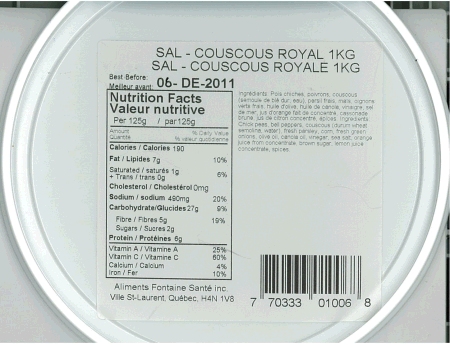
The Canadian Food Inspection Agency (CFIA) and Aliments Fontaine Santé Inc. are warning the public and retailers not to sell, use or consume the 1 kg “Sal-Couscous Royale” (Royal Couscous Salad) described below because the product may be contaminated with Listeria monocytogenes.

This product has been distributed in Quebec and Ontario and may also have been distributed nationally. There have been no reported illnesses associated with the consumption of this product.

MRSA Found in US Retail Meat and Turkey – Again

This article from the Wierd Science Blog is quoting two studies that have found MRSA (normally associated with health car facilities) in retail meats in the USA. They are calling the strain ‘livestock associated MRSA’ ST398 and it is also resistant to tetracycline, antibiotic resistance is of course an issue with these strains of Staphylococcus aureus.

US National Research Council Report – Public Posting of Enforcement Data

Publicly posting enforcement and testing data corresponding to specific meat, poultry, and egg products’ processing plants on the Internet could have “substantial benefits,” including the potential to favorably impact public health, says a new report from the National Research Council.  The report adds that the release of such data could contribute to increased transparency and yield valuable insights that go beyond the regulatory uses for which the data are collected. From my point of view I agree with the public should know, but great care would have  to be taken on the data released. As we have seen from information released in recent outbreaks that information is not always clear or correct.

This was also reported in an article in Food Quality News.

Norovirus Legal Limits and Control

An article in Food Production Daily has reported on a statement from the FSA that UK food safety authorities are not considering introducing new industrial processing techniques safety for oysters, despite over 75% grown in the UK containing the norovirus. The FSA are waiting in legal limits to be introduced by the EFSA.

Health Protection Scotland – Guidelines Norovirus – Health Care Settings

Guidelines for the management of norovirus outbreaks in acute and community health and social care settings have been issued by the Health Protection Scotland.

USDA -Kitchen Companion – Food Safety

The USDA have a Food Safety PDF for Food Safety in the Kitchen that some of you may find interesting. It is of course american based, but the principles are still the same. Kitchen Companion