
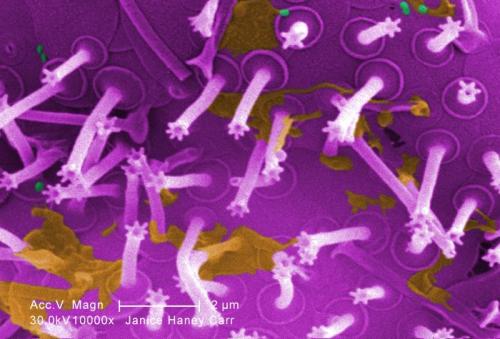
Biofilms are composed of bacteria living in a densely packed and organized community. Research paired high-level imaging tools with an algorithm to track a biofilm as it formed. Biofilm growth at multiple scales, they found, mimics aspects of how cities emerge from individual settlers.
The findings show that, as individual bacteria multiply and grow into a dense and sticky biofilm, such as the community that forms dental plaque, their growth patterns and dynamics mirror those seen in the growth of cities.
“We take this ‘satellite-level’ view, following hundreds of bacteria distributed on a surface from their initial colonization to biofilm formation,” says Hyun (Michel) Koo, a professor in Penn’s School of Dental Medicine and senior author on the work. “And what we see is that, remarkably, the spatial and structural features of their growth are analogous to what we see in urbanization.”
This new perspective on how biofilms grow could help inform efforts to either promote the growth of beneficial microbes or break up and kill undesirable biofilms with therapeutics.

 FoodWorld