
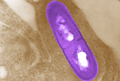
Sampling of agricultural and natural environments in two US states (Colorado and Florida) yielded 18 Listeria-like isolates that could not be identified as previously described species using traditional methods. Using whole genome sequencing and traditional phenotypic methods we identified five new species, each with a genome wide average blast nucleotide identity (ANIb) of less than 85% to currently described species. Phylogenetic analysis based on 16S rDNA sequences and amino acid sequences of 31 conserved loci showed the existence of four well-supported monophyletic clades within the genus Listeria; (i) a clade representing L. monocytogenes, L. marthii, L. innocua, L. welshimeri, L. seeligeri and L. ivanovii, which we refer to as Listeria sensu stricto, (ii), a clade consisting of L. fleischmannii and two newly described species, L. aquatica sp. nov. (type strain FSL S10-1188T =DSM 26686T =BEI NR-42633T) and L. floridensis sp. nov. (type strain FSL S10-1187T =DSM 26687T =BEI NR-42632T), (iii) a clade consisting of L. rocourtiae, L. weihenstephanensis, and three new species, L. cornellensis sp. nov. (type strain TTU A1-0210T = FSL F6-0969T =DSM 26689T =BEI NR-42630T), L. grandensis sp. nov. (type strain TTU A1-0212T =FSL F6-0971T =DSM 26688T =BEI NR-42631T) and L. riparia sp. nov. (type strains FSL 10-1204T =DSM 26685T = BEI NR- 42634T), and a clade containing L. grayi. Genomic and phenotypic data suggest the novel species are nonpathogenic.
KSWFoodWorld

 FoodWorld