Category Archives: Uncategorized

RASFF Alerts – Salmonella – Lamb Meat – Turkey Thigh – Ground Cumin -Organic Sesame Seeds

kswfoodworld rasff

RASFF – Salmonella (presence /25g) in lamb meat from Ireland in Sweden

RASFF-Salmonella (presence /25g) in frozen boneless skinless spiced turkey thighs from Brazil in the Netherlands

RASFF-Salmonella (presence /25g) in ground cumin from Turkey in Germany

RASFF-Salmonella (presence /25g) in organic sesame seeds from India in the UK

RASFF Alerts – Ochratoxin A – Dried Figs

kswfoodworld rasff

RASFF – ochratoxin A (5086 µg/kg – ppb) in dried figs from Spain, via Germany in Switzerland

RASFF-ochratoxin A (62.5 µg/kg – ppb) in dried figs from Turkey, via Germany in Switzerland

RASFF Alert – Norovirus – Bivalve Molluscs

kswfoodworld rasff

RASFF – norovirus (Gll /g) in live bivalve molluscs (Mytilus edulis) from Ireland, processed in France in Italy

RASFF Alert – STEC E.coli – Barley Grass Powder

kswfoodworld rasff

RASFF – Bacillus cereus (6,2E4 CFU/g) and shigatoxin-producing Escherichia coli (stx1+ /25g) in barley grass powder from Germany in Germany

RASFF Alert – Bacillus cereus – Barley Grass Powder

kswfoodworld rasff

RASFF – Bacillus cereus (6,2E4 CFU/g) and shigatoxin-producing Escherichia coli (stx1+ /25g) in barley grass powder from Germany in Germany

RASFF Alerts – Aflatoxin – Peanut Butter – Sugared Groundnuts – Pistachios – Chilli Powder – Basmati Rice

kswfoodworld rasff

RASFF – aflatoxins (B1 = 11; Tot. = 21 µg/kg – ppb) in peanut butter from the Netherlands in the Netherlands

RASFF-aflatoxins (B1 = 88; Tot. = 150 µg/kg – ppb) in peanut butter from Senegal in the Netherlands

RASFF-aflatoxins (B1 = 6.4; Tot. = 7.7 µg/kg – ppb) in sugared groundnuts from Senegal in Belgium

RASFF-aflatoxins (B1 = 13.8 µg/kg – ppb) in pistachios from Turkey in Germany

RASFF – aflatoxins (B1 = 48.1; Tot. = 107.1 µg/kg – ppb) in chilli powder from Ethiopia in Finland

RASFF-aflatoxins (B1 = 10.8; Tot. = 15.2 µg/kg – ppb) in pistachios from Iran in Germany

RASFF-aflatoxins (B1 = 3.1 µg/kg – ppb) in basmati rice from India, via Switzerland in Italy

RASFF-aflatoxins (B1 = 4.3; Tot. = 4.9 µg/kg – ppb) in groundnuts in shell from China, via Singapore in Bulgaria

RASFF-aflatoxins (B1 = 33; Tot. = 35.7 µg/kg – ppb) in pistachios from Iran in Germany

Egypt – Egypt: 2,262 children fell ill in suspected food poisoning

Daily Journal

CAIRO — Egypt’s Health Ministry says hundreds of schoolchildren have been admitted to hospital in a suspected mass food poisoning this week.

The ministry says the outbreak involved 2,262 children in eight schools in the southern province of Sohag. They developed symptoms after eating school meals provided as part of a government food program for schoolchildren.

The ministry statement late on Tuesday said most of those admitted to hospital have been released. Samples of the meals were being analyzed to ascertain the cause of the suspected poisoning.

The independent Al-Shorouk daily says the Sohag governor suspended the food program pending the outcome of the analysis.

In 2013, university students protested after some 160 colleagues fell ill after a tuna meal at the University of Al-Azhar, Cairo’s centuries-old seat of Sunni Muslim learning.

Research – Survival of Salmonella Newport on Whole and Fresh-Cut Cucumbers Treated with Lytic Bacteriophages

Journal of Food Protection Salmonella kswfoodworld
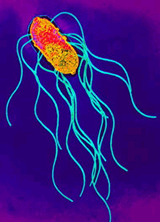
Salmonella enterica associated with consumption of cucumbers (Cucumis sativus) has led to foodborne outbreaks in the United States. Whole and fresh-cut cucumbers are susceptible to S. enterica contamination during growing, harvesting, and postharvest handling. The application of lytic bacteriophages specific for S. enterica was evaluated to reduce Salmonella populations on cucumbers. Unwaxed cucumbers (‘Lisboa’ variety, or mini-cucumbers purchased at retail) were inoculated with Salmonella Newport (5 log CFU per cucumber) and were sprayed with 3.2 mL of phosphate-buffered saline (control) or 10 log PFU/ml of SalmoFresh, a Salmonella-specific bacteriophage preparation (phage), to deliver 4.76 × 10⁷ PFU/cm2. Cucumbers were stored at 10 or 22°C for 7 days. Inoculated mini-cucumbers were sliced with a sterile knife to investigate Salmonella transfer to mesocarp, and cut pieces were stored at 4°C for 2 days. Populations (log CFU per cucumber) of Salmonella Newport on phage-treated whole cucumbers were significantly (P < 0.05) smaller (2.44 ± 0.94) than on control-treated cucumbers (4.27 ± 0.37) on day 0. Populations on phage-treated cucumbers stored at 10°C were 1.72 ± 0.77 and 1.56 ± 0.46, which were significantly lower than those on control-treated cucumbers (3.20 ± 0.48 and 2.33 ± 0.25) on days 1 and 4, respectively. Between days 0 and 1, populations on control-treated cucumbers stored at 10 and 22°C declined by 1.07 and 2.47 log CFU per cucumber, respectively. At 22°C, Salmonella Newport populations declined by 2.37 log CFU per cucumber between days 0 and 1. Phage application to whole cucumbers before slicing did not reduce the transfer of Salmonella Newport to fresh-cut slices. Lytic phage application may be a potential intervention to reduce Salmonella populations on whole cucumbers.


USA – RBR Meat Company, Inc. Recalls Frozen Pizza Product Due to Possible Listeria Contamination

FSIS USDA

RBR Meat Company, Inc., a Vernon, Calif. establishment, is recalling approximately 21,220 pounds of frozen pizza product that may be adulterated with Listeria monocytogenes, the U.S. Department of Agriculture’s Food Safety and Inspection Service (FSIS) announced today.

The supreme frozen pizza item was produced on Feb. 23, 2017. The following product is subject to recall: [View Labels (PDF only)]

  • 50.6-oz. corrugated box containing 1 shrink wrapped 16” pizza labeled as “Marketside Extra Large Supreme Pizza,” with lot code 20547.

The products subject to recall bear establishment number “EST. 1821” inside the USDA mark of inspection. These items were shipped to retail distribution centers in California, Nevada, Utah and Washington.

The problem was discovered during routine sampling by the firm. There have been no confirmed reports of adverse reactions due to consumption of these products.

India – Tumakuru food poisoning death toll rises to four

Bangalore Mirror

On March 9, three students died while one was hospitalised because of suspected food poisoning.

The hostel has 29 students while most of them ate chapatti and beetroot palya for dinner, four of the boys and the security guard opted to eat rice and rasam after which they fell sick.

Confirming the death, Superintendent of Police Isha Pant told Bangalore Mirror, that the reports from the Forensic Science Laboratory are crucial in this case. Teams have been speaking to everyone possible present that the boarding school on the day the unfortunate event took place, looking for vital clues and recording statements about what happened place during that day, she said.

Meanwhile, the police have also arrested former MLA Kiran Kumar and his wife Kavita to whom the school belongs.