Category Archives: Uncategorized

USA – EuroCan Manufacturing Voluntarily Recalling Barnsdale Farms® Pig Ears Because of Possible Salmonella Health Risk

FDA Salmonella kswfoodworld

EuroCan Manufacturing is voluntarily recalling Lot Number 84 consisting of it’s individually shrink-wrapped, 6-pack, 12-pack and 25-pack bags of Barnsdale Farms®, HoundsTooth® and Mac’s Choice® Pig Ears because they have the potential to be contaminated with Salmonella. Salmonella can affect animals eating the products and there is a risk to humans from handling contaminated pet products, especially if they have not thoroughly washed their hands after having contact with the products or any surfaces exposed to these products.

Hong Kong – Hong Kong reports additional Legionnaires’ disease case

legionellacOutbreak News Today

The Centre for Health Protection (CHP) of the Department of Health today reported the latest number of cases of Legionnaires’ disease (LD) in Hong Kong, and stressed the importance of using and maintaining properly designed man-made water systems, and that susceptible groups should strictly observe relevant precautions.

From March 12 to 18, one community-acquired LD case was reported. The male patient aged 77 with underlying illnesses lives in Hung Shek House, Ping Shek Estate, Kwun Tong.

“Epidemiological investigations are under way to identify potential sources of infection, high-risk exposure and clusters, if any,” a spokesman for the CHP said.

As of March 18, a total of 11 LD cases had been reported in 2017. In 2016 and 2015, there were 75 and 66 cases respectively.

USA – H & B Packing Co., Inc. Recalls Boneless Beef Products Due To Possible STEC E. coli O103 Contamination

FSIS – USDA

H & B Packing Co., Inc., a Waco, Texas establishment, is recalling approximately 73,742 pounds of boneless beef products that may be contaminated with E. coli O103, the U.S. Department of Agriculture’s Food Safety and Inspection Service (FSIS) announced today.

The boneless beef items were produced on March 6, 2017. The following products are subject to recall:[Label]

  • 60-lb. box containing boneless beef with case code 69029 and production date 03/06/17.
  • Multiple combo bins containing 73,682-lbs of boneless beef with case code 69029 and production date 03/06/17.

The products subject to recall bear establishment number “EST. M13054” inside the USDA mark of inspection. These items were shipped to food manufacturers within the state of Texas.

The problem was discovered when FSIS was notified by the State of Texas’ Meat Safety Assurance Unit about a positive non-O157 Shiga toxin-producing E. coli sample.

There have been no confirmed reports of illnesses due to consumption of these products.

Many clinical laboratories do not test for non-O157 Shiga toxin-producing E. coli (STEC), such as STEC O103 because it is harder to identify than STEC O157. People can become ill from STECs 2–8 days (average of 3–4 days) after consuming the organism. Most people infected with STEC O103 develop diarrhea (often bloody), and vomiting. Some illnesses last longer and can be more severe. Infection is usually diagnosed by testing of a stool sample. Vigorous rehydration and other supportive care is the usual treatment; antibiotic treatment is generally not recommended.

Most people recover within a week, but, rarely, some develop a more severe infection. Hemolytic uremic syndrome (HUS) is uncommon with STEC O103 infection. HUS can occur in people of any age but is most common in children under 5 years old, older adults and persons with weakened immune systems. It is marked by easy bruising, pallor, and decreased urine output. Persons who experience these symptoms should seek emergency medical care immediately.

FSIS and the company are concerned that some product may be frozen and in customers’ freezers.

Customers who have purchased these products are urged not to use them. These products should be thrown away or returned to the place of purchase.

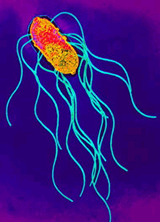
Research – Vietnamese pork regularly contaminated with bacteria, finds study

Global Meat News

Vietnamese pork regularly contaminated with bacteria, finds study

By Oscar Rousseau+Oscar Rousseau, 17-Mar-2017

Pork sold across Vietnam’s wet markets regularly carries food poisoning bacteria, such as Salmonella, according to researchers.

Research – Truffle oil fingered: 159 sickened with Salmonella at Fig & Olive in 2015

kswfoodworld SalmonellaBarf Blog

In the summer of 2015, some 150 people were stricken with Salmonella at uppity Fig and Olive restaurants in Washington, D.C. and Los Angeles.

The salmonella outbreak shut down the City Center, DC location for six days in Sept. 2015. The Food and Drug Administration and local health authorities never definitively determined the exact source of the salmonella, but truffle mushroom croquettes were a common denominator among Fig & Olive diners who got sick. Components of the dish were pre-prepared at a Long Island City commissary that supplied Fig & Olive’s restaurants around the country with already-made sauces, dressings, and more, and has since been closed.

USA – Minnesota Dry Fish Botulism Recall

Botulism Blog

The Minnesota Department of Agriculture has issued a consumer advisory for dried fish from a St. Paul market due to concerns about botulism.

The MDA said Friday that dried, uneviscerated fish sold from Shwe Karen Market has the potential to be contaminated with clostridium botulinum, which can cause life-threatening illness or death.

The product of concern is dried fish longer than 5 inches and still containing the internal organs. The fish was packaged in one kilogram clear plastic bags labeled “Dried Fish.” The fish was sold between Feb. 5 and March 2, 2017.

Research – How do Babies Contract Listeriosis?

kswfoodworld Listeria monocytogenesFood Poisoning Bulletin

In some Listeria monocytogenes food poisoning outbreaks, we tell you that infants contracted this infection. In the current listeriosis outbreak linked to recalled Vulto Creamery raw milk cheese, one of the illnesses was reported in a newborn baby. Since babies do not consume raw cow’s milk or eat raw cheeses or unpasteurized juices, the most common vectors for this pathogenic bacteria, how do they get sick?

Canada – PastaCo brand Bolognese Sauce recalled due to potential presence of dangerous bacteria – Clostridium botulinum

ClostCFIA

PastaCo is recalling PastaCo brand Bolognese Sauce from the marketplace because it may permit the growth of Clostridium botulinum. Consumers should not consume the recalled product described below.

Recalled products

Brand Name Common Name Size Code(s) on Product UPC
PastaCo Bolognese Sauce 750 ml All codes up to and including Best Before August 23, 2017 with the exception of codes 9/01123 Best Before July 20, 2017 and 9/01104 Best Before May 07, 2017 7 77192 51131 6

USA – Advanced Fresh Concepts Franchise Corp. Voluntarily Recalls Edamame Due to Potential Health Risk – Listeria monocytogenes

FDA

Advanced Fresh Concepts Franchise Corp. (“AFC”) of Rancho Dominguez, California is recalling its Edamame (Soybeans) – UPC 0-23012-00261-9, dated between 01/03/2017 and 03/17/2017 because it has the potential to be contaminated with Listeria monocytogenes.  Contamination was discovered via random testing under AFC’s Quality Assurance Program.


Research – Paper on aflatoxins in food: recent advances

Food Safety Brazil – Portuguese

Food Safety Brazil – English


For each hazard analysis I do, I look for updated information from a variety of sources. Conducting research on the internet, I discovered this interesting book about aflatoxins in food.  We know that mycotoxins are important far beyond the “peanut world,” but we do not always find a lot of data, do we? With this in mind, I recommend reading this book for anyone looking for information on aflatoxins:

Aflatoxins – Recent Advances and Future Prospects Aflatoxins – Recent Advances and Future Prospects