Category Archives: Uncategorized

Research – Bacterial Biofilms – Begone

Science Daily   pseud

By some estimates, bacterial strains resistant to antibiotics — so-called superbugs — will cause more deaths than cancer by 2050.

Colorado State University biomedical and chemistry researchers are using creative tactics to subvert these superbugs and their mechanisms of invasion. In particular, they’re devising new ways to keep harmful bacteria from forming sticky matrices called biofilms — and to do it without antibiotic drugs.

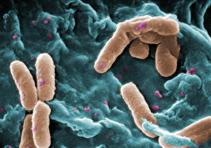
Researchers from the laboratory of Melissa Reynolds, associate professor of chemistry and the School of Biomedical Engineering, have created a new material that inhibits biofilm formation of the virulent superbug Pseudomonas aeruginosa. Their material, described in Advanced Functional Materials, could form the basis for a new kind of antibacterial surface that prevents infections and reduces our reliance on antibiotics.


Research – Magnetised Viruses Attack Harmful Bacteria – E.coli

Magnetized viruses attack harmful bacteria

Science Daily   Ecoli Istock

Clusters of nanoparticles with phage viruses attached find and kill Escherichia coli bacteria in a lab test at Rice University. Researchers at Rice and the University of Science and Technology of China have developed a combination of antibacterial phages and magnetic nanoparticle clusters that infect and destroy bacteria that are usually protected by biofilms in water treatment systems.

Research – Use Light to Kill Microbial “Vampires” – Staphylococcus aureus

Investigators use light to kill microbial ‘vampires’

Science Daily    Staph

On July 24 Vanderbilt scientist Eric Skaar, Ph.D., MPH, summarized his group’s latest paper in a tweet: “If S. aureus is going to drink our blood like a vampire, let’s kill it with sunlight.”

“That thing has been retweeted so many times,” said Skaar, the Ernest W. Goodpasture Professor of Pathology in the Vanderbilt University School of Medicine. “It’s one of the most popular tweets I’ve ever put out about our research.”

No wonder. Staphylococcus aureus (staph) is the leading cause of hospital-acquired infections. Antibiotic-resistant strains of the bug, like MRSA, can kill.

Staph needs iron to grow. “It breaks open the blood cells and grabs the hemoglobin and pulls the iron out,” Skaar said. Other Gram-positive pathogens probably do the same thing. “But the S. aureus systems are by far the most well studied,” he said.

Now Skaar and his colleagues have found a new way to destroy these microbial vampires. Just as daylight strips Dracula of his power, they have shown that an enzyme-activating small molecule they developed, when combined with “photodynamic therapy,” can kill bacteria in mouse models of skin and soft tissue infections.

USA – United Natural Trading LLC – Recall of Products Containing Organic and Natural Chopped Dates Due to Possible Health Risk – Listeria monocytogenes

FDA

United Natural Trading LLC Announces Voluntary Recall of Products Containing Organic and Natural Chopped Dates Due to Possible Health Risk

United Natural Trading LLC, Edison, NJ, is voluntarily recalling a limited number of products containing Organic and Natural dates (see below) and sold under the Nature’s Promise, Woodstock, Market Basket, and Wholesome Pantry brands due to a possible health risk from Listeria monocytogenes. Listeria monocytogenes is an organism which can cause serious and sometimes fatal infections in young children, frail or elderly people, and others with weakened immune symptoms. Although healthy individuals may suffer only short-term symptoms such as high fever, severe headache, stiffness, nausea, abdominal pain and diarrhea, Listeria infection can cause miscarriages and stillbirths among pregnant women.

Description Lot Number Best By Date UPC#
Nature’s Promise Organic Campfire Trail Mix 12oz. 17100 11/23/2017 688267066092
Nature’s Promise Organic Campfire Trail Mix 12oz. 17115 12/23/2017 688267066092
Nature’s Promise Cranberry Trail Mix 12oz. 17138 11/18/2017 688267066122
Nature’s Promise Cascade Trail Mix 12oz. 17158 12/30/2017 688267066160
Woodstock Organic Kumbaya Mix 10oz. 17096 11/23/2017 042563009366
Woodstock Organic Kumbaya Mix 10oz. 17124 11/23/2017 042563009366
Woodstock Organic Kumbaya Mix 10oz. 17100 11/23/2017 042563009366
Market Basket Cape Cod Cranberry Mix 10oz. 17132 12/30/2017 049705408322
Market Basket Cascade Trail Mix 11oz. 17156 12/30/2017 049705408377
Market Basket Fiber Frenzy 10oz. 17150 12/30/2017 049705409107
Wholesome Pantry Cape Cod Cranberry Mix 8oz. 17142 12/30/2017 041190054855
Wholesome Pantry Organic Trail Mix 8oz. 17142 12/14/2017 041190054992
Wholesome Pantry Organic Trail Mix 8oz. 17160 12/15/2017 041190054992

The lot numbers are printed on the back of each retail bag. The date containing products were shipped to retailers and distributors in limited quantities throughout the United States.

This recall was issued as a precaution because our firm received a recall notice from Hudson Valley Farms/ Bedemco recalling their natural and organic dates for potential contamination with Listeria monocytogenes.

No illnesses have been reported in association with the recall and no other date containing products under the brands are being recalled to date.

Research – Investigation of STEC E.coli 0121 – Flour – Canada 2016-2017

Notes from the Field: An Outbreak of Shiga Toxin–Producing Escherichia coli  O121 Infections Associated with Flour — Canada, 2016–2017

CDC

On December 29, 2016, PulseNet Canada identified a cluster of six Escherichia coli non-O157 isolates with a matching pulsed-field gel electrophoresis (PFGE) pattern combination that was new to the PulseNet Canada database. The patients resided in three geographically distinct provinces. In January 2017, the Public Health Agency of Canada (PHAC) initiated an investigation with local, provincial, and federal partners to investigate the source of the outbreak.

A case was defined as isolation of E. coli non-O157 with the outbreak PFGE pattern or closely related by whole genome sequencing (WGS) in a Canadian resident or visitor with onset of symptoms of gastroenteritis on or after November 1, 2016. Patients’ illness onset dates ranged from November 2016 to April 2017 (Figure). As of May 23, 2017, a total of 29 cases were identified in six provinces (Alberta, British Columbia, Newfoundland and Labrador, Ontario, Quebec, and Saskatchewan). One additional case was identified in a U.S. resident who traveled to Canada during the exposure period. Patients’ ages ranged from 2–79 years (median = 23.5 years) and 50% were female. Eight patients were hospitalized, and one developed hemolytic uremic syndrome. Clinical isolates were typed as E. coli O121:H19 (one case was typed as E. coli O121:H undetermined) with Shiga toxin 2–producing genes by in silico toxin testing and had closely related PFGE patterns and WGS.

Initial investigation into the source of the outbreak did not identify any clear hypotheses; common exposures were ground beef, sausage style deli-meats, pizza, and pork, but the data did not converge on any specific products. Patients were reinterviewed by PHAC using an open-ended approach. Knowledge of a recent E. coli O121 flour-associated outbreak prompted interviewers to ask about baking and exposure to raw flour or dough (1). Patients were also asked if any food items of interest, including flour, were available for testing.

Research – Campylobacter Contamination in Fresh Whole Chilled UK -Produced Chickens at Retail – Jan-March 2017

Food.gov campy2

Campylobacter contamination in fresh whole chilled

UK-produced chickens at retail: January-March 2017

Key Results

The latest results show that in January-March 2017, 6.5% of chickens had high levels of Campylobacter (over 1000 cfu/g), down from 9.3% over the same period the previous year.

 To compare the proportion of chickens with levels of Campylobacter above 1000 cfu/g between retailers, each was compared to the overall average (weighted by market share) among all other retailers:

– The named retailers which had a significantly lower prevalence compared to the average among all other retailers were M&S (2.5%), Morrisons (2.8%) and Waitrose (2.7 %).

– None of the named retailers had a prevalence estimate significantly higher than the average among all other retailers. However, the group ‘Others’, combining a number of smaller retailers and butchers, had a significantly higher prevalence (16.9%) compared to the market average among all other retailers.


Research – Real-Time Whole-Genome Sequencing of Listeria monocytogenes, France

CDC

Real-Time Whole-Genome Sequencing for Surveillance of Listeria monocytogenes, France

During 2015–2016, we evaluated the performance of whole-genome sequencing (WGS) as a routine typing tool. Its added value for microbiological and epidemiologic surveillance of listeriosis was compared with that for pulsed-field gel electrophoresis (PFGE), the current standard method. A total of 2,743 Listeria monocytogenes isolates collected as part of routine surveillance were characterized in parallel by PFGE and core genome multilocus sequence typing (cgMLST) extracted from WGS. We investigated PFGE and cgMLST clusters containing human isolates. Discrimination of isolates was significantly higher by cgMLST than by PFGE (p<0.001). cgMLST discriminated unrelated isolates that shared identical PFGE profiles and phylogenetically closely related isolates with distinct PFGE profiles. This procedure also refined epidemiologic investigations to include only phylogenetically closely related isolates, improved source identification, and facilitated epidemiologic investigations, enabling identification of more outbreaks at earlier stages. WGS-based typing should replace PFGE as the primary typing method for L. monocytogenes.

Research – Norovirus in Bottled Water Associated with Gastroenteritis Outbreak Spain 2016

CDC 


Norovirus in Bottled Water Associated with Gastroenteritis Outbreak, Spain, 2016

In April 2016, an outbreak of gastrointestinal illness (4,136 cases) occurred in Catalonia, Spain. We detected high levels of norovirus genotypes I and II in office water coolers associated with the outbreak. Infectious viral titer estimates were 33–49 genome copies/L for genotype I and 327–660 genome copies/L for genotype II.

Research – Estimated Annual Numbers of Foodborne Pathogen – Associated Illnesses, Hospitalisations and Deaths in France – 2008-2013

CDC

Estimated Annual Numbers of Foodborne Pathogen–Associated Illnesses, Hospitalizations, and Deaths, France, 2008–2013

Estimates of the annual numbers of foodborne illnesses and associated hospitalizations and deaths are needed to set priorities for surveillance, prevention, and control strategies. The objective of this study was to determine such estimates for 2008–2013 in France. We considered 15 major foodborne pathogens (10 bacteria, 3 viruses, and 2 parasites) and estimated that each year, the pathogens accounted for 1.28–2.23 million illnesses, 16,500–20,800 hospitalizations, and 250 deaths. Campylobacter spp., nontyphoidal Salmonella spp. and norovirus accounted for >70% of all foodborne pathogen–associated illnesses and hospitalizations; nontyphoidal Salmonella spp. and Listeria monocytogenes were the main causes of foodborne pathogen–associated deaths; and hepatitis E virus appeared to be a previously unrecognized foodborne pathogen causing ≈68,000 illnesses in France every year. The substantial annual numbers of foodborne illnesses and associated hospitalizations and deaths in France highlight the need for food-safety policymakers to prioritize foodborne disease prevention and control strategies.

China – Dim Sum Restaurant – 70 Sick – Salmonella

Shanghai daily

MORE than 70 diners became sick after salmonella was found in meals at popular Hong Kong-style dim sum chain LIST, which was involved in making cold pastries beyond the limits of its license, Shanghai’s food watchdog said today.

In total, 71 diners have received treatment at hospitals, suffering from fever and diarrhea, the Shanghai Food and Drug Administration said.

Salmonella bacteria were found on food samples.

Most of the customers’ symptoms developed between July 16 and 19, however they have all since recovered, according to the administration.