Category Archives: Uncategorized

USA – River Valley Sprouts Recalls Products for Possible Salmonella Contamination

Food Poisoning Bulletin 

River Valley Sprouts of Minnesota is recalling some of its products for possible Salmonella contamination. No illnesses have been reported to date in connection with this problem.

The recalled products are 5 ounce Alfalfa Sprouts, 4 ounce Alfalfa Sprouts, 5 ounce Garlic/Alfalfa, and 5 ounce Variety Sprouts. They were packed and shipped from March 6, 2018 through March 15, 2018. The products are packaged in a plastic cup or clam container. The sprouts were distributed in Wisconsin and Minnesota through various grocery stores. Some of the packages have sell by dates on the label ranging from March 15 through March 25, 2018.

FDA testing revealed the presence of Salmonella in some of the Alfalfa Sprouts. Production of the sprouts has been suspended while the FDA and the company investigate the problem.

If you have purchased any of these products, do not eat them, even if you are going to cook them. Throw them away in a sealed or double packaged package, or take them back to the place of purchase for a full refund.


USA – Salmonella cases increase in Nebraska

The Columbus Telegram

In 2018, a total of five Salmonella cases have been reported in eastern Nebraska resulting in four individuals being hospitalized.

Two men and three women ages 50-80 have contracted the illness, said Leah Bucco-White, public information officer at Nebraska Department of Health and Human Services.

According to the Centers for Disease Control (CDC) and the US Department of Agriculture, this multi-state outbreak was linked to contaminated chicken salads sold at Fareway grocery stores in Iowa, Minnesota, Nebraska and South Dakota. There are 170 reported cases nationally spanning across seven states but no deaths have been reported, information from the CDC says.

USA – Food bank recalls another 32 tons of food for pathogen risks

Food Safety News

Days after recalling 11 tons of donated chia seeds because of rodent droppings, the Oregon Food Bank recalled almost 32 tons of pumpkin seeds and half a ton of nutritional yeast.

The reason for the yeast recall was not included in the recall notice posted by the food bank. The 63,825 pounds of pumpkin seeds are under recall for possible contamination with Listeria monocytogenes.

As of the posting of the recall notices, public health authorities had not confirmed any illnesses in connection with the seeds or yeast recalled by the food bank. The food bank reported all three recalled products were donated at the same time.

Australia – Fifth person dies in Australia’s rockmelon Listeria outbreak

The Guardian

A Victorian man in his 80s has died and a woman has miscarried as a result of deadly outbreak.

An elderly man has died and a woman has miscarried as a result of the nationwide listeria outbreak, which has been linked to contaminated rockmelon.

The Victorian man in his 80s was the fifth person to die as a result of the outbreak.

The source of the outbreak has been traced to Rombola Family Farms in the Riverina region of NSW, according to authorities.

There have been at least 17 confirmed cases of listeria linked to the contaminated rockmelon, including two deaths in NSW and three in Victoria.

UK – Lidl recalls its Golden Sun Organic Grains (Amaranth) because it contains Salmonella

FSA

Lidl is recalling its Golden Sun Organic Grains (Amaranth) because Salmonella has been found in the product.

Product details

Product: Golden Sun Organic Grains Assorted (Amaranth)
Pack size: 500g
‘Best before’ date: All dates

No other Lidl products are known to be affected.

Risk

The presence of Salmonella in the product listed above. Symptoms caused by salmonella usually include fever, diarrhoea and abdominal cramps.

Our advice to consumers

If you have bought the above product do not eat it. Instead, return it to the store from where it was bought for a full refund.

Action taken by the company

Lidl is recalling the above product. Point of sale notices will be displayed in all Lidl stores that are selling this product. These notices explain to customers why this product is being recalled and tell them what to do if they have bought the product. Please see the attached notice.

South Africa – Rainbow Polony Privately Cleared of Deadly Listeria Strain – Rcl Foods

All Africa

None of the ST6 listeria strain believed to be behind the outbreak that has left 183 people dead since January 2017, was found at the Rainbow polony factory in Wolwehoek, RCL Foods said on Friday amid a precautionary recall of its polony.

“RCL Foods is pleased to state that tests conducted by an independent laboratory in France, which is considered to be a leading expert in this field, have confirmed that our Wolwehoek plant is clear of the ST6 listeria strain,” the company said in a statement.

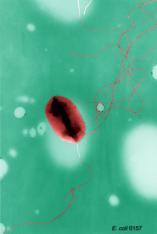
Canada- Food Safety Warning – Good Boucher brand Lean Ground Beef may be unsafe due to E. coli O157:H7

CFIA 


Advisory details

Ottawa, March 18, 2018 – The Canadian Food Inspection Agency (CFIA) is warning the public not to consume the products described below due to possible E. coli O157:H7 contamination.

Products

Brand Name Common Name Size Code(s) on Product UPC
Good Boucher Lean Ground Beef 285 g Lot: 18-03-07
Best before: 2018-03-21
None
Good Boucher Lean Ground Beef 510 g Lot: 18-03-05
Best before: 2018-03-19
None
Good Boucher Lean Ground Beef 510 g Lot: 18-03-07
Best before: 2018-03-21
None

Canada – A plan to reduce Salmonella illness risk

Poultry Med

In the last 10 years the incidence of salmonella illness in Canada has steadily increased. This increase has been driven by Salmonella enteritidis (SE), the most common strain of salmonella in the food supply that is often associated with poultry.
Extensive efforts have been made by the federal food safety partners and the industry to increase consumer awareness that these products are raw and need to be fully cooked before consumption, as well as significant attempts by the industry to improve labelling and cooking instructions on packages. Despite these efforts, frozen raw breaded chicken products continue to be identified as a source of salmonella infection in Canada. As such, the CFIA is working with industry to identify and implement measures at the manufacturing/processing level to reduce salmonella to below a detectable amount in frozen raw breaded chicken products such as chicken nuggets, chicken fingers, chicken strips, popcorn chicken and chicken burgers that are packaged for retail sale.
This approach focuses the responsibility on the poultry industry and represents a fundamental change to existing requirements for frozen raw breaded chicken products. These new measures call for processors to identify salmonella as a hazard and to implement changes in order to produce an end product that reduces salmonella to below a detectable amount. The CFIA has granted industry a 12-month implementation period, to begin immediately, to make these changes.

Research – Columbus State University Students Publish Breakthrough Study on Treating Antibiotic Resistant Bacteria

Food Poisoning Bulletin

Columbus State University Biology Majors have published a paper about their research on treating antibiotic resistant bacteria. The students were focusing on alternative therapies to treat Acinetobacter haumannii, which causes urinary tract infections, pneumonia, burns and wound infections, and septicemia.

The World Health Organization has said that antibiotic resistant bacteria is a major public health concern and may cause millions of deaths in the future because of untreatable common infections. And in 2016, the CDC found that antibiotic resistant Salmonella causes more than 6,000 illnesses in this country every year. Those types of infections are linked to beef, dairy, poultry, produce, and eggs.

The paper, titled “The Effects of Antimicrobial Peptides WAM-1 and LL-37 on Multidrug Resistant Acinetobacter baumannii, is published in Pathogens and Disease. The students found that a particular peptide was effective in killing bacteria that are resistant to most antibiotics.

USA – CDC – Fruit and Vegetable Safety

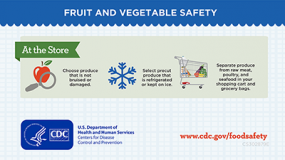
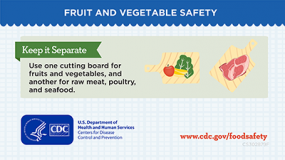
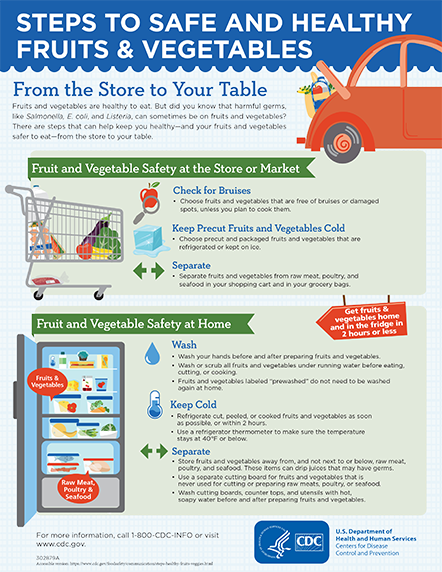
At the store choose fruits and veggies that are not bruised and keep meats separate in cart. Download social media graphics for facebook and twitter.CDC Keep meats and vegetables on separate cutting boards. Download social media graphics for facebook and twitter.

Eating a diet with plenty of fruits and vegetables provides important health benefits, but it’s important that you select and prepare them safely.

Fruits and vegetables add nutrients to your diet that help protect you from heart disease(https://www.cdc.gov/heartdisease/), stroke(https://www.cdc.gov/stroke/), and some cancers(https://www.cdc.gov/cancer/). In addition, choosing vegetables, fruits, nuts, and other produce over high-calorie foods can help you manage your weight(https://www.cdc.gov/obesity/).

But sometimes raw fruits and vegetables contain harmful germs, such as Salmonella(https://www.cdc.gov/salmonella/index.html), E. coli(https://www.cdc.gov/ecoli/index.html), and Listeria(https://www.cdc.gov/listeria/index.html), that can make you and your family sick. In the United States, nearly half(https://www.cdc.gov/foodborneburden/attribution/attribution-1998-2008.html) of foodborne illnesses are caused by germs on fresh produce.

The safest produce is cooked; the next safest is washed. Enjoy uncooked fruits and vegetables while taking steps to avoid foodborne illness, also known as food poisoning.

Cook sprouts thoroughly to reduce the risk of illness. Sprouts are a particular concern because the warm, humid conditions needed to grow sprouts also are ideal for germs to multiply. Therefore, eating raw or lightly cooked sprouts may lead to food poisoning. It’s especially important to avoid raw sprouts if you are in a group more likely to get seriously sick from food poisoning: pregnant women, young children, older adults, and people with weakened immune systems.

thumbnail for fruit and veggie safety posterSprouts: What You Should Know  

At the store or market:

  • Choose produce that isn’t bruised or damaged.
  • Keep precuts fruits and vegetables cold by choosing produce that is refrigerated or kept on ice.
  • Separate fruits and vegetables from raw meat, poultry, and seafood in your shopping cart and in your grocery bags.