Monthly Archives: March 2018

Canada- Food Safety Warning – Good Boucher brand Lean Ground Beef may be unsafe due to E. coli O157:H7

CFIA 


Advisory details

Ottawa, March 18, 2018 – The Canadian Food Inspection Agency (CFIA) is warning the public not to consume the products described below due to possible E. coli O157:H7 contamination.

Products

Brand Name Common Name Size Code(s) on Product UPC
Good Boucher Lean Ground Beef 285 g Lot: 18-03-07
Best before: 2018-03-21
None
Good Boucher Lean Ground Beef 510 g Lot: 18-03-05
Best before: 2018-03-19
None
Good Boucher Lean Ground Beef 510 g Lot: 18-03-07
Best before: 2018-03-21
None

Canada – A plan to reduce Salmonella illness risk

Poultry Med

In the last 10 years the incidence of salmonella illness in Canada has steadily increased. This increase has been driven by Salmonella enteritidis (SE), the most common strain of salmonella in the food supply that is often associated with poultry.
Extensive efforts have been made by the federal food safety partners and the industry to increase consumer awareness that these products are raw and need to be fully cooked before consumption, as well as significant attempts by the industry to improve labelling and cooking instructions on packages. Despite these efforts, frozen raw breaded chicken products continue to be identified as a source of salmonella infection in Canada. As such, the CFIA is working with industry to identify and implement measures at the manufacturing/processing level to reduce salmonella to below a detectable amount in frozen raw breaded chicken products such as chicken nuggets, chicken fingers, chicken strips, popcorn chicken and chicken burgers that are packaged for retail sale.
This approach focuses the responsibility on the poultry industry and represents a fundamental change to existing requirements for frozen raw breaded chicken products. These new measures call for processors to identify salmonella as a hazard and to implement changes in order to produce an end product that reduces salmonella to below a detectable amount. The CFIA has granted industry a 12-month implementation period, to begin immediately, to make these changes.

Research – Columbus State University Students Publish Breakthrough Study on Treating Antibiotic Resistant Bacteria

Food Poisoning Bulletin

Columbus State University Biology Majors have published a paper about their research on treating antibiotic resistant bacteria. The students were focusing on alternative therapies to treat Acinetobacter haumannii, which causes urinary tract infections, pneumonia, burns and wound infections, and septicemia.

The World Health Organization has said that antibiotic resistant bacteria is a major public health concern and may cause millions of deaths in the future because of untreatable common infections. And in 2016, the CDC found that antibiotic resistant Salmonella causes more than 6,000 illnesses in this country every year. Those types of infections are linked to beef, dairy, poultry, produce, and eggs.

The paper, titled “The Effects of Antimicrobial Peptides WAM-1 and LL-37 on Multidrug Resistant Acinetobacter baumannii, is published in Pathogens and DiseaseThe students found that a particular peptide was effective in killing bacteria that are resistant to most antibiotics.

USA – CDC – Fruit and Vegetable Safety

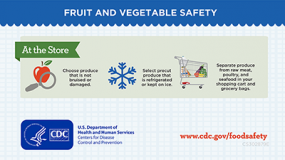
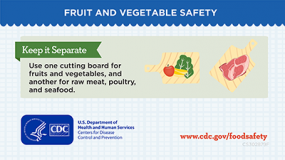
At the store choose fruits and veggies that are not bruised and keep meats separate in cart. Download social media graphics for facebook and twitter.CDC Keep meats and vegetables on separate cutting boards. Download social media graphics for facebook and twitter.

Eating a diet with plenty of fruits and vegetables provides important health benefits, but it’s important that you select and prepare them safely.

Fruits and vegetables add nutrients to your diet that help protect you from heart disease(https://www.cdc.gov/heartdisease/), stroke(https://www.cdc.gov/stroke/), and some cancers(https://www.cdc.gov/cancer/). In addition, choosing vegetables, fruits, nuts, and other produce over high-calorie foods can help you manage your weight(https://www.cdc.gov/obesity/).

But sometimes raw fruits and vegetables contain harmful germs, such as Salmonella(https://www.cdc.gov/salmonella/index.html), E. coli(https://www.cdc.gov/ecoli/index.html), and Listeria(https://www.cdc.gov/listeria/index.html), that can make you and your family sick. In the United States, nearly half(https://www.cdc.gov/foodborneburden/attribution/attribution-1998-2008.html) of foodborne illnesses are caused by germs on fresh produce.

The safest produce is cooked; the next safest is washed. Enjoy uncooked fruits and vegetables while taking steps to avoid foodborne illness, also known as food poisoning.

Cook sprouts thoroughly to reduce the risk of illness. Sprouts are a particular concern because the warm, humid conditions needed to grow sprouts also are ideal for germs to multiply. Therefore, eating raw or lightly cooked sprouts may lead to food poisoning. It’s especially important to avoid raw sprouts if you are in a group more likely to get seriously sick from food poisoning: pregnant women, young children, older adults, and people with weakened immune systems.
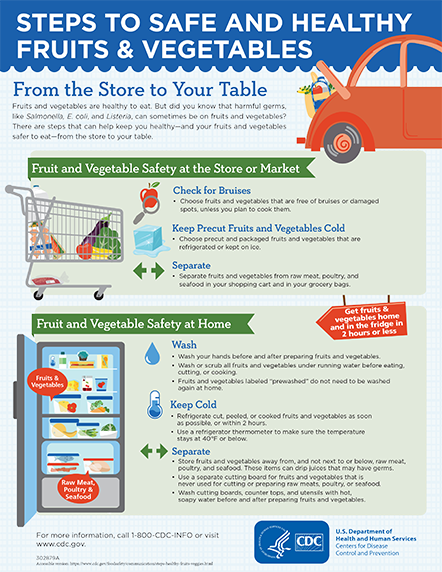
thumbnail for fruit and veggie safety posterSprouts: What You Should Know  

At the store or market:

  • Choose produce that isn’t bruised or damaged.
  • Keep precuts fruits and vegetables cold by choosing produce that is refrigerated or kept on ice.
  • Separate fruits and vegetables from raw meat, poultry, and seafood in your shopping cart and in your grocery bags.


Research – Street foods in Beirut city: An assessment of the food safety practices and of the microbiological quality

Wiley Online Library

Abstract

Street food is a prevalent part of the food service industry. It is convenient in terms of accessibility and cost, but perceived as potential risk of foodborne illness. Accordingly, the safety of street foods in Beirut, Lebanon was assessed using an observational checklist and microbiological analyses. A total of 30 vendors were observed for their food safety parameters and 60 samples were analyzed for their content of Escherichia coli, Staphylococcus aureus, Listeria spp., and Salmonella spp., then, statistical analyses were performed for possible correlations. Results showed unsatisfactory levels of foodborne pathogens. Microbiological contamination was significantly correlated to unproper environmnental surroundings, deficiency of potable water, money handling, inappropriate methods of refrigeration, and the limited access to improper disposal facilities near stalls. These findings reveal the microbiological quality of street foods served in Beirut, and highlight on the practices to be ameliorated to provide safe street food products to consumers.

Practical applications

Street food emerges as a social adaptation in urban areas due to its rapid lifestyle hence it may present a public health risk due to various factors. The current study is the first of its kind to be conducted in Beirut and its results present solid basis for further practices at different levels. Divulgation of its results would lead to new governmental laws to protect the public health and reduce the economic burdens related to hospitalization due to foodborne pathogens and poisoning. Educational institutions would also be involved in applications related to training and awareness sessions for street food handlers, to teach them the good hygienic practices. This study will also help consumers identify good and bad hygienic practices thus choose appropriate street food handlers.

Research – Norovirus – Applied math reveals the key to stopping Norovirus lies — literally — in our own hands

Science Daily 


From stately cruise ships to Olympic host cities, recent headline-grabbing outbreaks prove that norovirus, an incapacitating stomach bug, can strike anywhere and anytime. A new study uses mathematical modelling and data from real-world cruise ship outbreaks to find the best way of stopping the disease’s spread. Their surprising results reveal that washing your hands is more effective than surface cleaning or even quarantine at breaking the chain of transmission.

Research – Fruit Flies as Potential Vectors of Foodborne Illness

NCBI 


Abstract

Fruit flies are a familiar sight in many food service facilities. Although they have been long considered as “nuisance pests,” some of their typical daily activities suggest they may pose a potential public health threat. The aim of this study was to provide evidence of the ability of small flies to transfer bacteria from a contaminated source, food, or waste to surfaces or ready-to-eat food. Laboratory experiments were conducted by using purpose-built fly enclosures to assess the bacterial transfer capability of fruit flies. Drosophila repleta were capable of transferring Escherichia coli O157:H7, Salmonella Saint Paul, and Listeria innocua from an inoculated food source to the surface of laboratory enclosures. In addition, using an inoculated doughnut and noncontaminated lettuce and doughnut surfaces, fly-mediated cross-contamination of ready-to-eat food was demonstrated. Fruit flies were shown to be capable of accumulating approximately 2.9 × 10³ log CFU of E. coli per fly within 2 h of exposure to a contaminated food source. These levels of bacteria did not decrease over an observation period of 48 h. Scanning electron micrographs were taken of bacteria associated with fly food and contact body parts and hairs during a selection of these experiments. These data, coupled with the feeding and breeding behavior of fruit flies in unsanitary areas of the kitchen and their propensity to land and rest on food preparation surfaces and equipment, indicate a possible role for fruit flies in the spread of foodborne pathogens

USA – CDC – FDOSS – Foodborne Disease Outbreak Surveillance System (FDOSS)

1aaaaCDC 

The Foodborne Disease Outbreak Surveillance System (FDOSS) collects information from state and local health departments about foodborne disease outbreaks. Outbreaks are occurrences in which two or more people get the same illness from the same contaminated food or drink.

Outbreaks provide important insights into how germs are spread, which illness-causing germ are typically found in which foods, and how to prevent food poisoning.

Each year, CDC summarizes FDOSS data in an annual surveillance report(https://www.cdc.gov/fdoss/annual-reports/index.html) and makes it available through the National Outbreak Reporting System (NORS) Dashboard.

USA – Mechanically tenderized sirloins recalled for possible Salmonella contamination

Food Safety News

The Texas-based Standard Meat Company, located in Sagina, late Thursday recalled up to 53,154 pounds of raw beef products that may be contaminated with Salmonella, according to the U.S. Department of Agriculture’s Food Safety and Inspection Service (FSIS). The raw beef products incorporated a non-meat ingredient, Au Jus Seasoning, that was found positive for the presence of Salmonella.

UK – Pub company’s response to 62 people falling ill with food poisoning symptoms

Bristol Post

The company in partnership with a pub currently under investigation after diners fell ill with food poisoning symptoms has said it is supporting the venue.

It is understood 62 people have reported suffering from diarrhoea and vomiting after eating at The Old Farmhouse in Nailsea on Sunday.

An investigation is now underway and North Somerset Council environmental health officers have visited the venue in Trendlewood Way.

The kitchen at the pub, operated by pub chain Hall and Woodhouse, has been closed voluntarily while investigations continue. And Public Health England is now working with North Somerset Council to investigate the source of the sickness and diarrhoea outbreak.