Oxford Journals – Whole-genome sequencing used to investigate a nationwide outbreak of listeriosis caused by ready-to-eat delicatessen meat, Denmark, 2014
CDC – Molecular Typing and Epidemiology of Human Listeriosis Cases, Denmark, 2002–2012

Oxford Journals – Whole-genome sequencing used to investigate a nationwide outbreak of listeriosis caused by ready-to-eat delicatessen meat, Denmark, 2014
CDC – Molecular Typing and Epidemiology of Human Listeriosis Cases, Denmark, 2002–2012
Posted in Uncategorized
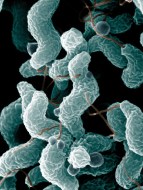
Case-control studies of sporadic Campylobacter infections have predominately been conducted in non-Hispanic populations. In Arizona, rates of campylobacteriosis have been historically higher than the national average, with particularly high rates in Hispanics. In 2010, health departments and a state university collaborated to conduct a statewide case-control study to determine whether risk factors differ in an ethnically diverse region of the United States. Statistically significant risk factors in the final multivariate model were: eating cantaloupe [odds ratio (OR) 7·64], handling raw poultry (OR 4·88) and eating queso fresco (OR 7·11). In addition, compared to non-Hispanic/non-travellers, the highest risk group were Hispanic/non-travellers (OR 7·27), and Hispanic/travellers (OR 5·87, not significant). Results of this study suggest Hispanics have higher odds of disease, probably due to differential exposures. In addition to common risk factors, consumption of cantaloupe was identified as a significant risk factor. These results will inform public health officials of the varying risk factors for Campylobacter in this region.
Posted in Uncategorized
CDC -Shiga Toxin–Producing Escherichia coli O157, England and Wales, 1983–2012
CDC-Serogroup-specific Seasonality of Verotoxigenic Escherichia coli, Ireland
Oxford Journals -Shiga Toxin-Producing Escherichia coli Infection, Antibiotics, and Risk of Developing Hemolytic Uremic Syndrome: A Meta-Analysis
BMJ -Disease severity of Shiga toxin-producing E. coli O157 and factors influencing the development of typical haemolytic uraemic syndrome: a retrospective cohort study, 2009–2012
Posted in Uncategorized
Raw milk can carry harmful germs that can make you very sick or kill you. If you’re thinking about drinking raw milk because you believe it has health benefits, consider other options.
Developing a healthy lifestyle requires you to make many decisions. One step you might be thinking about is adding raw milk to your diet. Raw milk is milk that has not been pasteurized (heating to a specific temperature for a set amount of time to kill harmful germs). Germs include bacteria, viruses, and parasites.
Posted in Uncategorized
Duquesne, PA – Greater Pittsburgh Community Food Bank is announcing a voluntary recall of one lot of Imperial Choice Mandarin Oranges Broken Segments in Light Syrup because some of the cans from this lot may leak, bulge or burst open. The product may be contaminated by spoilage organisms or pathogens, which could lead to serious or life-threatening illness if consumed. This recall only affects cans marked with code 4200/01029.
Bulging cans may be swollen at the top, bottom or both ends. Even if cans from this lot appear normal, this product should not be eaten. This recall only involves product that was distributed August 2015 through January 2016 through the Food Bank’s network of pantries throughout Southwestern PA. It was also distributed at Produce to People distributions in Allegheny Valley, Butler, Cambria, Fayette, Greene, McKeesport, Sheraden, Southside, Washington and West Greene and through emergency aid boxes provided to people visiting the Food Bank’s facility in Duquesne, PA.
Any consumer who has cans from this lot should dispose of them. Pantries with cans from this lot should remove them from their shelves and contact the Food Bank with an inventory of how many cans are remaining. The Food Bank is in communication with its supplier of this product and the Food and Drug Administration regarding this recall and no illnesses have been reported to date.
About Greater Pittsburgh Community Food Bank:
Greater Pittsburgh Community Food Bank, a member of Feeding America, is a not-for-profit organization founded in 1980 that distributes more than 23 million meals annually throughout a network of more than 400 partners across 11 counties in southwestern Pennsylvania. For more information on hunger in our region or how to get involved, visit www.pittsburghfoodbank.org .
Posted in Uncategorized

RASFF-aflatoxins (B1 > 5.0 µg/kg – ppb) in roasted peanuts from Argentina, via the Netherlands in Germany
RASFF-aflatoxins (B1 = 10; Tot. = 11 µg/kg – ppb) in corn from Serbia in Slovenia
RASFF-aflatoxins (B1 = 43; Tot. = 46 / B1 = 72; Tot. = 77 µg/kg – ppb) in pistachios in shell from Iran in Belgium
RASFF-aflatoxins (B1 = 10.1; Tot. = 10.9 / B1 = 8.9; Tot. = 9.1 µg/kg – ppb) in pistachio nuts with shell from Iran in Germany
Posted in Uncategorized
study commissioned by EFSA to prioritise future work in the area of food safety has identified 28 key topics. The results of this study will guide collaboration between EFSA and EU Member States and contribute to the development of a common risk assessment agenda.
The study used the Delphi methodology with a three-round iterative survey. It involved more than 200 scientists and experts from a wide range of fields related to risk assessment in the area of food safety.
The experts were asked to identify and rate food safety priorities according to certain criteria such as their potential for saving resources, their added value to support risk assessment activities and their potential to improve harmonisation of risk assessment.
The 28 topics are grouped in five categories: chemical, microbiological and environmental risk assessment, nutrition and a generic category of cross-cutting issues. Using an aggregate rating measure, two topics in each category were identified as top-rated. These include: common data collection across Europe, risk assessment of aggregated exposure, antimicrobial resistance, zoonoses, environmental contaminants in food, and the development of standard risk-benefit assessment methods of foods.
Posted in Uncategorized

RASFF-histamine (101; 339 mg/kg – ppm) in canned tuna from Vietnam in Germany
RASFF-histamine (400 mg/kg – ppm) in frozen marlin loins from Vietnam, via the Netherlands in Sweden
Posted in Uncategorized

RASFF-suspicion of Salmonella (presence /25g) in chilled clams (Tapes semidecussatus) from Italy in Italy
RASFF-Salmonella (present /25g) in frozen sausage and poultry skewers from Italy in France
RASFF-Salmonella (presence /25g) in frozen turkey meat preparation from Brazil in the Netherlands
RASFF-Salmonella (presence /25g) in frozen turkey meat preparation from Brazil in the Netherlands
RASFF-Salmonella (presence /25g) in ground cumin and ground coriander from India in the UK
RASFF-Salmonella enteritidis (presence /25g) in full cream milk powder from Spain, via France in the Netherlands
Posted in Uncategorized

RASFF-too high count of Escherichia coli (630 MPN/100g) in chilled mussels (Mytilus galloprovincialis) from Spain in Italy
RASFF-too high count of Escherichia coli (330 MPN/100g) in live mussels from Spain in Italy
RASFF-high count of Escherichia coli (9400; 3600; 1000; 720; 620 CFU/g) in chilled holy basil from Laos in the UK
Posted in Uncategorized