Category Archives: Uncategorized

Philippines – Food poisoning sickens 145 at Bacolod elementary school

Outbreak News Today

A team of investigators from the Philippines Department of Health (DOH) will arrive today in Bacolod City to attempt to determine what sickened some 145 students in the village of Barangay Handumanan, according to local media.

In the past several days, 145 students from Handumanan Elementary School have been hospitalized with symptoms of food poisoning.

Canada – Listeria outbreak: Richmond food-poisoning victim dies in hospital

Vancouver Sun

One of six people hospitalized after eating processed meat contaminated with listeria has died.

The six cases have been linked to food sold at Foody World in Richmond, said Claudia Kurzac, manager of health protection with Vancouver Coastal Health.

Foody World was closed Friday by VCH and remains shuttered, she said. The death occurred earlier this month.

“In our investigation of the store, we did an inspection and had concerns about food handling and sanitation,” Kurzac said.

“We collected samples of food and environmental samples from the kitchen on the (Oct.) 7th, and on the 14th we heard from the lab. Preliminary results were that some (samples) were positive for Listeria.”

Listeria was found in processed, ready-to-eat pork and beef.


UK -Scotland -Cheesemaker at centre of E.coli probe goes to court to fight ban

Herald Scotland

ONE of Scotland’s leading cheesemakers has pinned his hopes on legal action to keep his business open after it was caught up in an E.coli outbreak.

Humphrey Errington is seeking a judicial review to prevent Food Standards Scotland (FSS) from destroying all his stocks of Dunsyre Blue, which it claims lay behind the outbreak that affected 22 people and led to the death of a three-year-old girl.

Mr Errington said that unless the court rules in his favour his Lanarkshire firm Errington Cheese is “finished” and will have to close.


USA-Salmonella Javiana Outbreak in Maricopa County AZ Sickens 50

Food Poisoning Bulletin s_enterica

The Maricopa County Department of Public Health has released a PDF report on their investigation into a Salmonella Javiana outbreak that sickened at least 50 people in July and August, 2016. There are 40 confirmed cases and 10 probable cases. Thirty-three (66%) of the cases reported eating at Restaurant A, with exposure dates from July 16 to August 18, 2016. Forty other restaurants or fast food establishments were reportedly patronized by patients. Three had more than one person reporting eating there within the week before illness onset with two cases each


USA -Bacteria named in Mighty Taco outbreak; chain denies fault -Bacillus cereus

Food Safety News Bacillus_cereus_01

Bacteria sometimes associated with Chinese restaurants is the culprit behind an outbreak among more than 150 patrons of Mighty Taco restaurants in New York.

State health officials said Monday evening they had isolated Bacillus cereus in samples of refried beans collected from Mighty Taco locations as well as in lab samples submitted by sick people. Owners of the 43-year-old regional fast food chain took to Facebook to explain the situation, stating they did not want to be misquoted.

USA-Egg Producers to Spend 3 Months in Prison for 2010 Salmonella Outbreak

Food Safety Magazine EGGS

The 8th U.S. Circuit Court of Appeals in St. Louis, MO has denied appeals from Austin “Jack” DeCoster and his son Peter DeCoster–the pair behind a multistate Salmonella outbreak in 2010 that sickened roughly 56,000 people. The DeCosters’ family-owned company, Quality Egg LLC, was said to be the largest egg producer in the U.S. Now, both father and son–ages 82 and 52, respectively– will be spending the next 3 months in a Yankton, SD federal prison.

Research -Effect of inoculum size, bacterial species, type of surfaces and contact time to the transfer of foodborne pathogens from inoculated to non-inoculated beef fillets via food processing surfaces

Science Direct

16875_lores

CDC Photo


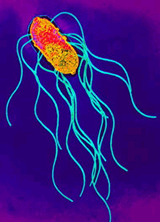
The objective of the present study was to determine the factors affecting the transfer of foodborne pathogens from inoculated beef fillets to non-inoculated ones, through food processing surfaces. Three different levels of inoculation of beef fillets surface were prepared: a high one of approximately 107 CFU/cm2, a medium one of 105 CFU/cm2 and a low one of 103 CFU/cm2, using mixed-strains of Listeria monocytogenes, or Salmonella enterica Typhimurium, or Escherichia coli O157:H7. The inoculated fillets were then placed on 3 different types of surfaces (stainless steel-SS, polyethylene-PE and wood-WD), for 1 or 15 min. Subsequently, these fillets were removed from the cutting boards and six sequential non-inoculated fillets were placed on the same surfaces for the same period of time. All non-inoculated fillets were contaminated with a progressive reduction trend of each pathogen’s population level from the inoculated fillets to the sixth non-inoculated ones that got in contact with the surfaces, and regardless the initial inoculum, a reduction of approximately 2 log CFU/g between inoculated and 1st non-inoculated fillet was observed. S. Typhimurium was transferred at lower mean population (2.39 log CFU/g) to contaminated fillets than E. coli O157:H7 (2.93 log CFU/g), followed by L. monocytogenes (3.12 log CFU/g; P < 0.05). Wooden surfaces (2.77 log CFU/g) enhanced the transfer of bacteria to subsequent fillets compared to other materials (2.66 log CFU/g for SS and PE; P < 0.05). Cross-contamination between meat and surfaces is a multifactorial process strongly depended on the species, initial contamination level, kind of surface, contact time and the number of subsequent fillet, according to analysis of variance. Thus, quantifying the cross-contamination risk associated with various steps of meat processing and food establishments or households can provide a scientific basis for risk management of such products.

Research -Tolerance of Clostridium perfringens biofilms to disinfectants commonly used in the food industry

Science Direct Clost

Clostridium perfringens is an opportunistic pathogen that can cause food poisoning in humans and various enterotoxemia in animal species. Recently, it was shown to form mono-species biofilms, a structured community of bacterial cells enclosed in a self-produced extracellular matrix. Biofilms have been associated with tolerance to antibiotics, disinfectants, and physical and environmental stresses. Very little is known about the tolerance of C. perfringens biofilm toward disinfectants. In the present study, susceptibilities of C. perfringens biofilms to five types of commonly used disinfectants on farms and in food processing environments were analysed. In this paper, we show that C. perfringens mono-species biofilms can protect the bacterial cells from the action of potassium monopersulfate, quaternary ammonium chloride, hydrogen peroxide and glutaraldehyde solutions. However, sodium hypochlorite solution was shown to be effective on C. perfringens biofilms. Our investigation of dual-species biofilms of C. perfringens with the addition of Staphylococcus aureus or Escherichia coli demonstrated that overall, the mono-species biofilm of C. perfringens was more tolerant to all disinfectants than the dual-species biofilms. For the anaerobic grown biofilms, the mono-species biofilm of C. perfringens was more tolerant to sodium hypochlorite and quaternary ammonium chloride than the dual-species biofilms of C. perfringens with S. aureus or E. coli. This study demonstrates that C. perfringens biofilm is an effective protection mechanism to disinfectants commonly used on farms and in food processing environments.

Egypt -Egypt says all its frozen and fresh strawberries are Hepatitis A-free

Food Safety News Hepatitis A kswfoodworld

Egypt’s reaction to the Hepatitis A outbreak in the United States sourced to frozen strawberries exported from the Middle East nation may not be anymore meaningful  than its response  to Europe’s massive 2011 E. coli outbreak.

This time, Egypt’s Ministry of Climate Change and Environment said that frozen strawberries originating from the country are, based on sampling, Hepatitis-free. Said to be the world’s fourth-largest strawberry producer, Egypt has been working on that answer since August.


Research Europe -The potential impact of media reporting in syndromic surveillance: an example using a possible Cryptosporidium exposure in North West England, August to September 2015

Eurosurveillance 763px-Cryptosporidium_parvum_01

During August 2015, a boil water notice (BWN) was issued across parts of North West England following the detection of Cryptosporidium oocysts in the public water supply. Using prospective syndromic surveillance, we detected statistically significant increases in the presentation of cases of gastroenteritis and diarrhoea to general practitioner services and related calls to the national health telephone advice service in those areas affected by the BWN. In the affected areas, average in-hours general practitioner consultations for gastroenteritis increased by 24.8% (from 13.49 to 16.84) during the BWN period; average diarrhoea consultations increased by 28.5% (from 8.33 to 10.71). Local public health investigations revealed no laboratory reported cases confirmed as being associated with the water supply. These findings suggest that the increases reported by syndromic surveillance of cases of gastroenteritis and diarrhoea likely resulted from changes in healthcare seeking behaviour driven by the intense local and national media coverage of the potential health risks during the event. This study has further highlighted the potential for media-driven bias in syndromic surveillance, and the challenges in disentangling true increases in community infection from those driven by media reporting.