Category Archives: Uncategorized

USA -Ready Pac Foods Inc. Recalls Chicken Salad Products Due to Possible Listeria Contamination

FSIS – USDA

WASHINGTON, Feb. 22, 2017 – Three Ready Pac Foods Inc. establishments, located in Swedesboro, N.J., in Jackson, Ga., and the headquarters establishment in Irwindale, Calif., are recalling approximately 59,225 pounds of one variety of chicken salad product that may be adulterated withListeria monocytogenes, the U.S. Department of Agriculture’s Food Safety and Inspection Service (FSIS) announced today.

The Puro Picante Blazin’ Hot salad items were produced between Jan. 17, 2017 and Feb. 17, 2017. The following products are subject to recall: [View Labels(PDF only)]

  • 7.5-oz. single serve salad bowl packages of “Ready Pac Foods Puro Picante Blazin Hot” with Use By Dates of 01/31/17 through 03/04/2017.

The products subject to recall bear establishment number P-27497, P-32081, or P-18502B inside the USDA mark of inspection. These items were shipped to retail locations nationwide.

The problem was discovered on Feb. 21, 2017 when the firm received notification from the cheese supplier that the cheese ingredient utilized in the chicken salad products was included in an expanded cheese recall due to potential contamination with L. monocytogenes. There have been no confirmed reports of adverse reactions due to consumption of these products.

Consumption of food contaminated with L. monocytogenes can cause listeriosis, a serious infection that primarily affects older adults, persons with weakened immune systems, and pregnant women and their newborns. Less commonly, persons outside these risk groups are affected.

Listeriosis can cause fever, muscle aches, headache, stiff neck, confusion, loss of balance and convulsions sometimes preceded by diarrhea or other gastrointestinal symptoms. An invasive infection spreads beyond the gastrointestinal tract. In pregnant women, the infection can cause miscarriages, stillbirths, premature delivery or life-threatening infection of the newborn. In addition, serious and sometimes fatal infections can occur in older adults and persons with weakened immune systems. Listeriosis is treated with antibiotics. Persons in the higher-risk categories who experience flu-like symptoms within two months after eating contaminated food should seek medical care and tell the health care provider about eating the contaminated food.

FSIS and the company are concerned that some of this recalled product may be in consumers’ refrigerators.

Consumers who have purchased these products are urged not to consume them. These products should be thrown away or returned to the place of purchase.

FSIS routinely conducts recall effectiveness checks to verify recalling firms notify their customers of the recall and that steps are taken to make certain that the product is no longer available to consumers. When available, the retail distribution list(s) will be posted on the FSIS website at www.fsis.usda.gov/recalls.

Consumers with questions regarding the recall can contact Mary Toscano, Corporate Affairs Supervisor, at 1-800-800-7822. Media with questions regarding the recall can contact Alan Hilowitz, Director of Corporate Communications, at (626) 678-2180.

Consumers with food safety questions can “Ask Karen,” the FSIS virtual representative available 24 hours a day at AskKaren.gov or via smartphone at m.askkaren.gov. The toll-free USDA Meat and Poultry Hotline 1-888-MPHotline (1-888-674-6854) is available in English and Spanish and can be reached from 10 a.m. to 4 p.m. (Eastern Time) Monday through Friday. Recorded food safety messages are available 24 hours a day. The online Electronic Consumer Complaint Monitoring System can be accessed 24 hours a day at: https://www.fsis.usda.gov/reportproblem.
Research -Finds Salmonella Food Poisoning Could Damage DNA

SalmonellaFood Poisoning Bulletin

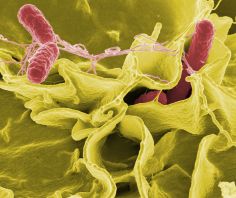
Research at Cornell University has found that Salmonella food poisoning caused by some serotypes of the pathogenic bacteria could permanently damage your DNA. The study is published in the journal mBio by the American Society for Microbiology as “The Cytolethal Distending Toxin Produced by Nontyphoidal Salmonella Serotypes Javiana, Montevideo, Oranienburg, and Mississippi Induces DNA Damage in a Manner Similar to That of Serotype Typhi.” Dr. Rachel Miller, author of the study, said, “not all Salmonella serotypes are equal.”

Europe -Antimicrobial Resistance

Europa

Antimicrobial Resistance (AMR) is the ability of microorganisms to resist antimicrobial treatments, especially antibiotics. AMR not only has a direct impact on human and animal health – due to the failure in the treatment of infectious diseases – but also carries a heavy economic cost.

AMR is a natural phenomenon but an accumulation of factors, including excessive and inappropriate use of antimicrobial medicines on humans and animals and poor infection control practices, transformed AMR into a serious threat to public health worldwide.

This leads to:

  • increasing healthcare costs
  • prolonged hospital stays
  • treatment failures
  • a significant number of deaths

Global consumption of antibiotics in human medicine rose by nearly 40% between 2000 and 2010 (UK Report).

In the US alone, “more than two million people are sickened every year with antibiotic-resistant infections, with at least 23.000 dying as a result” (data from the Centers for Disease Control and Prevention, 2009-2011).

In the EU, 25.000 people die each year from an infection due to antibiotic-resistant bacteriapdf(data from 2007). Infections due to these selected multidrug-resistant bacteria in the EU result in extra healthcare costs and productivity losses of at least €1.5 billion each year. If the current trend is not altered, 300 million people worldwide are expected to die prematurely because of drug resistance over the next 35 yearspdf.

AMR spreads through global tourism, transfer of patients between healthcare facilities within and from outside the EU, and through trade in food and animals.

It is an important global economic and a societal challenge that can’t be tackled by countries or public administrations alone. Therefore, the problem needs a comprehensive “One Health” approach to it. That means that a holistic, multi-sectorial approach, involving many different sectors (public health, food safety, bio-safety, environment, research and innovation, international cooperation, animal health and welfare as well as non-therapeutic use of antimicrobial substances) is needed to tackle this complex problem.

In June 2016, the Commission published the Eurobarometer results on Antimicrobial Resistance awarenesspdf(3 MB) Choose translations of the previous link . The main conclusion of this Eurobarometer was that knowledge across the EU remains low.

The report, published on 16 June 2016, shows a 6% decrease in consumption in the last years even though some countries are still showing an increase in their consumption.

For more information, please refer to:

A Flash Eurobarometer in non-EU countries was also published in November 2016.

For more background information regarding AMR, please refer to the following factsheet: AMR: A major European and Global challenge.pdf(358 kB)

Research -Researchers zap Norovirus on fresh lettuce with blast of ionized gas

Eurofins Food Testing UKFood Safety News

When you put one of the toughest bugs on the planet in a match-up with some of the most delicate fresh foods, it doesn’t take a Vegas mathematician to figure the odds are against the food making it through a sterilization process undamaged.

Among the most delicate and most prone to carry foodborne illnesses are leafy greens. Among the most difficult to kill bugs is norovirus. But a microbiologist at the University of Minnesota-St. Paul is working on a solution.

As it turns out, norovirus, aka the stomach bug or the cruise ship blues, can’t stand up to cold plasma treatment and researcher Hamada Aboubakr has shown that at least one leafy green can survive the sterilization process with no apparent damage.

Research -Listeria a bigger threat for miscarriage in the early stages of pregnancy

Outbreak News Today

Listeria, a common food-borne bacterium, may pose a greater risk of miscarriage in the early stages of pregnancy than appreciated, according to researchers at the University of Wisconsin-Madison School of Veterinary Medicine studying how pathogens affect fetal development and change the outcome of pregnancy.

“For many years, listeria has been associated with adverse outcomes in pregnancy, but particularly at the end of pregnancy,” says Ted Golos, a UW-Madison reproductive physiologist and professor of comparative biosciences and obstetrics and gynecology. “What wasn’t known with much clarity before this study is that it appears it’s a severe risk factor in early pregnancy.”

Hong Kong – A batch of roast beef suspected to be contaminated with Listeria monocytogenes

CFS

<!–

–>

Issue Date 2017-02-22
Source of Information Centre for Food Safety (CFS)
Food Product Roast beef
Name of Importer
Product name and Description Product name: Roast Beef
Product brand: Leo’s Fine Food
Manufacturer: Leo’s Fine Food Co Ltd
Use-by date: February 27, 2017
Reason For Issuing Alert

– The Centre for Food Safety (CFS) collected the above-mentioned roast beef sample from an online shop for testing under its regular Food Surveillance Programme. The test result showed that the sample contained Listeria monocytogenes.

– Listeria monocytogenes can be easily destroyed by cooking but can survive and multiply at refrigerator temperatures. Most healthy individuals do not develop symptoms or only have mild symptoms like fever, muscle pain, headache, nausea, vomiting or diarrhoea when infected. However, severe complications such as septicemia, meningitis or even death may occur in newborns, the elderly and those with a weaker immune system. Although infected pregnant women may just experience mild symptoms generally, the infection of Listeria monocytogenes may cause miscarriage, infant death, preterm birth, or severe infection in the newborns.

Action Taken by the Centre for Food Safety

– The CFS has informed the vendor of the test result and instructed it to stop sale of the affected batch of the product and initiate a recall. The manufacturer has suspended its production temporarily to carry out thorough cleaning and disinfection. According to the distribution record of the vendor, the affected batch of the product has been sold to four clients. The vendor is initiating the recall action with concerned clients.

– The CFS will continue to closely monitor the situation and take appropriate action to safeguard food safety and public health.

Advice to the Trade

– Stop using or selling the product concerned immediately.
Advice to Consumers
– Stop consuming the affected product if they have purchased any, and to seek medical advice if they feel sick upon consumption.
Further Information The CFS press release

For enquiries about the recall, members of the public may call Leo’s Fine Food Co Ltd (2814 1766) during office hours.

Ireland -SuperValu Recalls Batches of Wicklow Blue Cheese Due to Possible Presence of Listeria monocytogenes

FSAI

Summary
Category 2: For Information
Alert Notification: 2017.05
Product: Wicklow Blue (cut and packed in-store)
Batch Code: Use by Dates: 21/02/2017, 22/02/2017, 23/02/2017
Country Of Origin: Ireland

Message:

As a precautionary measure, SuperValu is recalling the above batches of Wicklow Blue, due to the possible presence of Listeria monocytogenes. SuperValu is issuing point of sale recall notices requesting customers who have bought the implicated batch not to consume it.

Japan -Over 950 students, staff suffer food poisoning in Tachikawa

Japan Today

TOKYO —

More than 950 staff members and students at seven elementary schools in Tachikawa, Tokyo, suffered food poisoning on Friday, the Tachikawa Board of Education and local health officials said.

According to the board, 954 students and staff reported symptoms such as vomiting and diarrhea on Friday evening and Saturday afternoon, Fuji TV reported. Five were hospitalized.

Following a meeting on Sunday afternoon, headmasters decided to close four of those elementary schools on Monday.

Health officials said all the students and staff got sick after eating lunches prepared by a supply center of school meals that prepared 3,000 lunches on Thursday.

UK -Morrisons recalls Peppered Beef Slices because of the presence of Listeria monocytogenes

FSA

Product details

Product: Ready to Eat Peppered Beef Slices
Pack size: 150g
‘Use By’ date: 21 February 2017

No other Morrisons products are known to be affected.

Risk

The presence of Listeria monocytogenes in the product(s) listed. Symptoms caused by this organism can be similar to flu and include high temperature, muscle ache or pain, chills, feeling or being sick and diarrhoea. However, in rare cases, the infection can be more severe, causing serious complications, such as meningitis.

Some people are more vulnerable to listeria infections, including those over 65 years of age, pregnant women and their unborn babies, babies less than one month old and people with weakened immune systems.

Our advice to consumers

If you have bought the above product do not eat it. Instead, return it to the store from where it was bought for a full refund.

Action taken by company

Morrisons is recalling the above product. Point of sale notices will be displayed in all stores that are selling this product. These notices explain to customers why the products are being recalled and tell them what to do if they have bought the product. Please see the attached notice.

Research -New Evidence Links the Collapse of Aztec Society to a Deadly Salmonella Outbreak

Science Alert Salmonella kswfoodworld

When Spanish forces arrived in Mexico in 1519, the native population was estimated to be around 25 million. A century later, there were only around 1 million left, following several devastating outbreaks of disease brought in from overseas.

Despite plenty of speculation, the diseases that contributed to the collapse of Aztec society remain unconfirmed. But now scientists have presented the first DNA evidence of a bacterial species from one of the worst epidemics – and it suggests that a deadly outbreak of salmonella might have been involved.