Category Archives: Neurotoxic Shellfish Poisoning

New Zealand – Eight fast facts about toxic shellfish poisoning

MPI

With warmer weather on the way, Kiwis all over the motu will be heading to the beach to enjoy the sea’s bounty. But before you go gathering shellfish, New Zealand Food Safety deputy director-general Vincent Arbuckle has some fast facts to share about toxic shellfish poisoning and how to keep yourself, your whanau and friends safe.

1. New Zealand hasn’t had a toxic shellfish poisoning outbreak for a decade

Toxic shellfish poisoning can cause serious illness and can even be fatal. Fortunately, we haven’t had an outbreak of toxic shellfish poisoning since 2014, when 13 people fell ill.

New Zealand Food Safety works hard to keep it that way by monitoring key recreational shellfish harvesting areas around the country for biotoxins.

2. New Zealand Food Safety regularly tests water and shellfish for biotoxins to keep the public safe

New Zealand Food Safety has more than 40 monitoring sites, with water tested weekly for toxic algae and shellfish tested fortnightly for biotoxins. The commercial shellfish industry also provides their own biotoxin monitoring data from more than 30 sites, giving us even greater coverage.

If shellfish are found to contain biotoxins at unsafe levels, we issue public health warnings and post signs at affected beaches. In 2023 we issued 17 biotoxin alerts.

3. Cooking does not destroy biotoxins

It’s important to know that cooking will not make toxic shellfish safe to eat, because cooking doesn’t destroy biotoxins.

If anyone becomes ill after eating shellfish from an area where a public health warning has been issued, phone healthline for advice on 0800 61 11 16, or seek medical attention immediately. We advise that you also contact your nearest public health unit and keep any leftover shellfish for testing.

4. Shellfish become poisonous by feeding on toxic algae

Shellfish with 2 shells (bivalve shellfish) can each filter more than 200 litres of water a day. They do this to filter out microscopic algae (called phytoplankton) and other particles as a food source. If these algae are toxic, the biotoxins can build up in the shellfish, making them poisonous. Generally, the more toxic algae there are in the water, the more toxic the shellfish get.

5. Bivalve shellfish are the most affected by biotoxins

Shellfish affected by biotoxins usually include bivalves like mussels, oysters, tuatua, pipi, toheroa, cockles and scallops. But pūpū (cat’s eyes) and Cook’s turban and can also have elevated levels of some biotoxins.

Generally, you can still eat pāua, crab and crayfish, but only if you remove the gut before cooking, as biotoxins accumulate in the gut. Finfish are not affected by biotoxins from algal blooms, but we advise discarding the liver before cooking. 

6. Not all species of phytoplankton are toxic

Phytoplankton are photosynthetic microscopic algae, meaning that, just like plants, they use the sunshine to grow. And, like plants, they also need nutrients (which they get from the water) to grow.

If conditions are right, phytoplankton can multiply to high numbers and form algal blooms. Most species of phytoplankton are harmless, but some can naturally produce highly toxic chemicals we call marine biotoxins.

7. Algal blooms occur naturally under particular conditions

Algal blooms usually occur naturally when wind and water currents are favourable for their growth. Causes can include slow water circulation or unusually high water temperatures. Some blooms have happened after extreme weather events like cyclones, floods, or drought.

New Zealand Food Safety does extra monitoring during a toxic algal bloom to track its spread and see how it is affecting different kinds of shellfish.

8. There are 4 main types of toxic shellfish poisoning in New Zealand

Paralytic shellfish poisoning (PSP) is potentially the most serious of the 4 main types of toxic shellfish poisoning found in NZ.

PSP symptoms usually appear within 10 minutes to 3 hours of eating and may include:

  • numbness and tingling around the mouth, face, hands, and feet
  • difficulty swallowing or breathing
  • dizziness and headache
  • nausea and vomiting
  • diarrhoea
  • paralysis and respiratory failure
  • and, in severe cases, death.

If you suspect someone has PSP poisoning after eating shellfish from an area where we have issued a public health warning, seek medical attention immediately.
Hong Kong – Food Safety Focus (202nd Issue, May 2023)– Article 1 – Shellfish Poisoning

CFS

The Centre for Food Safety (CFS) received a referral from the Centre for Health Protection in April 2023 of a suspected case of diarrhoetic shellfish poisoning (DSP) presented with diarrhoea, nausea, vomiting and abdominal pain within an hour after consuming venus clams from a restaurant. This article will give a brief introduction on shellfish poisoning.

What is Shellfish Poisoning?

Shellfish poisoning is caused by a group of toxins, known as shellfish toxins, produced by certain species of algae. When shellfish eat toxins producing algae, the toxins can accumulate in their tissue. Consumption of shellfish with shellfish toxins by humans can cause a variety of gastrointestinal and neurological illnesses, known as shellfish poisoning. Examples of shellfish that have been involved in shellfish poisoning include mussels, clams, oysters, scallops and geoducks.

Many shellfish toxins have been described around the world; they could cause different types of shellfish poisoning

Hong Kong – Food Safety Bulletin 95th Issue

CFS

Feature Article

Shellfish Poisoning

The Centre for Food Safety (CFS) received in April 2023 a referral from the Centre for Health Protection of a suspected case of diarrhoetic shellfish poisoning in which the affected persons developed diarrhoea, nausea, vomiting and abdominal pain within an hour after consuming venus clams at a restaurant.  This article gives a brief introduction on shellfish poisoning.

What is Shellfish Poisoning?

Shellfish poisoning is caused by shellfish toxins produced by certain species of algae.  When shellfish eat toxin-producing algae, the toxins can accumulate in their tissue.  Consumption of shellfish containing shellfish toxins by humans can cause a variety of gastrointestinal and neurological illnesses, known as shellfish poisoning.  Examples of shellfish that have been involved in shellfish poisoning include mussels, clams, oysters, scallops and geoducks.

Numerous shellfish toxins have been discovered around the world; they could cause different types of shellfish poisoning.  Five major types of shellfish poisoning are discussed below:

(i) Paralytic shellfish poisoning (PSP) — caused by paralytic shellfish toxins (PSTs), which are a group of water-soluble alkaloid neurotoxins, including saxitoxins (STXs).

(ii) Diarrhoetic shellfish poisoning (DSP) — caused by diarrhoetic shellfish toxins (DSTs), which are a group of lipid-soluble polyether toxins, including okadaic acid (OA).

(iii) Neurotoxic shellfish poisoning (NSP) — caused by neurotoxic shellfish toxins (NSTs), which are a group of lipid-soluble polyether toxins, including brevetoxins (BTXs).

(iv) Amnesic shellfish poisoning (ASP) — caused by amnesic shellfish toxins (ASTs), including the water-soluble amino acid domoic acid (DA).

(v) Azaspiracid shellfish poisoning (AZP) — caused by azaspiracid shellfish toxins (AZTs), including the lipid-soluble toxin azaspiracid (AZA).

Characteristics of Shellfish Toxins

Different groups of shellfish toxins display multifarious chemical structures, which can be broadly classified into amino acids (DA), alkaloids (STXs) and polyketides (OA, BTXs and AZA).

The reasons why some algae produce shellfish toxins remain unknown.  These toxins are secondary metabolites with no explicit function for the algae.  They are probably used by the algae to compete for space, defence against predators or prevent the overgrowth of other organisms.

In general, shellfish toxins are heat stable, odourless, tasteless and not destroyed by cooking, freezing or other food preparation procedures.  It is hard to distinguish between toxic and non-toxic shellfish visually.

Bioaccumulation of Shellfish Toxins in Bivalve Molluscs

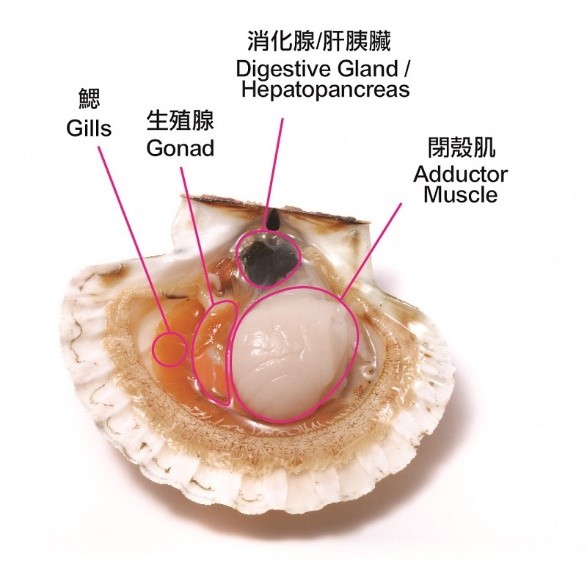
Algae are part of the natural diet of bivalve molluscs.  After shellfish has ingested shellfish toxin-producing algae, shellfish toxins will accumulate and concentrate in their internal organs, such as hepatopancreas of bivalves (Figure 1).  Generally speaking, the adductor muscle contains only a low level of shellfish toxins.

Figure 1: Internal parts of a scallop

Symptoms of Shellfish Poisoning

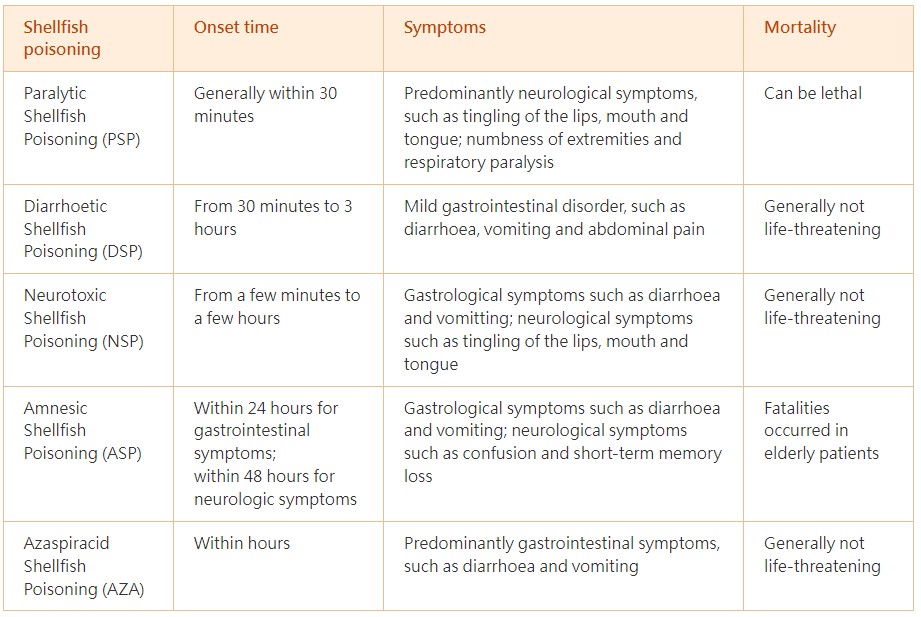
Shellfish toxins can cause a wide variety of symptoms in humans, depending on the type and amount of toxins ingested.  Symptoms of different types of shellfish poisoning are summarised below:

Safety Levels of Shellfish Toxins

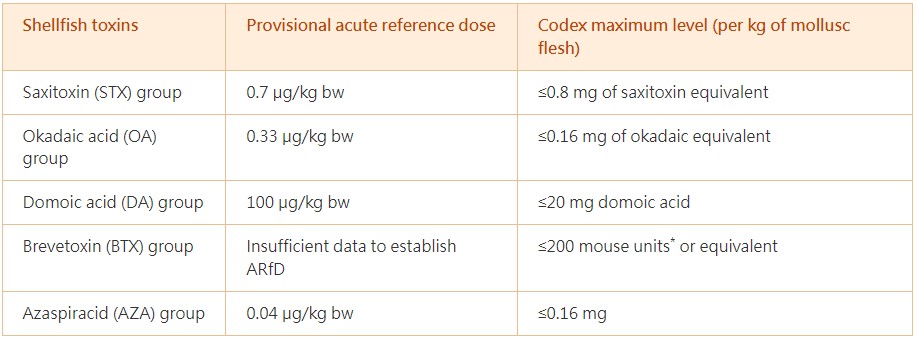
The toxicity of various shellfish toxins was evaluated by a joint expert working group of the Food and Agriculture Organization of the United Nations (FAO), the World Health Organization (WHO) and the Intergovernmental Oceanographic Commission of UNESCO in 2004.  Acute reference doses (ARfDs) (i.e. the amount of toxins that can be ingested in a period of 24 hours or less without appreciable health risk) have been established for these shellfish toxins.  In addition, the Codex Alimentarius Commission (Codex) has established the maximum levels (MLs) for shellfish toxins in edible parts (the whole or any part intended to be eaten separately) of live bivalve molluscs.  While the ARfDs are critical in assessing the safety of food in terms of the level of shellfish toxins contained, Codex MLs are the levels recommended by Codex to be permitted in shellfish.

*An estimate of toxicity of the toxin made by mouse bioassay.

Key Points to Note

  • Shellfish toxins are heat stable, odourless, tasteless and not destroyed by cooking, freezing or other food preparation procedures.
  • It is hard to distinguish between toxic and non-toxic shellfish visually.
  • In general, shellfish toxins accumulate and concentrate in the internal organs of bivalves. 

Advice to Consumers 

  • Purchase shellfish from reliable sources.
  • To reduce the health risk of shellfish poisoning, remove and discard all internal organs of shellfish where possible before consumption.
  • Seek medical attention immediately if you feel ill after eating shellfish.