
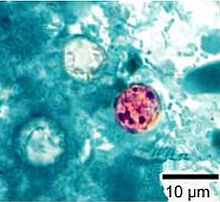
This Special Issue presents important advances, particularly regarding the better detection methods now available, and reviews important aspects of C. cayetanensis and cyclosporiasis. It includes two publications about the epidemiology of the parasite in humans, one in Ghana and another in Colombia. The study in Ghana, one of the few studies of this parasite in Africa, confirmed that immunosuppressed patients are more prone and vulnerable to C. cayetanensis infection. In endemic countries, the most susceptible populations are children, foreign people, and immunocompromised patients, while in industrialized countries, C. cayetanensis affects people of any age [2]. The study in Colombia showed the high endemicity of C. cayetanensis in the Colombian Wiwa indigenous people and observed a higher prevalence of C. cayetanensis in the rainy season (July–November) compared to a previous study performed in the same area during the dry season (January–April) [4]. C. cayetanensis infection is remarkably seasonal, although it varies by geographical region most likely due to human activities, environmental contamination, and the optimal sporulation conditions in each area

 FoodWorld