
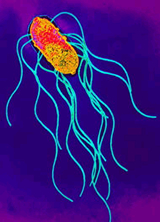
Scientists have deciphered how some types of ‘swimming’ bacteria have evolved to be able to escape when trapped in small spaces. The discovery could pave the way to finding new methods to stop the spread of certain bacteria, including species that cause food poisoning and stomach ulcers.
Many bacteria can swim, allowing them to seek out new sources of nutrients, or in the case of pathogenic bacteria, infect and spread.
Almost all swimming species of bacteria propel themselves forward using corkscrew-like propellers called “flagella.” Bacterial flagella are composed of thousands of protein building blocks arranged in spiralling chains.
A multidisciplinary team of scientists, including researchers from the University of York, has discovered that some types of bacteria have evolved complex flagella made up of many different types of proteins to enable them to manoeuvre themselves out of small spaces.
The scientists looked at a soil-dwelling species of bacteria called Shewanella putrefaciens and found that when they get stuck in a tight space their multi-component flagella buckle, wrapping around the cell bodies and allowing them to corkscrew free.

 FoodWorld