
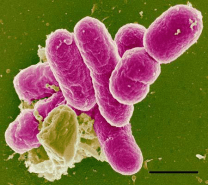
Surviving the treacherous journey through the human body from the mouth to the colon takes a special kind of bacterial pathogen. Shigella – a group of bacteria responsible for much of the diarrheal disease affecting children in the developing world – travels unimpeded from the mouth to the colon, where they unleash powerful machinery to trigger debilitating diarrhea. Researchers from Massachusetts General Hospital (MGH) have been looking not only at how Shigella survives this journey but also how it takes advantage of substances that would kill many less persistent organisms.
Each year Shigella is responsible for at least 80 million infections and approximately 700,000 deaths worldwide. Long-term effects for Shigella survivors can include impaired physical and cognitive development, poor gastrointestinal health, reactive arthritis or kidney damage depending on the strain causing infection. Although 99 percent of cases occur in developing nations, approximately half a million occur in the U.S. each year.


