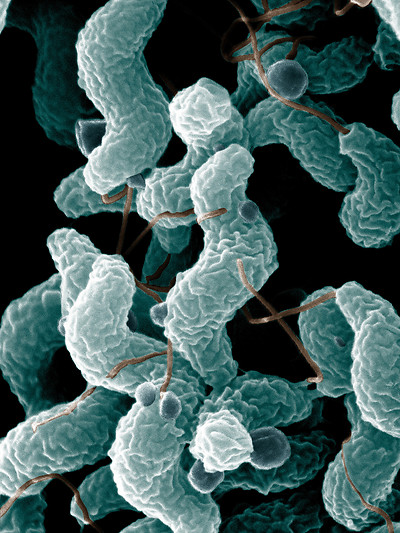
Tag Archives: campylobacter

UK – FSA – The 2015 Chicken Challenge

FSA imagesCAYZ5I84food_standards_agency_logo

We pledge to do our bit to cut campylobacter food poisoning in half….see the web page!

Research – Antimicrobial Resistance Campylobacter on Poultry – Microbial Biofilms in Seafood

Science Direct –  Five-year study on prevalence and antimicrobial resistance of Campylobacter from poultry carcasses in Poland

During 2009–2013 a total of 2114 swab samples collected from broiler carcasses in all 16 voivodeships (administrative districts) of Poland were examined for the presence of Campylobacter jejuni and Campylobacter coli. The antimicrobial resistance of the isolates to ciprofloxacin, tetracycline and erythromycin using the MIC method was also tested. It was found that 1151 (54.4%) carcasses were contaminated with Campylobacter, with 50% of C. jejuni and C. coli species isolated from positive samples. The temporal trend in the prevalence of Campylobacter-positive samples demonstrated that the highest percentage of carcasses was contaminated during the first year of the survey (70.5%) whereas in the last year (2013) only 36.3% of broilers contained these bacteria. Antimicrobial resistance analysis showed that overall 939 (81.6%) of isolates were resistant to ciprofloxacin, 646 (56.1%) to tetracycline but only 28 (2.4%) to erythromycin. Significant differences in resistance profiles between C. jejuni and C. coli were observed with greater resistance level observed in the latter species. Furthermore, a significant increase in the percentage of C. jejuni resistant to ciprofloxacin (from 59.6% in 2009 to 85.9% in 2014) and to tetracycline (from 23.2% to 70.4%, respectively) was identified. Only 20 (1.7%) Campylobacter isolates displayed a multiresistance pattern.

Science Direct – Microbial biofilms in seafood: A food-hygiene challenge

Seafood forms a part of a healthy diet. However, seafood can be contaminated with foodborne pathogens, resulting in disease outbreaks. Because people consume large amounts of seafood, such disease outbreaks are increasing worldwide. Seafood contamination is largely due to the naturally occurring phenomenon of biofilm formation. The common seafood bacterial pathogens that form biofilms are Vibrio spp., Aeromonas hydrophila, Salmonella spp., and Listeria monocytogenes. As these organisms pose a global health threat, recent research has focused on elucidating methods to eliminate these biofilm-forming bacteria from seafood, thereby improving food hygiene. Therefore, we highlight recent advances in our understanding of the underlying molecular mechanisms of biofilm formation, the factors that regulate biofilm development and the role of quorum sensing and biofilm formation in the virulence of foodborne pathogens. Currently, several novel methods have been successfully developed for controlling biofilms present in seafood. In this review, we also discuss the epidemiology of seafood-related diseases and the novel methods that could be used for future control of biofilm formation in seafood.

Research – FSA – UK – Campylobacter Survey: Cumulative Results from the First Nine Months

FSA food_standards_agency_logo

The Food Standards Agency (FSA) has today published the latest set of results from its year-long survey of campylobacter on fresh chickens. Campylobacter is a food bug mainly found on raw poultry and is the biggest cause of food poisoning in the UK.

The results are published for the first time as Official Statistics and the full report can be found via the link on this page. Cumulative results for samples taken between February and November 2014 have now been published, including results presented by major retailer.


Research – EFSA – Salmonella and Campylobacter show significant levels of resistance to common antimicrobials in humans and animals

EFSA

Treatment options for some of the most common food-borne infections are decreasing, as types of bacteria (called ‘isolates’) continue to show resistance to antimicrobial drugs. For example, multi-drug resistant isolates of Salmonella continue to spread across Europe. Also, high resistance to the antimicrobial ciprofloxacin in Campylobacter isolates in both humans and animals has been reported in some Member States. Encouragingly, co-resistance to critically important antimicrobials for both bacteria remains low. These are some the findings of the latest EFSA-ECDC European Union Summary Report on antimicrobial resistance (AMR) in zoonotic and indicator bacteria from humans, animals and food, which analyses data from 2013.

For the first time, EFSA and ECDC have used similar criteria to interpret data. “Findings in antimicrobial resistance in humans, animals and foods are now more comparable. This is a step forward in the fight against antimicrobial resistance”, said Marta Hugas, Acting Head of EFSA’s Risk Assessment and Scientific Assistance Department.

“The high levels of resistance to fluoroquinolones observed in Campylobacter isolates from both humans and broilers are of concern considering that a large proportion of human Campylobacter infections come from handling, preparation and consumption of broiler meat. Such high resistance levels reduce the effective treatment options for severe human Campylobacter infections”, said Mike Catchpole, Chief Scientist at ECDC.


Meat Trades Journal – Cracking Down on Campy Webinar

Meat Trades Journal

Campylobacter is the most common cause of food poisoning in the UK. About four in five cases of campylobacter poisoning in the UK come from contaminated poultry – that’s an estimated 280,000 people a year.

As part of the ongoing MTJ campaign to tackle campylobacter we have joined forces with the FSA to run a webinar on March 18 to explore ways of tackling campylobacter across the food chain. Meat Trades Journal Editor, Ed Bedington, will be chairing the session with presentations by Steve Wearne, Director of Policy at the FSA, David Keeble, Faccenda’s Technical & Development Director and Gary Ford, Chief Poultry Adviser at the NFU. These presentations will be followed by a live Q and A session.

Sign up today for a webinar which will provide valuable insights and advice for businesses on what can be done to minimise campylobacter and stop so many people getting ill.

USA – FSIS Releases New Salmonella, Campylobacter Performance Standards for Poultry

Food Safety News imagesCAYZ5I84

The U.S. Department of Agriculture estimates that its new pathogen performance standards for Salmonella and Campylobacter in ground poultry and chicken parts will prevent about 50,000 illnesses each year.

USDA’s Food Safety and Inspection Service’s (FSIS) proposed changes to the Salmonella and Campylobacter Verification Testing Program create brand-new standards for Salmonella and Campylobacter in chicken breasts, legs and wings, and for Campylobacter in ground chicken and turkey.


Campylobacter Resource Group Website

Campylobacter Joint Working Group

This site contains information on the status of campylobacter in the UK, along with details of the scientific research carried out by the Joint Working Group to reduce levels of campylobacter.…


Information : Campylobacter Website Launched for Consumers

Meat Info Campylobacter

A new consumer website which offers advice on preventing campylobacter has been launched by poultry bodies. As campylobacter continues to hit the headlines – most recently the Food Standards Agency (FSA) advised consumers to bag chicken separately in the fridge – the website, www.campylobacter.org.uk, aims to raise awareness for consumers and provide transparency for the poultry industry.


UK – M&S Five Point Action Plan – Campylobacter

EPR Retail News imagesCAYZ5I84

Marks & Spencer (M&S) today announces details of its five point action plan to tackle the industry-wide challenge of reducing levels of Campylobacter in whole chickens.

The measures, which have been in place for the majority of M&S chickens sold since the end of September, include even clearer front-of-pack labelling and double bagging whole chickens so they can be placed straight into the oven without the need to unwrap and handle the chicken. Action is also underway on M&S farms with bonuses paid to farmers who produce Campylobacter free farms and innovative new safety technology in place on the production line.

UK – BPC – Campylobacter Report Misleading?

The Grocer

The British Poultry has claimed recent medis reports about Campylobacter in retail outlets may be misleading.