TRADITIONAL UNFLAVOURED SPREAD

Czechia, 23/04/2025

Unsatisfactory parameter:

Fungi visible to the eye

White, gray and black mold was present on the surface of the food. A food is not considered safe if it shows signs of spoilage.

The sample was taken from the opened package. The food had an expired expiration date.

Expiry date:03.03.
Cover:original plastic bucket with lid
Quantity of product in the package:0.9 kg
Date of sampling:04.04.2025
Reference number:25-000172-SZPI-CZ

The sample was detected by an official inspection by the Czech Agriculture and Food Inspection Authority.

Captain’s Choice brand Shredded Coconut recalled due to Salmonella

Canada, 17/04/2025

Original link

Summary

Product

Shredded Coconut

Issue

Food – Microbial contamination – Salmonella

What to do

Do not consume, use, sell, serve, or distribute recalled products

Distribution

Alberta

British Columbia

Saskatchewan

Sweet Cream brand and D. Effe T. brand frozen pastries recalled due to Salmonella

Canada, 19/04/2025

Original link

Product

Frozen pastries

Issue

Food – Microbial contamination – Salmonella

What to do

Do not consume, use, sell, serve, or distribute recalled products

Distribution

Alberta

Manitoba

Nova Scotia

Ontario

Quebec

Possibly other provinces and territories

FoodWorld: What happens next?

Hello Everyone! You have probably guessed by now that there have been a few changes here at FoodWorld. I’m Greg, and I will be posting your updates on food microbiology. I aim to update you every Friday in the traditional style you are used to, however it would be brilliant to hear what sort of future you would like to see for this blog. Do you want more summary information? Are you interested in sharing your opinions more widely? Are there areas of food micro that you feel aren’t yet covered that we could address here?

Salad being washed

Please let me know your thoughts in the comments, I look forward to hearing from you.

First foodborne illness tied to Bacillus velezensis found in bakery cake outbreak

FSN

A study published in Applied and Environmental Microbiology has identified Bacillus velezensis, a bacterial agent commonly used in agriculture, as the cause of a foodborne outbreak because of rope spoilage in cakes, marking the first documented case of illness linked to this biocontrol strain.

The outbreak occurred on May 12, 2024, during a business celebration at 11 sites in Greene County, OH, involving cakes from a small retail bakery. A survey of 35 employees found 12 reported mild enteric symptoms, including stomach aches, nausea, cramps, and diarrhea. Symptoms began between 25 minutes to 4.5 hours after consumption. Five patients experienced delayed diarrhea. No hospitalizations or deaths occurred. The Ohio Department of Health Laboratory confirmed B. velezensis in leftover cakes using VitekMS mass spectrometry, which identifies microbes by analyzing protein spectra.

Rope spoilage and bakery practices
Rope spoilage, known for over a century, causes a sweet, pineapple-like odor and stringy texture in baked goods. It has historically been linked to Bacillus subtilis and other Bacillus species. The study notes that taxonomic changes since 1973, which reclassified strains such as B. amyloliquefaciens subsp. plantarum into B. velezensis, may explain why B. velezensis has not previously been reported as a spoilage agent. The bacterium’s ability to grow at pH levels between 5 and 10 and water activity levels of 0.90 to 1.0 — conditions typical of cakes — enabled its growth and survival.

Australia reviews egg standards after Salmonella outbreak

FSN

Food Standards Australia New Zealand (FSANZ) is calling for comments on a review of egg safety standards that came about after a large Salmonella outbreak.

Proposed changes to the Australia New Zealand Food Standards Code aim to strengthen egg and egg product safety in Australia with measures including environmental monitoring, improved traceability, and temperature control during storage and transport.

The review follows a 2018 to 2019 Salmonella Enteritidis outbreak linked to eggs which resulted in 245 illnesses.

FSANZ said existing measures, incomplete uptake of industry schemes and inconsistent state regulatory approaches have created gaps in egg food safety management and national inconsistency in application of requirements in the industry.

The main proposed changes are introducing environmental monitoring of poultry houses for the presence of Salmonella Enteritidis, strengthening egg traceability requirements, and temperature control during egg storage and transport.

Details on planned changes
FSANZ plans to require egg producers to sample and test layer flock environments for Salmonella Enteritidis. A positive detection would trigger a response to determine whether the flock is infected. When a positive flock is detected, each state has legislation that includes biosecurity controls. The agency has not set the frequency of sampling and testing but said it should be risk-based.

Another proposal will require each egg to identify the relevant producer through the use of a unique mark applied to the egg before it can be sold. This will enable faster traceback to a source farm. Current requirements have shown traceback to the producer to be a fraught, time consuming and often unsuccessful activity until more illnesses have occurred, said FSANZ.

Egg producers and processors will have to make sure time and temperature conditions under which eggs are stored and transported do not make them unsafe or unsuitable. Existing regulatory measures do not address the problem of Salmonella presence and growth inside the egg.

Because of the likely costs for refrigeration of eggs throughout the supply chain to retail sale, and continued sporadic nature of flock infection with Salmonella Enteritidis, mandating refrigeration following grading was not the preferred approach.

Planned changes also cover pest control, egg cleaning, and areas that free range hens are able to access. Comments can be submitted until May 12.

Campylobacter and Salmonella on the increase in England

FSN

England saw an increase in Campylobacter and Salmonella reports from 2022 to 2024, according to recently released information.

The data comes from the UK Health Security Agency’s (UKHSA) first annual report summarizing infectious disease trends.

Between 2022 and 2024, there was an increase in Campylobacter laboratory reports, with the rate per 100,000 population going up by 27 percent from 96.1 in 2022 to 122 in 2024. During this time Salmonella reports also increased by 24.1 percent from a rate of 14.5 to 18 per 100,000 population.

In 2023, more than 60,000 Campylobacter cases were reported compared to more than 70,300 in 2024. In 2023, almost 8,900 Salmonella infections were recorded compared to nearly 10,400 in 2024.

The UKHSA said there are likely multiple factors driving the changes and further analyses are ongoing.

In 2023, there was an increase in Cryptosporidium lab reports which resulted in the rate almost doubling compared to 2022. This was driven by a rise in Cryptosporidium hominis which was seen across Europe. There was a decrease in reports in 2024.

Listeria and E. coli
Listeria cases in England and Wales stayed steady with 177 in 2023 and 178 in 2024. Clostridium perfringens infections in England went up from 1,659 to 1,702. Shiga toxin-producing E. coli (STEC) O157 rose from 538 to 567 and Yersinia increased from 454 to 660. Cyclospora cases almost doubled from 61 in 2023 to 123 in 2024.

Listeriosis has the highest incidence in those more than 80 years old. One sixth of infections in 2023 were associated with pregnancy, of which almost a quarter resulted in stillbirth or miscarriage. Seven outbreaks were linked to consumption of smoked fish, soft cheese and beef products.

An increase in STEC has been seen since the COVID-19 pandemic. One outbreak of STEC O145 in summer 2024 resulted in 288 patients. There were nine cases of hemolytic uremic syndrome (HUS) and two deaths. An investigation linked the outbreak to multiple types of sandwiches containing contaminated salad leaves.

The UKHSA has also published a list of 24 pathogen families that could pose the greatest risk to public health. It provides information on pathogens where the UKHSA believes further research would be most beneficial to boost preparedness.

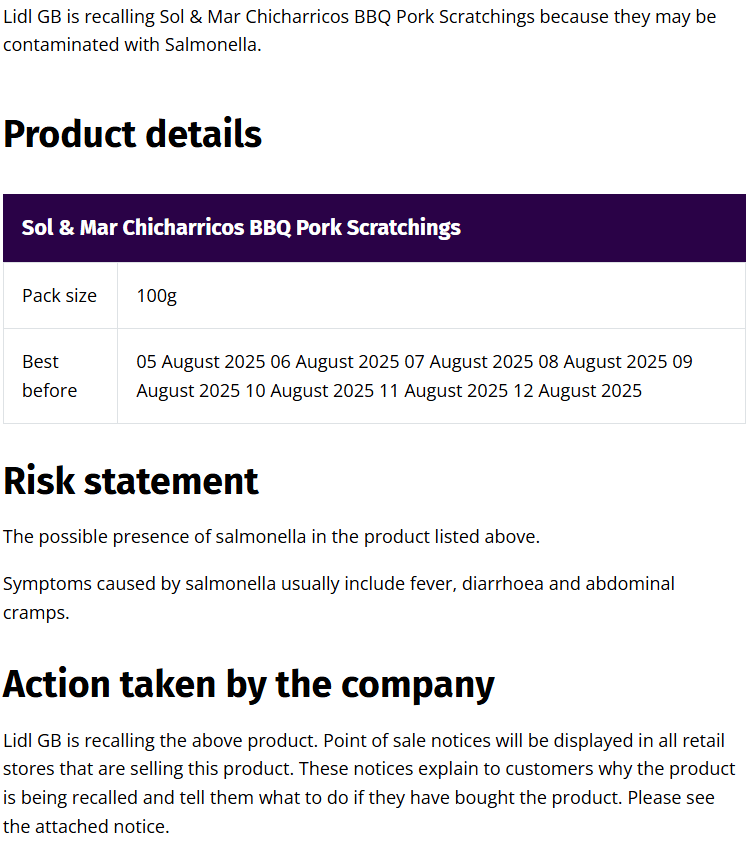
Recall: Lidl GB recalls Sol & Mar Chicharricos BBQ Pork Scratchings because of possible contamination with Salmonella

FSA

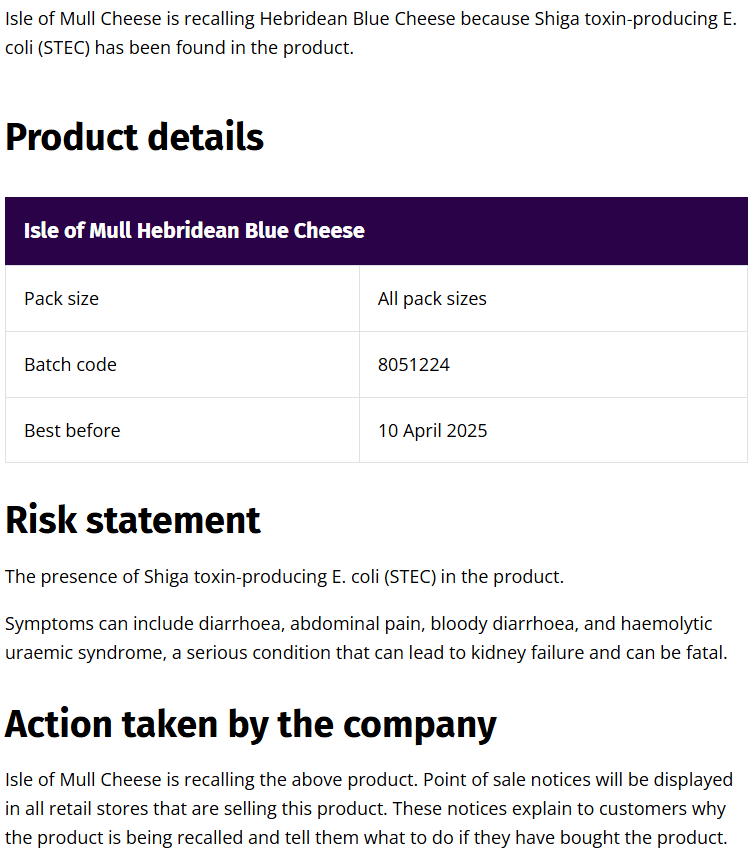
Recall: Isle of Mull Cheese recalls Hebridean Blue Cheese because of contamination with E.coli

FSA

Boar’s Head hires food safety chief following deadly 2024 Listeria outbreak

FSN

More than six months after a deadly Listeria outbreak was traced to Boar’s Head deli meat, the company has hired a chief food safety officer.

Natalie Dyenson will begin work for the family owned, billion dollar company on May 12, according to a statement from company officials.

The hiring comes in response to a 2024 outbreak that sickened 59 people across 19 states, killing 10. All of the patients required hospitalization because of the severity of their illnesses. Food and Drug Administration investigators found the outbreak strain of Listeria in unopened packages of Boar’s Head deli meat.

In July 2024 Boar’s Head recalled more than 7.2 million pounds of deli meats in relation to the Listeria outbreak.

The company closed its Jarrett, VA, production plant implicated in the outbreak and permanently discontinued production of liverwurst nationwide. The company is owned by the Brunckhorst and Bischoff families and is based in Sarasota, FL.

Documents uncovered by investigators with the USDA’s Food Safety and Inspection Service showed food safety problems dating back at least two years. The USDA did not shut down the plant after those problems were found.