Category Archives: Uncategorized

Ireland -Authorities not enforcing food safety rules

The Times alfalfa

Enforcement actions by the Irish authorities against some producers who fail to comply with food safety regulations are ineffective, EU officials have found.

EU inspectors auditing food hygiene practices in Ireland found European regulations were being broken, particularly in relation to seeds and sprouts.

In November last year, four official samples of sprouts tested positive for salmonella. However, the batch was placed on the market without waiting for the final analytical results.

The Department of Agriculture said it had increased controls on businesses involved in the production of sprouts.

USA -W. Bloomfield grocer recalls Salmonella-tainted tahina

Detroit News Salm2

A West Bloomfield grocery store has recalled containers of its sesame paste that might be contaminated with salmonella.

Sinbad Foods, located at 6251 Haggerty Road, said in a Tuesday release that 1-pound and 2-pound containers of its Tahina Telkef with “packed on” dates of Oct. 7, 2016, and “sell by” dates of Dec. 5, 2016, are on the recall list.

The 1-pound containers will have the numbers 0200004506472 and 0200004406413 in the barcode. Two-pound containers will have 0200000406295 in the barcode.

Though no illnesses have been reported in connection with the tahina, Sinbad Foods is asking customers to return the unused portion of the product for a refund.

Research-Antimicrobial-Resistant Campylobacter in Organically and Conventionally Raised Layer Chickens

Mary Ann Liebert Campylobacter

Poultry is a major source of Campylobacter, which can cause foodborne bacterial gastroenteritis in humans. Additionally, poultry-associated Campylobacter can develop resistance to important antimicrobials, which increases the risk to public health. While broiler chickens have been the focus of many studies, the emergence of antimicrobial-resistant Campylobacter on layer farms has not received equal attention. However, the growing popularity of cage-free and organic layer farming necessitates a closer assessment of (1) the impact of these farming practices on the emergence of antimicrobial-resistant Campylobacter and (2) layers as a potential source for the transmission of these pathogens. Here, we showed that the prevalence of Campylobacter on organic and conventional layer farms was statistically similar (p > 0.05). However, the average number of Campylobacter jejuni-positive organically grown hens was lower (p < 0.05) in comparison to conventionally grown hens. Campylobacter isolated from both production systems carried antimicrobial resistance genes. The tet(O) and cmeB were the most frequently detected genes, while the occurrence of aph-3-1 and blaOXA-61 was significantly lower (p < 0.05). Farming practices appeared to have an effect on the antimicrobial resistance phenotype, because the isolates from organically grown hens on two farms (OF-2 and OF-3) exhibited significantly lower resistance (p < 0.05) to ciprofloxacin, erythromycin, and tylosin. However, on one of the sampled organic farms (OF-1), a relatively high number of antimicrobial-resistant Campylobacter were isolated. We conclude that organic farming can potentially impact the emergence of antimicrobial-resistant Campylobacter. Nevertheless, this impact should be regularly monitored to avoid potential relapses.

Research -Dynamic kinetic analysis of growth of Listeria monocytogenes in a simulated comminuted, non-cured cooked pork product

Science Direct Eurofins Food Testing UK

The objective of this study was to directly construct a tertiary growth model for Listeria monocytogenes in a simulated comminuted, non-cured cooked pork product and simultaneously determine the kinetic parameters using a combination of dynamic and isothermal growth curves. Growth studies were conducted using a cocktail of 5 strains of L. monocytogenes in cooked pork under both dynamic and isothermal temperature profiles designed to examine the effect of temperature on bacterial growth.

A direct kinetic analysis method was used to construct the growth models and determine the kinetic parameters. The bacterial growth was simulated by a set of differential equations, and the temperature effect was evaluated by the cardinal parameters model. A numerical analysis and optimization method was used to simultaneously solve the different equations and search for the best fits of kinetic parameters for the growth curves and models. The estimated minimum, optimum, and maximum growth temperatures were 0, 33.0, and 42.6 °C, matching well with typical growth characteristics of this microorganism. The root-mean-square error (RMSE) of curve-fitting was 0.42 log CFU/g.

The growth models and kinetic parameters were validated using both independent dynamic and isothermal growth curves to check the accuracy of the models. The results showed that the RMSE of predicted growth was 0.49 log CFU/g. The residual errors of predictions follow a Laplace distribution, with 80.3% of the residual errors falling within ±0.5 log CFU/g of the observations. This study proves that the one-step dynamic analysis with both dynamic and isothermal temperature profiles can be an effective approach for simultaneously constructing a tertiary model and determining the kinetic parameters.


Research -Experimental studies and modelling the behaviour of anaerobic growth of Clostridium perfringens in cooked rice under non-isothermal conditions

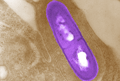
Science Direct closta

The aim of this study was mainly to develop the dynamic model to evaluate the non-isothermal growth of Clostridium perfringens in cooked rice that is currently popular product in Asian countries. The isothermal growth was measured by culturing C. perfringens in cooked rice stored under anaerobic condition at temperatures from 20 to 48 °C, followed by developing the four different primary models using these observed data. The specific growth rate (SGR, log CFU/h) obtained from each primary model were individually applied in the modified Ratkowky model to estimate the changes in the SGR as a function of temperature. The performances of secondary models developed basing on the different primary model were evaluated by using the validation factors including bias factor, accuracy factor, and mean square error. The resulting validations demonstrate that the Baranyi-based Ratkowky model shows greater performance than those developed basing on other primary models. To predict the non-isothermal growth in two different cooling scenarios of 50 to 19 °C, the Baranyi and Roberts differential equations was developed with the initial physiological state (q0 = 0.16). To validate the dynamic models, the predicted data were compared with experimental data obtained from the non-isothermal experiment. The developed dynamic model provided good prediction of anaerobic growth of C. perfringens in cooked rice under non-isothermal conditions, and it could be used to assess microbial safety of cooked rice during storage and cooling procedure.


Australia – Compendium of Microbiological Criteria for Food

FSANZ Staph

Microbiological testing can play an important role in food safety management providing the reason for testing is clear and the test applied is appropriate.

Microbiological criteria support decision making about a food or process when microbiological testing is used. A microbiological criterion provides microbiological limits that are considered appropriate to a food at a specific point of the food chain and states the actions to be taken when the criterion is not met.
Microbiological criteria that are applied to determine the safety of a food lot (food safety criteria) are included in the Australia New Zealand Food Standards Code (the Code).
Other microbiological criteria (process hygiene criteria) can be developed and applied at various stages throughout the food chain to indicate whether the food safety controls in place are working as intended.
The Compendium of Microbiological Criteria for Food is a compilation of process hygiene criteria that have been established for specific food commodities and microbiological guideline criteria used for ready-to-eat foods. It supersedes the Guidelines for the microbiological examination of ready-to-eat foods and User guide to Standard 1.6.1 – Microbiological Limits for Food with additional guidelines criteria.
The development of process hygiene criteria is an ongoing activity associated with the review of Standard 1.6.1.  The Compendium will be continually updated to include new criteria as it is established.


USA – FDA bans frozen strawberries from Egyptian firm, cites Hep A

Food Safety News Hepatitis A kswfoodworld

Federal officials have red listed frozen strawberries from an Egyptian grower-shipper because of contamination with Hepatitis A, but they won’t say if the import ban is related to the ongoing outbreak linked to Tropical Smoothie Café locations.

The Food and Drug Administration issued an Import Alert for frozen strawberries from the International Company for Agricultural Production & Processing (ICAPP) on Wednesday, meaning frozen strawberries from the Egyptian firm will be detained at the border and not allowed to be distributed in the U.S.

Korea -Food poisoning downs 90 pupils

Korea Herald

Some 90 elementary students who showed signs of food poisoning during a school trip were rushed to a hospital, the Busan Metropolitan City Office of Education said Monday.

The students had complained of stomach ache, high fever and diarrhea. About 220 students had gone on a three-day school trip Wednesday to Gangwon Province.


UK -Dying for your Sunday roast: How the lethal bacteria that can lurk inside leads to 500,000 cases of food poisoning every year…and 100 deaths – Campylobacter

Daily Mail Campylobacter kswfoodworld

On Saturday, we began a powerful new series examining the terrifying truth about British meat, from pork pumped full of antibiotics to supermarket cuts containing MRSA. Here, we reveal the insidious truth about how today’s mass-produced chickens are less healthy than in the past — and can also be contaminated with deadly bacteria…


Finland -Water contamination causes 100 to suffer gastrointestinal symptoms in Finland – E.coli

Famagusta Gazette

More than 100 people have suffered gastrointestinal symptoms as E. coli (Escherichia coli) bacteria was found in drinking water in central Finland, Finnish new agency STT reported on Thursday.

Last weekend, E. coli bacteria was found in drinking water in Aanekoski, a small city in central Finland, due to pipe fracture.

Residents in Aanekoski and surrounding areas were advised to boil the water that they need for preparing food. About 800 households were involved.

Sinikka Rissanen, health inspector from the Environmental Health Service of Aanekoski, estimated on Thursday that at least 100 residents have suffered gastrointestinal symptoms caused by the polluted tap water so far.

According to Rissanen, the cleaning work of the water supply system will last longer than expected. The water chlorination will continue until next Wednesday, she added.

The city of Aanekoski started on Thursday to supply clean water to local residents, reported STT.