Category Archives: Uncategorized

USA – Health Warning About Salmonella in Pride and Joy Raw Milk

Food Poisoning Bulletin

Health Warning About Salmonella in Pride & Joy Raw Milk

An advisory about Salmonella in Pride & Joy raw milk products has been issued by the Washington State Department of Health. They are advising consumers not to drink this milk because it could cause serious illness.

USA – Salmonella Outbreak Associated with Restaurant in Easton, MA

Salmonella Outbreak Associated With Restaurant in Easton, MA

Food Poisoning Bulletin

A Salmonella outbreak is being investigated in Eaton, Massachusetts, Ann Scales of the Massachusetts Department of Health told Food Poisoning Bulletin. The investigation began on Monday, September 25, 2017. The MDH is working with the Easton Board of Health to collect information to determine the source. The outbreak is associated with a restaurant.


Research – Clostridium perfringens Outbreak Catered Lunch 2016 – USA

Notes from the Field: Clostridium perfringens Outbreak at a Catered Lunch — Connecticut, September 2016

CDC

In September 2016, the Connecticut Department of Public Health was notified of a cluster of gastrointestinal illnesses among persons who shared a catered lunch. The Connecticut Department of Public Health worked with the local health department to investigate the outbreak and recommend control measures. Information about symptoms and foods eaten was gathered using an online survey. A case was defined as the onset of abdominal pain or diarrhea in a lunch attendee <24 hours after the lunch. Risk ratios (RRs), 95% confidence intervals (CIs), and Fisher’s exact p-values were calculated for all food and beverages consumed. Associations of food exposures with illness were considered statistically significant at p<0.05.

Among approximately 50 attendees, 30 (60%) completed the survey; 19 (63%) respondents met the case definition. The majority of commonly reported symptoms included diarrhea (17 of 18), abdominal pain (15 of 16), and headache (7 of 15). The median interval from lunch to illness onset was 5.3 hours (range = 0.4–15.5 hours) for any symptom and 7 hours (range = 2.5–13 hours) for diarrhea. Analysis of food exposures reported by 16 ill and 10 well respondents (four respondents did not provide food exposure information) found illness to be associated with the beef dish (RR = undefined; CI = 1.06–∞; p = 0.046) (Table). All 16 ill respondents reported eating the beef. Coffee was also associated with illness; however, all 13 coffee drinkers who became ill also ate the beef. Eating cake approached significance (p = 0.051); all 10 cake eaters who became ill also ate the beef.

The caterer had begun preparing all dishes the day before the lunch. Meats were partially cooked and then marinated in the refrigerator overnight. In the morning, they were sautéed 2 hours before lunch. Inspection of the facility found the limited refrigerator space to be full of stacked containers that were completely filled with cooked food, disposable gloves that appeared to have been washed for reuse, and a porous wooden chopping block.

The caterer’s four food workers reported no recent illness. Stool specimens from the food workers and from four ill attendees all tested negative for norovirus, Campylobacter, Escherichia coli O157, Salmonella, and Shigella at the Connecticut State Public Health Laboratory. All eight specimens were sent to the Minnesota Department of Health Public Health Laboratory, where additional testing was available. Two specimens from food workers were positive for enterotoxigenic Escherichia coli by polymerase chain reaction, but no enterotoxigenic E. coli colonies were isolated. Seven specimens (four from food workers and three from attendees) were culture-positive for Clostridium perfringens, and specimens from all attendees contained C. perfringens enterotoxin. Pulsed-field gel electrophoresis of 29 C. perfringens isolates from the culture-positive specimens found no matches among attendee isolates, but demonstrated a single matching pattern between two food worker specimens. No leftover food items were available for testing.

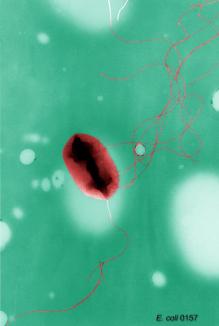
Research – Recurrent Outbreak STEC O55 in SW England 2014-2015

Recurrent seasonal outbreak of an emerging serotype of Shiga toxin-producing (STEC O55:H7 Stx2a) in the south west of England, July 2014 to September 2015

Eurosurveillance

Shiga toxin-producing (STEC) is known to cause self-limiting diarrhoeal illness, sometimes bloody diarrhoea and complications such as haemorrhagic colitis and haemolytic uraemic syndrome (HUS) [1–3]. STEC O157:H7 is the most common serotype in England while the incidence of non-O157 STEC serotypes such as O26, O45, O103, O111, O121 and O145, some of which have been implicated in a number of outbreaks internationally [4–8], may be under-reported in the English national surveillance system run by Public Health England (PHE). This is due to the lack of general applicability of current culture-based detection methods [9,10].

Research – Mild Illness STEC E.coli O157 – Agricultural Show – Australia

Mild Illness during Outbreak of Shiga Toxin−Producing Escherichia coli O157 Infections Associated with Agricultural Show, Australia

CDC 


During a large outbreak of Shiga toxin−producing Escherichia coli illness associated with an agricultural show in Australia, we used whole-genome sequencing to detect an IS1203v insertion in the Shiga toxin 2c subunit A gene of Shiga toxin−producing E. coli. Our study showed that clinical illness was mild, and hemolytic uremic syndrome was not detected.

RASFF Alert – Possible Microbial Contamination – Vegan Pesto

kswfoodworld rasff

RASFF – possible microbiological contamination of organic vegan pesto in glass jars from Italy in Italy

RASFF Alert – STEC E.coli – Lambs Lettuce

kswfoodworld rasff

RASFF -shigatoxin-producing Escherichia coli (stx2+) in lamb´s lettuce (Valerianella locusta) from Italy in Finland

Research – Molecular Tracing to Find Source of Proactivated Invasive Listerosis Outbreak – Southern Germany 2012-2016

CDC Listeria cdc

Molecular Tracing to Find Source of Protracted Invasive Listeriosis Outbreak, Southern Germany, 2012–2016

We investigated 543 Listeria monocytogenes isolates from food having a temporal and spatial distribution compatible with that of the invasive listeriosis outbreak occurring 2012–2016 in southern Germany. Using forensic microbiology, we identified several products from 1 manufacturer contaminated with the outbreak genotype. Continuous molecular surveillance of food isolates could prevent such outbreaks.

RASFF Alerts – Salmonella – Beef Trimmings – Chicken Meat – Chicken Fillet -Salted Chicken Half Breast – Almonds – Poultry Meat Preparations – Mussels – Pork Meat

kswfoodworld rasff

RASFF – Salmonella enterica ser. Gaminara (presence /25g) in beef trimmings from the Netherlands in Sweden

RASFF-Salmonella enterica ser. Enteritidis (presence /25g) in chilled chicken meat from Belgium in Belgium

RASFF-Salmonella (detected /25g) in frozen chicken fillets with added water from Thailand in the UK

RASFF-Salmonella (present /25g) in frozen salted chicken half breasts from Brazil in the Netherlands

RASFF-Salmonella (presence /25g) in frozen salted chicken breasts from Brazil in the Netherlands

RASFF-Salmonella (presence /25g) in shelled almonds from Germany in France

RASFF-Salmonella (presence /25g) in frozen salted chicken half breasts from Brazil in the Netherlands

RASFF-Salmonella (presence /25g) in frozen salted chicken breast fillets from Brazil in Ireland

RASFF-Salmonella (presence /25g) in poultry meat preparations from Thailand in Belgium

RASFF-Salmonella (present /25g) in frozen salted chicken half breasts from Brazil in the Netherlands

RASFF-Salmonella (present /25g) in frozen chicken breast halves with bouillon from Brazil in Germany

RASFF-Salmonella enterica ser. Typhimurium (present /25g) in various poultry meat products from the Netherlands in the Netherlands

RASFF-Salmonella (presence /25g) in frozen salted half chicken breasts from Brazil in the Netherlands

RASFF-Salmonella (present /25g) in frozen chicken breast halves with bouillon from Brazil in Germany

RASFF-Salmonella (presence /25g) in fresh mussels from the Netherlands in the Netherlands

RASFF-Salmonella (presence /25g) in frozen pork meat from Spain in Italy

RASFF-Salmonella (presence /25g) in frozen salted chicken breast fillets from Thailand in Germany

RASFF-Salmonella (O:7,8 /25g) in frozen salted chicken breasts from Thailand in Germany

RASFF Alerts – Aflatoxin-

kswfoodworld rasff

RASFF – aflatoxins (B1 = 12.2 µg/kg – ppb) in dried red chilli from Sri Lanka in the UK

RASFF-aflatoxins (B1 = 72.8; Tot. = 80.8 / B1 = 28.8; Tot. = 31.6 µg/kg – ppb) in pistachio from Iran in Poland

RASFF-aflatoxins (Tot. = 24 µg/kg – ppb) in organic dried figs from Spain in Denmark

RASFF-aflatoxins (B1 = 5.86 µg/kg – ppb) in groundnut kernels from Argentina in Romania

RASFF-aflatoxins (B1 = 17.9; Tot. = 21.4 µg/kg – ppb) in shelled hazelnuts from Turkey in Italy

RASFF-aflatoxins (B1 = 12.2; Tot. = 36.5 µg/kg – ppb) in shelled hazelnuts from Azerbaijan in Italy

RASFF-aflatoxins (B1 = 2.9; Tot. = 9,2 / B1 = 5.7; Tot. = 11 µg/kg – ppb) in roasted groundnuts from China in Sweden

RASFF-aflatoxins (B1 = 13.7; Tot. = 15.8 µg/kg – ppb) in hazelnut kernels from Turkey in Greece