Category Archives: Uncategorized

UK – England – Filthy chippy ordered to close after food poisoning allegations

Leicester Mercury

A filthy fish bar has been shut down by health officials after prolonged food hygiene failures and claims from customers about food poisoning.

It comes after environmental health inspectors found a catalogue of problems including high levels of dangerous bacteria, hatching insects, disgusting surfaces and staff not washing their hands when they visited Bailey’s Fish Bar, in Derby Road, Kegworth.

Europe – Scheme to boost seafood safety in Europe gets under way

New Food Magazine

After a kick-off event in Lisbon, SEAFOODTOMORROW, a project formed of a partnership between 35 Europe-wide organisations, has begun.

A three-year project geared at developing sustainable solutions to improve seafood safety and dietary properties has been launched.

SEAFOODTOMORROW, a €7m European Union Horizon 2020-funded project, brings together 35 partners from across Europe. It aims to connect them with up-to-date technology and market-orientated expertise to meet challenges likely to develop over the next 30 years.

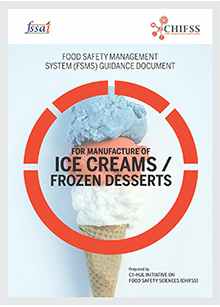
Information – India – FOOD SAFETY MANAGEMENT SYSTEM (FSMS) GUIDANCE DOCUMENT – FOR MANUFACTURE OF ICE CREAM AND FROZEN DESSERTS

CHIFSS  publication2

FOOD SAFETY MANAGEMENT SYSTEM (FSMS) GUIDANCE DOCUMENT

FOR MANUFACTURE OF ICE CREAMS / FROZEN DESSERTS


USA – Baby milk not in U.S. – Lactalis – Salmonella

Food Safety News

The recalled products were not distributed in the United States, though Lactalis does have a robust U.S. operating unit. Countries known to have received the recalled products include: Britain, Greece, Morocco, Sudan, Peru, Colombia, Pakistan, Bangladesh and China. Click here for the full list of recalled products, which includes brand names such as Milumel, Celia, and Picot.

One of the largest dairy groups in the world, Lactalis recommended “not to consume these batches or, in case of absence of alternative, to boil the recombined milk during 2 minutes and bring back it at the consumption temperature.”

Research – Typhoid fever toxin has a sweet tooth

Science Daily 


Although the insidious bacterium Salmonella typhi has been around for centuries, very little is actually known about its molecular mechanisms. A new study from researchers at the College of Veterinary Medicine addresses this knowledge gap and may lead to novel, targeted treatments.


Salmonella typhi can live either inside or outside host cells. Those living within cells, called intracellular, secrete the typhoid toxin that is responsible for many symptoms of typhoid fever, according to lead author Dr. Yi-An Yang, a postdoctoral researcher in the Song Lab. The research finds that the current vaccine for typhoid fever, called Ty21a, is effective against Salmonella typhi but not against the typhoid toxin.

The study, published in Nature Microbiology Dec. 4, shows how the toxin exclusively damages selected cells at the organism level. This toxin has a sweet tooth, specifically seeking cells that express particular sugars because of their binding abilities. When the typhoid toxin finds those cells, it intoxicates them and triggers symptoms such as lethargy, malaise, stupor, decreased white blood cells and neurological complications.

“What’s most exciting is that our results provide insights that may help the development of potential prophylactics and therapeutics to prevent and treat typhoid fever,” said senior author Jeongmin Song, assistant professor of microbiology and immunology.

Knowing the toxin’s target enables the development of new, non-antibiotic, sugar-based therapeutics, which could help stem increasing antibiotic resistance. Sugar-based therapeutics are not limited to typhoid fever, moreover, and may be effective against other diseases in which sugars play crucial roles.

Typhoid fever is a life-threatening disease often caused by poor sanitation. It afflicts approximately 21.5 million people in the developing world each year, and of the nearly 6,000 cases that appear in the United States, most are acquired internationally, according to the Centers for Disease Control and Prevention.

A conjugated vaccine leveraging the toxin combined with Ty21a is likely to be more effective than Ty21a. Researchers found that mice immunized with inactive typhoid toxins presented no symptoms when challenged with a lethal dose of typhoid toxin. Both mice and humans have the sugar-coated cells to which the toxins are attracted, said Yang.

The researchers also found that the toxin, once secreted, doesn’t limit itself to one bodily system in its search for sweets. “Intriguingly, our study shows that the typhoid toxin targets both the immune system and central nervous system,” said Song. “This represents a new paradigm in the infectious agents’ incursion of the host.” Furthermore, the fact that the two systems must work together to address infectious threats is “a newly established neuro-immune axis paradigm in our body’s responses,” said Song.

Story Source:

Materials provided by Cornell University. Note: Content may be edited for style and length.


Journal Reference:

  1. Yi-An Yang, Sohyoung Lee, Jun Zhao, Andrew J. Thompson, Ryan McBride, Buyankhishig Tsogtbaatar, James C. Paulson, Ruth Nussinov, Lingquan Deng, Jeongmin Song. In vivo tropism of Salmonella Typhi toxin to cells expressing a multiantennal glycan receptor. Nature Microbiology, 2017; DOI: 10.1038/s41564-017-0076-4

USA – Holiday Hazard: ‘Canned’ bread a recipe for botulism poisoning

Food Safety News

Holiday baking is a staple for many gift givers, but bread makers should take caution: Making bread in canning jars creates a readymade package, but poses life-threatening risks.

According to the National Center for Home Food Preservation, some bread and cake recipes call for baking in canning jars and then closing with a canning lid. However, these recipes have very little or no acid, providing the perfect habitat for the growth of Clostridium botulinum and its toxin that causes botulism poisoning. Botulism is a sometimes fatal foodborne illness that paralyzes muscles, including respiratory muscles.

“When breads and cakes in jars are made for sale commercially by reputable companies, additives, preservatives and processing controls (that are) not available for home recipes are used,” according to University Extension Food Specialists from the University of Georgia. “Safety tests would have been conducted for each specific recipe for commercial products.”

USA – Certain Tim Hortons patrons should seek Hepatitis A treatment

Food Safety News

Another restaurant worker in Michigan has tested positive for hepatitis A, this time at a Tim Hortons location in Monroe, igniting another round of recommendations from public health officials that restaurant patrons seek post-exposure treatment immediately.

The post-exposure treatment for the highly contagious virus must be given within two weeks of exposure, otherwise it is not effective.

Canada – An E. coli O157 Outbreak in Canada is Linked to Romaine Lettuce, Sickening 21 People in 3 Provinces

Food Poisoning Bulletin Eurofins Food Testing UK

An E. coli O157 outbreak in Canada is linked to romaine lettuce. There are no product recalls at this time associated with this outbreak. At least 21 people are sick in three provinces. The case count by province is: Quebec (3), New Brunswick (5), and Newfoundland and Labrador (13).

Australia – Cryptosporidium: NSW Health warns of swimming pool risk

Outbreak News Today

NSW Health is urging people not to swim for two weeks after having diarrhoea to avoid contaminating pools with the nasty infection cryptosporidiosis, with cases expected to rise over summer.

Dr Jeremy McAnulty, Director Health Protection NSW Health, said people of all ages, particularly parents and carers of young children, should take steps to prevent the spread of the parasitic intestinal infection as more people take the plunge to escape the heat.

Baby Formula Maker Calls Global Recall Over Salmonella Fears

USNEWS

PARIS (AP) — Baby milk maker Lactalis and French authorities have ordered a global recall of millions of products over fears of salmonella bacteria contamination.

The French company, one of the world’s largest dairy groups, said it was warned by health authorities in France that 26 infants have become sick since Dec. 1.

According to a list published on the French health ministry’s website, the recall affects customers in countries around the world, including: Britain and Greece in Europe, Morocco and Sudan in Africa, Peru and Colombia in South America and Pakistan, Bangladesh and China in Asia. The United States, a major market for Lactalis, is not affected.

Company spokesman Michel Nalet told The Associated Press on Monday that the “precautionary” recall involves “several million” products made since mid-February.

Lactalis said in a statement that the 26 cases of infection were linked to products branded Picot SL, Pepti Junior 1, Milumel Bio 1 and Picot Riz