Category Archives: Uncategorized

Research – Microbiological Food Safety and a Low-Microbial Diet to Protect Vulnerable People

Mary Ann Liebert

Low-microbial diets are advised by many institutions for people with neutropenia resulting from treatment with immunosuppressive drugs or medical conditions that increase their susceptibility to foodborne disease. In this article, the main microbiological hazards associated with foods are outlined, and a low-microbial diet in which higher-risk foods are replaced by lower-risk foods is described.


Research – Campylobacter Contamination in Chicken Carcasses

Science Direct Campylobacter

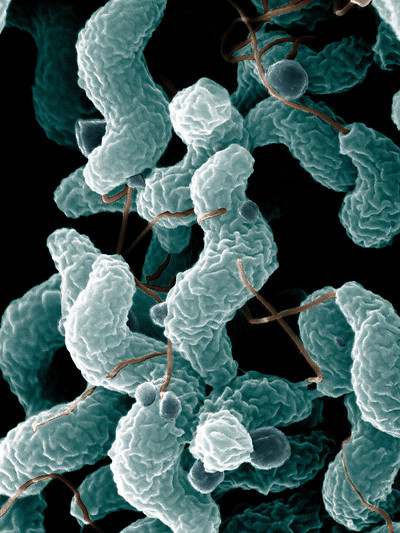
This study aimed to investigate Campylobacter contamination in carcasses and chicken products derived from a Campylobacter-negative flock when the flock is slaughtered immediately after a Campylobacter-positive flock. The first 2 flocks slaughtered on 10 different dates were investigated at an abattoir. Eighteen of the 20 flocks tested were positive for Campylobacter. A Campylobacter-negative flock was slaughtered immediately after a Campylobacter-positive flock on only 1 of the 10 slaughter dates. In this case, Campylobacter was detected in the carcasses and chicken products originating from the Campylobacter-negative flock, and all the flaA genotypes of these isolates were identical to those present in the caecal contents, carcasses, and chicken products from the Campylobacter-positive flock. The Campylobacter concentrations in the products originating from the Campylobacter-negative flock were: close to the enumeration limit (1.7 log10 cfu/carcass) in the carcass samples; and below the enumeration limit (2.0 log10 cfu/g) in the liver samples. The mean Campylobacter concentrations in the carcasses and liver products originating from the 18 Campylobacter-positive flocks were 3.8 log10 cfu/carcass and 2.6 log10 cfu/g, respectively. While 91% (246/270) of chicken products originating from Campylobacter-positive flocks were positive for Campylobacter, chicken products originating from the remaining Campylobacter-negative flock were free from Campylobacter cross-contamination by slaughter prior to a Campylobacter-positive flock. These results prove that slaughtering Campylobacter-negative flocks does not introduce Campylobacter into the abattoirs and indicate that although carcasses and chicken products originating from the Campylobacter-negative flock were cross-contaminated with Campylobacter from the Campylobacter-positive flock slaughtered immediately before, the Campylobacter contamination levels were lower than those in carcasses and chicken products from Campylobacter-positive flocks. Based on these findings, the reduction of Campylobacter prevalence in broiler flocks should be taken as an effective control measure for preventing introduction of Campylobacter into abattoirs and consequently for reducing Campylobacter prevalence in chicken products in addition to the good hygienic practice at abattoirs and logistic slaughter.

Research – Salmonell Outbreaks in Sweden and USA in 2013

BarfBlog

The Swedish National Food Agency (Livsmedelsverket) has identified cold meats as the primary source for a recent outbreak of listeria in Sweden that has been connected to the deaths of up to 14 people since autumn 2013.

CDC

In early 2013, four clusters of human Salmonella infections were identified through PulseNet, the national molecular subtyping network for foodborne bacteria. Many of the ill persons in these four clusters reported contact with live poultry, primarily chicks and ducklings, from a single mail-order hatchery; therefore, these investigations were merged. During March 4–October 9, 2013, a total of 158 persons infected with outbreak strains of Salmonella serotypes Infantis, Lille, Newport, and Mbandaka were reported from 30 states.

Research – 5 Second Rule

Aston Uni Salm2

Food picked up just a few seconds after being dropped is less likely to contain bacteria than if it is left for longer periods of time, according to the findings of research carried out at Aston University’s School of Life and Health Sciences.

The findings suggest there may be some scientific basis to the ‘5 second rule’  – the urban myth about it being fine to eat food that has only had contact with the floor for five seconds or less. Although people have long followed the 5 second rule, until now it was unclear whether it actually helped.

New Online Learning Tool – ClickLearner


What is clickLearner?
ClickLearner is a new, web based, video training assessment tool. It has many applications, however, following a recent trial, our current focus is training assessment within the Food and service sector. It is perfect for very procedural applications such as laboratories or factories!
Training assessment can be time consuming. There is pressure from auditors to regularly train and assess workers and it can involve much form filling to provide the records required. clickLearner can do this easily and effectively.

How does it work?
Clicklearner uses a video taken in your own business to create an online, interactive challenge, for employees. The video content is planned, shot, edited and uploaded online to create a challenge. The video includes the events which you want your employees to respond to, e.g. incorrect procedures relating to a critical control point or hazards within the laboratory or factory. These events are embedded in the video and respondents are asked to watch the video and interact by clicking on these events. The clicks are recorded and respondents receive immediate feedback. Results are stored for download at anytime.

Please do visit clickLearner at www.clicklearner.co.uk and have a go at the example challenge. In the meantime, if you would like any further information, do get in touch.

Caroline
www.clicklearner.co.uk
Tel: 07970 115961
Email: caroline@clicklearner.co.uk

USA – Research – Hospital Food and ESBL E.coli

Science Daily Ecoli Istock

A new study found more than 80 percent of raw chicken used in hospitals in food for patients and staff was contaminated with a form of antibiotic resistant bacteria called extended-spectrum beta-lactamase producing E. coli. While sufficient preparation eliminated the presence of bacteria, poultry meat delivered to hospital kitchens remains a potential point of entry for these dangerous bacteria into the hospital.

ESBL E.coli


RASFF Alert – Norovirus – Frozen Strawberries

Food Testing - Eurofins

RASFF – norovirus in frozen strawberries from Poland, via the Netherlands in Belgium

RASFF Alert – Animal Feed – Aflatoxins – Maize

Food Testing - Eurofins

RASFF – aflatoxins (B1 = 0.35 mg/kg – ppm) in maize from India in Belgium

RASFF Alerts – Animal Feed – Salmonella – Fish Meal – Rapeseed – Animal Protiens

RASFF-Logo

RASFF -Salmonella enterica in fish meal from Denmark, via Slovakia in the Czech Republic

RASFF -Salmonella kedougou in rapeseed extraction meal from Germany

RASFF-Salmonella Llandoff in soy bean meal from Italy

RASFF-Salmonella in processed animal protein (pork) from Germany in Belgium

RASFF -Salmonella in processed animal proteins from Germany in Belgium

Research – Food Safety – Who is Best Europe or the USA?

The Acheson Group

Last week, the European Union (EU) published a summary report of zoonotic infection data focused primarily on trends since 2005, and the rise or fall of confirmed campylobacteriosis, salmonellosis, listeriosis, and verocytotoxigenic Escherichia coli (that is what the EU calls Shiga toxin producing E. coli like O157:H7) cases between 2011 and 2012 in the EU. The report is based on European Food Safety Authority and the European Centre for Disease Prevention and Control analyses of information submitted by 27 European Union Member States on the occurrence of zoonoses and food-borne outbreaks in 2012. Much has been made in the EU of the decreases in rates of salmonellosis. Is the EU faring better than we are? Do they have practices in place that we should learn from? Or are they in the process of catching up to the US?

The fairest way to make a comparison is to look at illness rates: how many people out of 100,000 got sick?

Illness
US
EU
Campylobacteriosis 14.3 55.5
Salmonellosis 16.42 22.2
Listeriosis 0.25 0.41
Pathogenic E. coli 1.12 (O157); 1.16 (non O157 STEC) 1.15(VTECs)