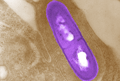
RASFF– too high count of Enterobacteriaceae (1700 CFU/g) in fish meal from Chile in Spain
RASFF-Salmonella spp. (presence /25g) in poultry meal from Spain in Italy

For years, doctors have puzzled over why pregnant women are 20 times more likely than others to be infected by the bacterium Listeria monocytogenes. Researchers at the University of California, Berkeley, now think they have the answer, and it isn’t pretty.
Their research, conducted in guinea pigs, shows that the bacteria can invade the placenta, where – protected from the body’s immune system – they proliferate rapidly before pouring out to infect organs such as the liver and spleen. The illness they cause often results in miscarriage or infection of the fetus.
The study is the first to trace such a pathway of infection, and it dashes the widely-held assumption that immune-system changes during pregnancy are to blame for elevated Listeria infection rates.
“The reason the mother is more susceptible is not necessarily because her immune system is compromised, but because the bacteria that got into her placenta are infecting her,” said Anna Bakardjiev, the study’s lead author and a postdoctoral researcher with Daniel Portnoy, professor of biochemistry and molecular biology at UC Berkeley. “The miscarriages that result from these infections may be a natural defense mechanism to dispel this source of infection.”
Posted in Uncategorized
In yet another case of food poisoning due to midday meals, 23 schoolchildren, all 13-year-olds were admitted to Sion hospital on Tuesday. The incident occurred at 3.40pm in Dayanand Balak Vidyalaya, Matunga East.
The children were admitted for observation after at least six started vomitting and got loose motions.
Raw milk can carry harmful bacteria that can cause serious illness. Implementing current good hygiene practices at farms is essential to reduce raw milk contamination, while maintaining the cold chain is also important to prevent or slow the growth of bacteria in raw milk. However, these practices alone do not eliminate these risks. Boiling raw milk before consumption is the best way to kill many of the bacteria that can make people sick.
Consumer interest in drinking raw milk has been growing in the European Union (EU) as many people believe it has health benefits. Under EU hygiene rules, Member States can prohibit or restrict the placing on the market of raw milk intended for human consumption. Sale of raw drinking milk through vending machines is permitted in some Member States, but consumers are usually instructed to boil the milk before consumption.
In their scientific opinion on public health risks associated with raw milk in the EU, experts from EFSA’s Panel on Biological Hazards (BIOHAZ) conclude that raw milk can be a source of harmful bacteria – mainly Campylobacter, Salmonella, and Shiga toxin-producing Escherichia coli (STEC).
The Cost Estimates of Foodborne Illnesses data product provides detailed data about the costs of major foodborne illnesses in the United States, updating and extending previous ERS research. This data set includes:
Disease outcomes include both acute illness and chronic disease that sometimes follow these acute illnesses. These 15 pathogens account for over 95 percent of the illnesses and deaths from foodborne illnesses acquired in the United States for which the U.S. Centers for Disease Control and Prevention (CDC) can identify a pathogen cause. These estimates build on CDC estimates of the incidence of foodborne disease; peer-reviewed synthesis of data on medical costs, and economic, medical and epidemiological literature; and publicly available data on wages.
This data product provides Federal agencies such as USDA’s Food Safety and Inspection Service (FSIS) with a set of consistent, peer-reviewed estimates of the costs of foodborne illness that can be used in analyzing the impact of Federal regulation. It also provides other stakeholders and the general public with a means of understanding the relative impact of different foodborne infections in the United States. Cost estimates of foodborne illnesses have been used in the past to help inform food-safety policy discussions, and these updated cost estimates will provide a foundation for economic analysis of food safety policy.
This product consists of 15 Excel files detailing disease outcomes for each pathogen together with associated costs, technical notes and documentation, and links to associated research projects and publications.
Posted in Uncategorized
When Günter Klein, head of the Institute of Food Quality and Food Safety at the University of Veterinary Medicine Hanover in Germany, and colleagues investigated a norovirus outbreak at a German military facility, they noticed something interesting. Although consumption of norovirus-contaminated salad caused the peak of the illnesses, virus also could be detected on several common surfaces tested, including a computer keyboard, a doorknob and a mail collection box.
Schreiner’s Fine Sausage Company of Phoenix, AZ, is voluntarily recalling 28 ready-to-eat meat products because they might be contaminated with Listeria.
The following products were distributed in the metro Phoenix area and bear the establishment number “EST 24” inside the mark of inspection produced prior to Dec. 1, 2014, and are subject to recall:
If consumers have the product in their refrigerator or freezer, the meat should be thrown out or returned to the place of purchase.
California Department of Public Health (CDPH) Director and State Health Officer Dr. Ron Chapman warned consumers today not to eat certain Santa Barbara Smokehouse cold-smoked salmon products due to possible contamination with Listeria monocytogenes, which can lead to severe illness or death.
CDPH and the U.S. Food and Drug Administration (FDA) are currently investigating Santa Barbara Smokehouse in Santa Barbara, California, due to bacteriologic contamination found in the processing facility.
Santa Barbara Smokehouse has initiated a voluntary recall of two batches of cold-smoked salmon manufactured in August and September 2014, and all cold-smoked salmon packed between December 17 and 24, 2014, after learning about Listeria monocytogenes contamination in product-surveillance samples and environmental samples collected at the processing facility. No illnesses have been associated with the recalled products at this time.
Santa Barbara Smokehouse’s recalled cold-smoked salmon was packed under the Cambridge House, Channel Island Smokehouse, Coastal Harbor, Santa Barbara Smokehouse and Harbor Point brand names, and has pack dates of 8-22-14, 9-17-14 through 9-19-14, and 12-17-14 through 12-24-14. The recalled products were vacuum-packed and distributed as both fresh and frozen products. The CDPH website has a list of the specific product names and codes affected by this recall and product photos.
Due
The food recall warning issued on January 8, 2015 has been updated to include additional information. This additional information was identified during the Canadian Food Inspection Agency’s (CFIA) food safety investigation.
Industry is recalling Granny Smith apples and Gala apples exported by Bidart Bros. in the United States (US) from the marketplace due to possible Listeria monocytogenes contamination. Identified importers of the recalled products include Beauvais Ltee., Courchesne Larose, Coosemans Montreal Inc. and Fruits et Légumes Gaétan Bono Inc. Consumers should not consume and retailers, restaurants and institutions should not sell or use the recalled products described in the link above.
Rocky Mountain Chocolate Factory, St. John’s, NL, is recalling caramel apples that used recalled apples sourced from the United States (US) from the marketplace due to possible Listeria monocytogenes contamination. Consumers should not consume the recalled products described in the link above.
Scotian Gold Co-operative Limited is recalling Scotian Gold brand apple slices that used apples sourced from the United States (US) that are now recalled from the marketplace due to possible Listeria monocytogenes contamination. Consumers should not consume the recalled products described in the link above.
Posted in Uncategorized
Two quantitative risk assessment (RA) models were developed to describe the risk of salmonellosis and listeriosis linked to consumption of raw milk sold in vending machines in Italy. Exposure assessment considered the official microbiological records monitoring raw milk samples from vending machines performed by the regional veterinary authorities from 2008 to 2011, microbial growth during storage, destruction experiments, consumption frequency of raw milk, serving size, and consumption preference. Two separate RA models were developed: one for the consumption of boiled milk and the other for the consumption of raw milk. The RA models predicted no human listeriosis cases per year either in the best or worst storage conditions and with or without boiling raw milk, whereas the annual estimated cases of salmonellosis depend on the dose-response relationships used in the model, the milk storage conditions, and consumer behavior in relation to boiling raw milk or not. For example, the estimated salmonellosis cases ranged from no expected cases, assuming that the entire population boiled milk before consumption, to a maximum of 980,128 cases, assuming that the entire population drank raw milk without boiling, in the worst milk storage conditions, and with the lowest dose-response model. The findings of this study clearly show how consumer behavior could affect the probability and number of salmonellosis cases and in general, the risk of illness. Hence, the proposed RA models emphasize yet again that boiling milk before drinking is a simple yet effective tool to protect consumers against the risk of illness inherent in the consumption of raw milk. The models may also offer risk managers a useful tool to identify or implement appropriate measures to control the risk of acquiring foodborne pathogens. Quantification of the risks associated with raw milk consumption is necessary from a public health perspective.