Author Archives: RM

Frozen desserts recalled in Canada because of Salmonella outbreak

FSN

A recall of tartlets in Canada is being conducted as part of an investigation into a Salmonella outbreak.

The Canadian Food Inspection Agency is reporting that D. Effe T. brand Lemon Delight and Tartlet with Forest Fruits are under recall because of their link to a Salmonella illness. The recall is related to a larger outbreak of Salmonella illnesses linked to other recalled dessert items.

The dessert items were distributed in Ontario. Consumers are urged to not consume the products. Retailers are under order to not sell the products. Some of the products may have been sold clerk-served or in smaller packages, with or without a label that may not bear the same brand, product name, or best before date. 

Eleven sick in French raw milk cheese outbreak

FSN

Eleven people have been sickened in a severe Shiga toxin-producing E. coli (STEC) outbreak in France linked to raw milk cheese. 

Nine hemolytic uremic syndrome (HUS) cases in adults have been confirmed by the National Reference Center for E. coli. HUS is a severe complication associated with E. coli infections that causes kidney failure.

Investigations by Santé publique France, the National Reference Centre for E. coli, the General Directorate of Food (DGAL) and General Directorate of Health (DGS) tracked illnesses to the consumption of Morbier cheeses made from raw milk produced by the company Perrin-Vermot.

Canada: Tahini recalled because of Salmonella

FSN

Al-Watan brand tahini us being recalled in Canada because of Salmonella contamination.

The implicated tahini was distributed in Ontario, according to the Canadian Food Inspection Agency.

The recall was triggered by the company. As of the posting of the notice, no illnesses had been confirmed in relation to the recalled tahini.

Nepal: Beetroot salad suspected in flight-related outbreaks; 43 passengers sickened

FSN

Beetroot salad contaminated with Staphylococcus aureus was the likely source of illness onboard two flights from Nepal.

The Centre for Health Protection (CHP) of the Department of Health in Hong Kong said 43 passengers, 22 men and 21 women, on two flights from Kathmandu earlier this month were affected.

They developed symptoms of food poisoning such as vomiting, nausea, abdominal pain, and diarrhea, about 10 to 60 minutes after having inflight meals. Patients were aged between 11 and 75 and none of them required hospitalization.

California orders recall of raw milk, quarantines Schoch Family dairy

FSN

Raw whole cow milk produced and packaged by Schoch Family Farmstead Inc. of Monterey County is the subject of a statewide recall and quarantine order announced by California State Veterinarian Dr. Annette Jones.

The quarantine order came following the confirmed detection of the bacteria Campylobacter jejuni in the farm’s packaged raw whole milk sampled and tested by the California Department of Food and Agriculture.

The order applies to “Schoch Family Farmstead Grade A Raw Milk” distributed in half-gallon (64 oz) glass jugs with a code date “BEST BY 01/24” marked with a sticker on the cap.

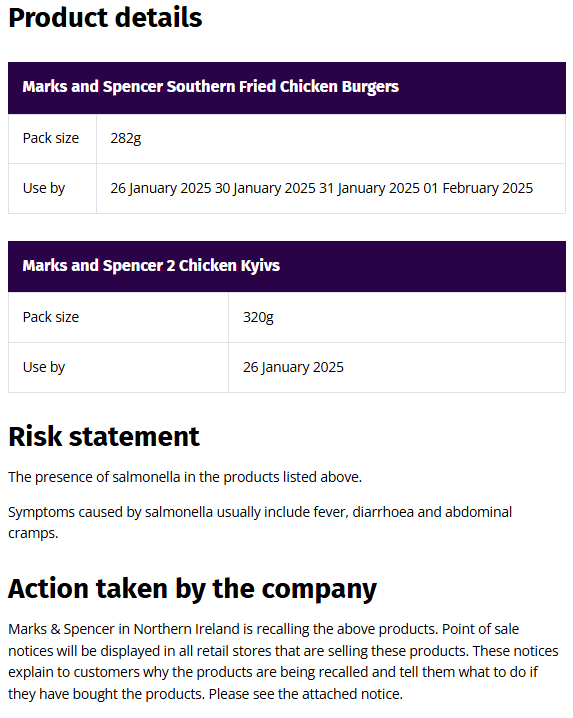
Marks & Spencer in Northern Ireland recalls Southern Fried Chicken Burgers and 2 Chicken Kyivs because of contamination with Salmonella

FSA

Marks & Spencer is recalling Crispy Southern Fried Chicken Burgers and 2 Chicken Kyivs because Salmonella has been found in the products. These products are only sold in Marks and Spencer in Northern Ireland.

USA: Researcher gets $150,000 grant to use AI for Salmonella detection in onions

FSN

A researcher at Southern Illinois University-Carbondale is working on using artificial intelligence (AI) to detect the deadly pathogen Salmonella before it ever enters the food supply.

Anas Alsobeh, assistant professor of information technology, recently received a $150,000 grant from the USDA’s National Institute of Food and Agriculture to develop an AI-based rapid detection method for finding Salmonella in onions. The system combines microscopic imaging with AI, which compares samples to a large-scale dataset containing images of bacterial microcolonies at early stages of growth.

The technology integrates convolutional neural networks that can automatically detect the presence of the bacteria. The grant also funds hands-on workshops to train stakeholders on using intelligent imaging in food inspection processes.

Norway reports largest outbreak in decades with 230 sick; sprouts blamed

FSN

Norway has reported its largest foodborne outbreak in almost 50 years with 230 people sick.

The Norwegian Institute of Public Health (FHI) said 105 people are infected with Salmonella Newport and 120 with Salmonella Typhimurium. The remaining five are infected with other types of Salmonella.

Patients became ill from mid-October to mid-December 2024. They range in age from less than 1 to 90 years old with a median age of 47.5 years old. A total of 159 patients are women and 76 people have been hospitalized.

Sick people live in different parts of the country but Vestland has the most patients with more than 70.

Seeds from Italian supplier
Umaer Naseer, acting section head of infection control and emergency preparedness at FHI, said there has been a large increase in sick people from when the agency last reported on the outbreak in December 2024 when 49 people were ill.

“This is not unexpected as it takes time from sampling of those who have become ill to the final results of the laboratory analyses. Most of the infected people became ill in the period between November and December 2024, around the time of the withdrawal of organic alfalfa sprouts.”

In November 2024, organic alfalfa sprouts were withdrawn from the market by Norske Spirer because of suspected Salmonella contamination. Seeds used in sprout production came from a large Italian company, which also supplied other EU countries.

The Norwegian Food Safety Authority (Mattilsynet) and Norwegian Veterinary Institute have detected the same type of Salmonella in sprouts that the lab at FHI found in patients.

“This is one of the largest Salmonella outbreaks linked to a food product we have had in Norway, at least since the 1980s, when chocolate made over 300 people sick,” said Lindis Folkvord, section manager for biological food safety at the Norwegian Food Safety Authority.

Sweden had related outbreak
The Norwegian Food Safety Authority interviewed patients, obtained purchase information and looked at the distribution pattern of products. Samples of sprouts were taken at the company and from individuals who fell ill. Samples were also taken in the production premises.

The Norwegian Veterinary Institute detected Salmonella Newport in sprouts and in the production environment at a sprout producer.

Sweden also reported a large outbreak linked to alfalfa sprouts from the Italian supplier. From August to November 2024, 100 people from 18 regions fell ill with one of 14 genetically closely related bacterial variants of Salmonella Typhimurium sequence type 36. Of the cases, 65 were women and 35 were men. They ranged in age from 1 to 89 years old with a median of 43 years old.

In Finland, Salmonella Kisarawe was detected in sprouts from Italy but was not found in patients that had consumed the sprouts. These three people were infected by Salmonella Typhimurium. The Finnish Institute for Health and Welfare (THL) said it did not know yet if cases were linked to patients in other countries but it was investigating the situation.

The European Centre for Disease Prevention and Control (ECDC) and European Food Safety Authority (EFSA) are working with authorities in Norway and other EU countries to investigate measures that should be taken to prevent similar outbreaks in the future.

Research team receives funding to develop Campylobacter vaccine

FSN

Researchers at the University of Oxford are part of a team that has received a grant to develop vaccines against Campylobacter.

The project also involves researchers at Centre Suisse de Recherche Scientifique in Cote d’Ivoire; the Medical Research Council Unit, The Gambia; London School of Hygiene and Tropical Medicine; and the Nigerian Institute of Medical Research.

The Ineos Oxford Institute has received a £5 million ($6.1 million) Wellcome Discovery Award to develop vaccines against pathogens that cause diarrhea. Diarrheal diseases are a major threat to public health, especially for children in low and middle income countries (LMICs).

Campylobacter is the most common bacterial cause of diarrhea. It is prevalent in livestock such as poultry, cattle, pigs, and sheep and can be transmitted to humans via contaminated water and food, especially chicken meat. However, there is under-reporting and declining antibiotic effectiveness.

The process of disease transmission is unclear because Campylobacter is very common in the guts of wild and domestic animals and can be transmitted easily to humans. Limited laboratory and diagnostics facilities, and low patient attendance at health facilities in LMICs make it hard for scientists to study the disease and find treatments.

Research: Prevalence and Antibiotic Resistance of Salmonella spp. and Campylobacter spp. Isolated from Retail Chickens in Saudi Arabia

mdpi

Abstract

Foodborne pathogens such as Salmonella spp.and Campylobacter spp. pose significant threats to the safety of broiler meat worldwide. However, data on their prevalence in retail chicken meat in Saudi Arabia are scarce. This context mainly concerns the vast poultry market in Saudi Arabia, which may double by 2030. The overall objective of this study was to determine the prevalence and antibiotic resistance of Salmonella spp. and Campylobacter spp. in retail chickens from small, medium-sized, and large production companies in Saudi Arabia. Of the 212 chicken samples tested, Salmonella was detected in 9.3% of samples, all identified as Salmonella enterica serovar Enteritidis. Campylobacter was more prevalent, found in 35.8% of samples, with Campylobacter jejuni accounting for 26.4% and Campylobacter coli for 9.3%. Pathogen prevalence was higher in small-scale than in medium-sized and large producers. Salmonella Enteritidis isolates were resistant to nalidixic acid (90%), amoxicillin-clavulanic acid, and tetracycline (70%). Most Campylobacter coli isolates (90%) exhibited resistance to erythromycin, clindamycin, and gentamicin, followed by tetracycline (80%). Campylobacter jejuni isolates showed high resistance to erythromycin, clindamycin, tetracycline, azithromycin, and nalidixic acid (75–92%). Multidrug resistance (MDR) was observed in all Campylobacter jejuni isolates, 90% of Campylobacter coli isolates, and 70% of Salmonella isolates. These findings underscore the urgent need for adherence to food safety guidelines, particularly in small-scale poultry farms. The pervasive presence of MDR Salmonella spp. and Campylobacter spp. in broiler meat calls for enhanced surveillance, stricter enforcement of food safety practices, and public health initiatives to mitigate the risk of foodborne diseases in Saudi Arabia.